Executive Brief · For Insurance Leaders
Secure AI Across the Insurance Value Chain
Underwriters lose 40% of their week to administration. Adjusters hold ten-system claims together by hand. The value of AI in insurance is in the crossing — and it can be captured without exposing a single record.
01Insurance value has two branches. Both end in workflows.
Every insurance value model I've ever built comes down to the same tree: combined ratio on one branch, profitable growth on the other. Follow either branch far enough down and you don't land in a system. You land in a workflow. Submission triage. Risk selection. Endorsements and certificates. Claims handling. Premium audit. Renewal retention. And nearly every one of those workflows crosses several systems: the policy admin platform, the claims system, broker email, loss-run PDFs, rating tools, payer and vendor portals, the general ledger.
That's why AI deployed inside any single platform, however good, moves the ratio so little. The expense isn't inside the platforms. It's in the swivel chair between them.
02The numbers behind the automation case
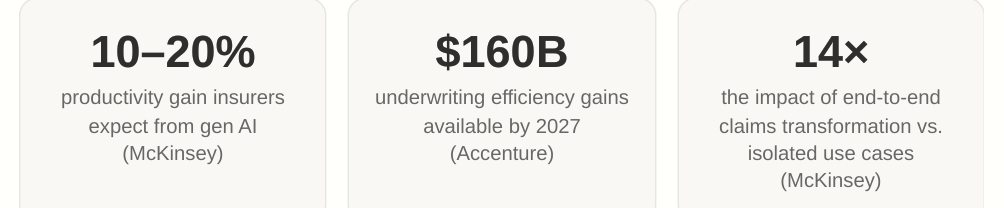
McKinsey's survey of insurance executives puts the expected gains at 10–20% productivity, 1.5–3.0% premium growth, and 1.5–3.0 points of technical-result improvement. Accenture finds underwriters spending up to 40% of their time on non-core and administrative work, and estimates up to $160 billion in underwriting efficiency gains by 2027. And on the claims side, Accenture puts up to $170 billion of premium at risk over five years from poor claims experiences alone.
03Where the crossing work lives
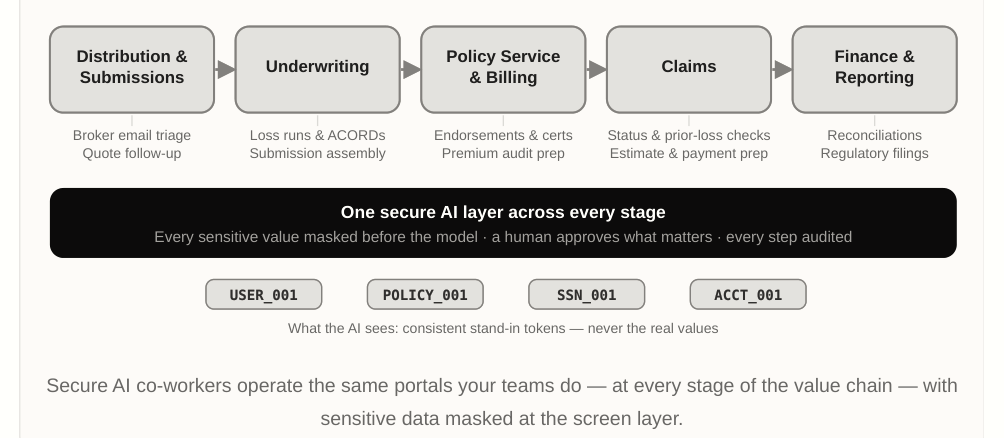
Underwriting & submissions
The submission file is scattered across broker email, loss-run PDFs, prior-carrier records, and rating tools. That is how underwriters end up spending up to 40% of their time on administration instead of risk selection. The co-worker assembles the file, chases the missing pieces, and runs the routine checks. The underwriter makes the risk decision. Faster quote turnaround is a growth lever, not just an expense one: speed to quote is often the difference between winning and losing the account.
Policy service & billing
Endorsements, certificates of insurance, premium audit preparation, agency-bill reconciliation: high-volume, deadline-driven, and spread across the policy admin system, agency portals, and email. This is the quiet middle of the expense ratio, and it's almost entirely crossing work.
Deep dive: claims
Adjusters don't have a claims-system process. They have a claim, and one hail claim crosses the claims system (Guidewire, Duck Creek, or the one your team built in-house), the policy system, weather analytics, the prior-loss database, the assignment platform, an aerial measurement report, the estimating platform, the payment platform, email, and the photo repository. Ten systems, held together by one adjuster who is carrying a hundred and fifty other files.

On one wind/hail claim, the co-worker can:
- Pull the loss date and risk address from the claims system, and verify in weather analytics that hail actually hit that roof on that date — before anyone drives out.
- Confirm the deductible and endorsements in the policy system, before the estimate sets an expectation the policy won't pay.
- Run the prior-loss and fraud check every time, on every claim, and surface the roof that was already paid for.
- Route the assignment and watch the cycle-time clock so the adjuster doesn't have to.
- Order the aerial measurement and hand the sketch straight into the estimating platform.
- Assemble the estimate, photos, weather report, and prior-loss result into one documented recommendation, which the adjuster reviews and approves.
- Queue payment and mortgagee handling. No payment moves without a named person's approval on record.
Leakage rarely comes from bad decisions. It comes from checks that didn't happen because there wasn't time. Consistency, the check that runs every time on every file, is what closes the 7–14% gap. And with the most experienced professionals retiring, capacity has to come from somewhere other than requisitions.
04Why this hasn't happened already
The blocker was never AI capability. It was trust. Every screen in that value chain holds someone's name, SSN, address, bank details, medical information, or loss history, and nobody could let an AI read those screens. So we built an AI that works the screens without reading them: Sensitive values are replaced with consistent stand-in tokens at the screen layer, before any model sees them. Real values resolve only on approved destinations at the moment of action. Even a successfully manipulated agent exfiltrates tokens rather than policyholder data. Your CISO gets the audit schema, white papers under NDA, and a session with our founders before anything touches a live system.
05What insurance leadership gets
- Expense ratio. The 10–20% productivity gain, aimed at the crossing work where the hours actually are.
- Loss ratio. Verification, prior-loss, and fraud checks that run on every file, every time; estimates built against current price lists.
- Growth and retention. Faster quote turnaround on the front end; a claims experience that doesn't put premium at risk on the back end.
- Capacity for the retirement wave. Each underwriter and adjuster carries more, at higher quality, with judgment kept where it belongs.
- A complete audit trail. Every step, in every system, logged as tokens with no plaintext policyholder data.
06Where to start
One workflow, one team, one quarter. Submission intake for a single line, status chasing for one claims region, or certificate processing for one service center. Baseline the cycle time and touch count in week one, then let the 30-day numbers make the argument at the leadership table.
Thirty minutes on one workflow you pick.
We come with questions, not a pitch deck. Bring an ops leader and your security lead: the architecture was built to survive both of their hardest questions.
Book a workflow conversation →Sources
- McKinsey & Company, "The potential of gen AI in insurance: Six traits of frontrunners" — 10–20% productivity gains, 1.5–3.0% premium growth, 1.5–3.0 pts technical-result improvement; up to 14× impact from end-to-end claims transformation vs. individual use cases.
- Accenture, "Why AI in Insurance Claims and Underwriting" — underwriters spend up to 40% of time on non-core and administrative activities; up to $160B underwriting efficiency gains by 2027; up to $170B of premiums at risk from poor claims experiences.
- EY, "Tackling indemnity and leakage in P&C litigated claims" — leakage at approximately 7–14% of carriers' total spend.
- Verisk, "The New Adjuster Reality" — 400,000 projected retirements by end of 2026 (citing Slayton Search Partners); 58% of frontline claims professionals reporting 20%+ of time on manual data entry (citing ATOM Advantage).
- OWASP, "LLM01:2025 Prompt Injection".