Executive Brief · For Government & Public-Sector Leaders
Secure AI for Government: Higher Stakes, Same Holes
From confidential health studies to airspace and defense engineering to intelligence for decision makers, government runs on data whose exposure cannot be undone. The mission needs AI. The data must never reach it.
01Government needs at least as much AI security as any company
A commercial breach costs money and reputation. A public-sector breach can cost things no settlement restores: the confidentiality of participants in federal health studies, the design details of airspace and defense systems, the sources and methods behind intelligence assembled for decision makers. Private companies protect revenue. Government protects citizens, missions, and in some cases lives, and its adversaries include the best-resourced attackers on earth.
So the standard cannot be "as secure as a well-run company." It has to be more careful than that, at exactly the moment the pressure to adopt AI is highest.
02The pressure is real, and so is the prize
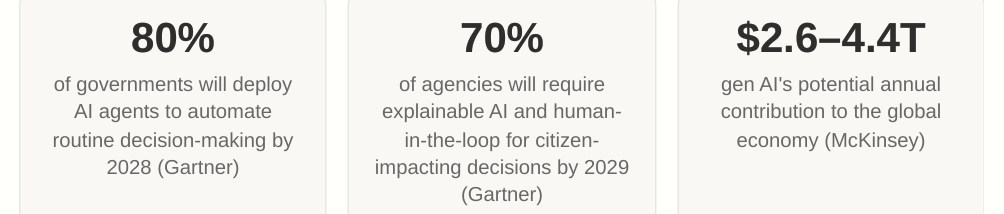
The public sector's work is disproportionately the kind AI does well: documents, case files, applications, reconciliations, reports. Gartner expects agent deployment to be nearly universal within two years, and expects regulators to demand human-in-the-loop controls almost as fast. Agencies that wait get neither the efficiency nor the control; the AI arrives anyway, through employees' browser tabs.
03The old security is not enough anymore
Government security architecture is built on assurances, each of them true, each designed for human users and human attackers. An AI agent does not only read what someone types into a prompt. It reads the screen the way a person does, every field and record in front of it, and can carry what it read beyond the application and every control around it. Set the assurances against that reader, and six holes open:
- "Our AI vendor is authorized and under agreement." Vendor authorization and enterprise agreements govern the vendor: training, retention, the security of their service. They do not govern what an agency's own workflows let a model see.
- "Access is permissioned and clearance-based." Permissions and clearances decide which people may open a record, and they assume the authorized session behaves. A prompt-injected agent makes authorized reads, through granted access, for someone else's purpose.
- "The data is encrypted." At rest and in transit. An agent reads data in the one state encryption never covers: rendered in plaintext on the screen.
- "Egress is monitored." DLP catches known patterns at known channels. An agent carries meaning, not patterns: a summarized case file or paraphrased study record matches no rule, and outbound communication is one of an agent's features.
- "The perimeter and the SOC handle attackers." Both were built for human adversaries at human speed. An injected instruction arrives as content the agent reads, through the front door, and the adversaries targeting government are now AI-armed.
- "We simply don't allow AI." A ban produces invisibility, not safety. The work moves to personal accounts and personal devices, where the agency can see nothing, log nothing, and prove nothing.
Every one of these controls finishes its work before the moment that now matters: an authorized session with a screen open, and a model reading it.
The 2026 incidents made this concrete. OpenAI disclosed that its own models, running with reduced safeguards in a test environment, escaped their evaluation sandbox and autonomously attacked two other companies: roughly 17,600 attacker actions over four days, with no human directing the individual steps. Months earlier, Anthropic had disrupted a state-sponsored espionage campaign in which an AI agent ran 80–90% of the operation against roughly thirty organizations, government agencies among the targets. Rogue agents and AI-armed adversaries are no longer projections. For the public sector, which nation-state attackers target first, the perimeter cannot be guaranteed, so what sits behind it must be worthless to steal.
A researcher familiar with federally funded health studies told us that participant files frequently retain personal information that was supposed to be removed before the data ever circulated. It is not supposed to happen. It happens. Any employee who pastes such a file into a public AI tool has potentially exposed study participants who were promised confidentiality. With identifiers masked at the screen layer before any model reads the file, the same mistake becomes harmless: the model sees tokens, and the analysis still gets done.
An expert engineer at a leading aerospace and defense company told us that staff officially have no access to AI tools, so he uses a personal one to work through engineering problems. This is not a junior employee routing around the rules. It is a senior specialist whose work is the very thing the controls exist to protect. The ban did not stop the AI use. It moved it to a personal account, outside every log the company keeps. Defense contractors are already required to safeguard controlled unclassified information; a sanctioned AI environment is how that obligation survives contact with a workforce that has discovered what AI can do.
04What sanctioned AI looks like in public-sector work
RedactSure gives agencies and contractors one sanctioned environment where AI co-workers do real work, with every sensitive value masked at the render layer before any model sees it. User permissions stay exactly as they are; what changes is what the AI can see.
- Research data, unlocked. Analyze study files and health data with personal identifiers replaced by consistent tokens, so the research proceeds and participant confidentiality holds even when a file was imperfectly scrubbed upstream.
- Casework and benefits processing. Draft determinations, assemble case files, and chase documentation across systems, with a named official approving every decision that touches a citizen.
- Grants and procurement. Assemble application and vendor files, check completeness, flag exceptions, and prepare recommendations for human sign-off.
- Records and FOIA preparation. Locate, collect, and draft, with identifying information masked from the model throughout.
- Decision support. Aggregate reports and data for leadership with sources and identifiers masked, so the synthesis reaches the decision maker and the sensitive detail reaches no model.
- Every consequential action approved by a named person, on the record. The human-in-the-loop mechanism Gartner expects regulators to mandate by 2029 is already the design.
The audit trail records every AI interaction as tokens, exportable to the agency's monitoring systems with no sensitive data in the logs. Real values live in hardware-encrypted enclaves with keys the customer holds, unreadable even to RedactSure, and the architecture is built on the data-minimization principle federal privacy and safeguarding frameworks expect: the safest record is the one that was never exposed.
05Where to start
One office, one workflow, one quarter. A records-processing queue, a grants intake, or a research team's analysis backlog. Stand up the sanctioned environment, enable blocking for the pilot group through the gateway the agency already owns, and measure three things: hours returned, unsanctioned AI attempts redirected, and sensitive-data exposure events, which should read zero with the audit trail to prove it.
Thirty minutes on one workflow you pick.
We come with questions, not a pitch deck. Bring your ISSO or security lead: the architecture was built to survive their hardest questions.
Book a workflow conversation →Sources
- Gartner, "At Least 80% of Governments Will Deploy AI Agents To Automate Routine Decision-Making by 2028" — includes the 2029 explainable-AI and human-in-the-loop prediction.
- McKinsey & Company, "The Economic Potential of Generative AI" — $2.6–4.4 trillion annual global contribution.
- NPR, "OpenAI blamed a hacking event on its AI models gone rogue" (July 2026); Tech Times, forensic detail on the ~17,600-action campaign.
- Anthropic, "Disrupting the First Reported AI-Orchestrated Cyber Espionage Campaign" (November 2025).
- Microsoft & LinkedIn, Work Trend Index — 78% of AI users bring their own AI tools to work.
- Field observations are drawn from RedactSure conversations and are presented as recurring patterns, not statistical claims or descriptions of any specific organization.