
RedactSure Perspectives · The Enterprise AI Operating Models
Accountable AI and Workflow Governance
Making the people who do the work accountable for the AI's actions. Agentic tools removed the person from the work. This is how you put one back.

Published · Updated
01The missing layer is a person
When an employee moves money, grants access, or sends a record, someone is accountable, and everyone knows who. Most agentic AI tools broke that. An agent acts, and no person stands behind the action: nobody granted its access deliberately, nobody decided what it should see, nobody is watching it work, and nobody signed the decision it just made.
The principle that fixes this is older than software: responsibility follows authority. An employer answers for what an employee does on the job. A parent answers for a child; an owner answers for a dog. Whoever holds authority over another actor answers for that actor's behavior. AI co-workers now belong in that category. Many organizations unleash an agent on a task without ever deciding who holds authority over it, and for sensitive work that is the whole question. This is a new work paradigm, and it needs a name. Accountable AI is AI-enabled work where a named person holds authority over the agent and answers for its actions: the person who delegates the work is accountable for the AI that performs it. Workflow Governance is what makes that accountability real instead of theoretical.
Every control the enterprise already built keeps its job, because the agent works through the same applications and logins a person does. What gets added is the layer no existing control supplies: model-provider controls do not replace identity, DLP does not decide whether an agent may submit a payment, and application permissions do not govern a process that leaves the application. Workflow Governance is that layer, and the two sections that follow are the whole of it: who the agent works for, and what a person confirms before it runs.
02Supervised delegation: every agent works for someone
The first governance decision for any agent is identity: give the agent its own login, or run it under the access of a person. The independent login sounds cleaner and governs worse. An agent with its own credentials is an agent nobody is standing behind, and its access becomes one more identity to provision, audit, and forget to revoke.
RedactSure binds every agent to a human supervisor instead. A claims adjuster's agent works with the adjuster's access. A claims manager's agent, with the manager's. An IT administrator's, with the administrator's. Three things follow:
- Accountability is built in. Every action traces to the named person supervising it, in systems that person was already entitled to use.
- The boundary is already governed. The agent can never reach beyond what your identity systems granted the supervisor. No new permission schema to reconcile.
- Supervision is possible. The person whose access the agent uses can watch the run, step in, and take over. An agent on its own login has no one in that seat.
Inherited access is exactly what makes ungoverned agents dangerous: a person's role often spans far more than any one task needs. The render layer is what makes the inheritance safe here. The agent works the same screens the supervisor could open, with sensitive values already replaced by tokens before any model reads them, and the supervisor watching the run sees the placeholders too. The two operator risks that dominate security reviews, the manipulated agent and the compromised insider, collapse into one defense: nothing real on the screen for either of them to leak, photograph, or be talked out of.
03Nothing runs until a person confirms it
RedactSure builds the workflow automatically. Governance happens before it is allowed to run, in three confirmations:
- Each step of the process. The workflow is reviewed step by step, and a human confirms every part before the agent may execute it. The automation is proposed; the person disposes.
- The redaction policy. A human confirms what gets masked for this workflow, field by field, before the agent sees its first screen.
- Every application, explicitly. Each system the agent will log into is set up in the configurator, credential by credential, with credentials vaulted where the model never sees them. No configured credential, no access, and real values resolve only on the destinations the policy authorizes, at the moment of action.
04Data minimization and redaction
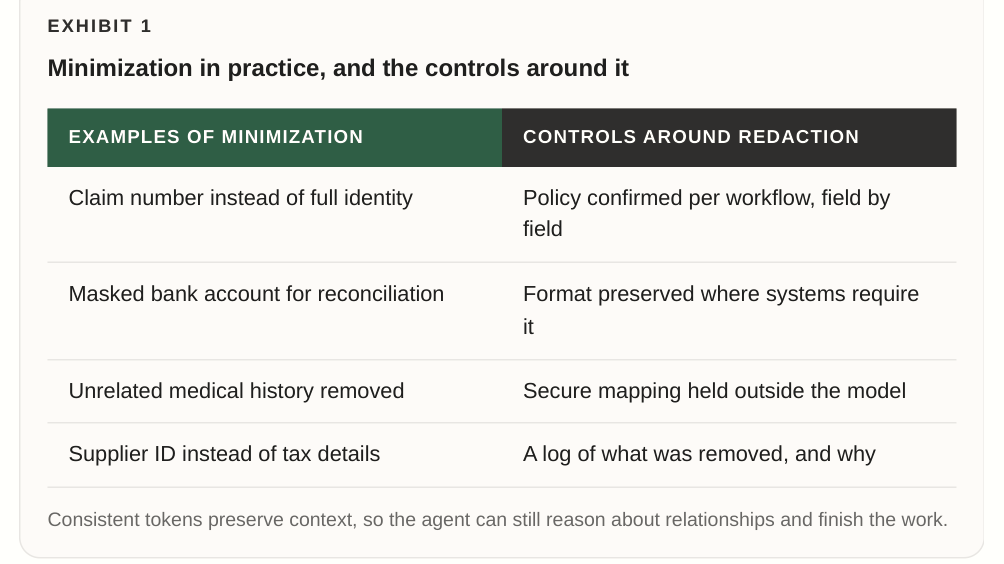
The safest sensitive data is data the model never receives: the redaction policy removes what the task does not need and tokenizes what remains.
05Confirmation burden follows consequence
A workflow that drafts summaries and a workflow that queues payments should not carry the same confirmation burden. Because every step was reviewed at setup, the confirmation points sit where the consequences are: external communication, payments, and record changes wait for a named person's approval; low-stakes steps run without interruption. One supervisor oversees multiple agents from a single dashboard, and can pause a run, take over the browser, and hand control back. If an agent is manipulated by content it read, the damage is bounded twice over: it holds tokens rather than data, and its consequential actions are waiting on a person who can decline them.
At one customer, budget reconciliations move only when the human agrees the transfer is the right decision. Then the agent takes the action and seeks further approval up the management chain as required, the same way an employee would. That last phrase is the design goal: the agent slots into the approval structure the organization already trusts, instead of routing around it.
06The audit plane
Every run produces a complete record: which supervisor, which model, which applications, what was redacted, which steps were confirmed and by whom. The log holds tokens rather than sensitive data and exports to the monitoring systems you already run. Governance stops being a policy PDF and becomes evidence a security team can query.
07The reference policy object
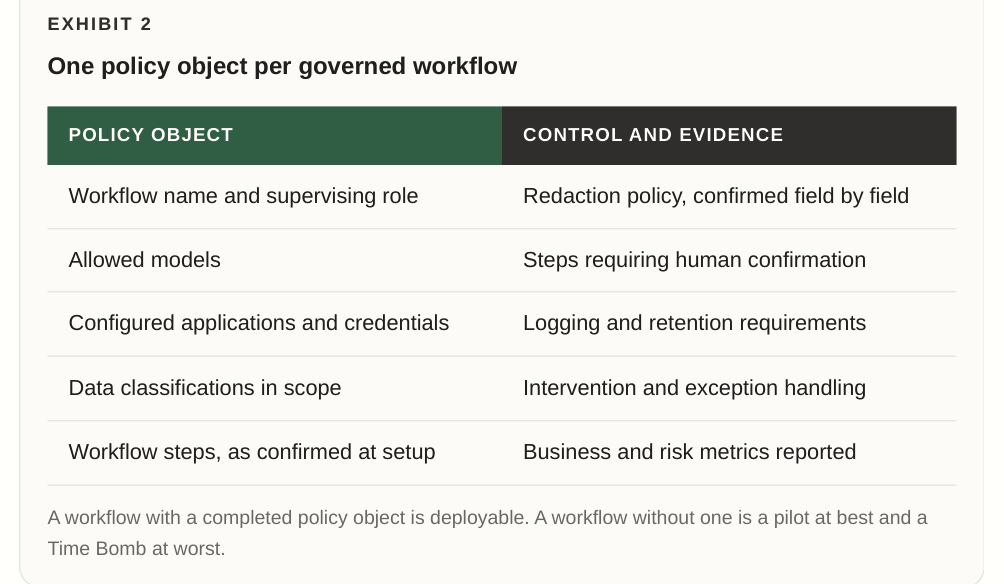
The practical instrument is a reusable policy object, one per workflow:
08Where RedactSure fits
RedactSure is the enforcement point for this layer. User permissions stay exactly as they are, and real values live in hardware-encrypted enclaves with keys only the customer holds. That property is provable rather than promised: a fully compromised RedactSure administrator, with access to every server and every database, could take the service offline. They could not take the data.
The broader Workflow Governance program still requires ownership, identity, data classification, native application controls, monitoring, and change management. That operating discipline belongs to the enterprise. The platform makes it enforceable.
Sources
- Gartner, "Applying Uniform Governance Across AI Agents Will Lead to Failure"; "Six Steps to Manage AI Agent Sprawl". Original source 1; Original source 2 Publisher or vendor account.
- NIST, "AI Risk Management Framework: Generative AI Profile (AI 600-1)". Original source Official guidance or public record.
- OWASP, "Top 10 for Large Language Model Applications 2025" , prompt injection, sensitive information disclosure, excessive agency. Original source Standards or industry-body guidance.
- Microsoft Purview, "Data Security Posture Management for AI". Original source Publisher or vendor account.
- Product behavior described in this article (supervised delegation, setup confirmations, credential configuration, render-layer redaction) reflects RedactSure's current design. Original source First-party RedactSure explanation.
See it on your workflow.
Bring one billing, collections, claims or patient-account workflow and your questions.
Book a demo