
RedactSure Perspectives · The Enterprise AI Operating Models
Beyond Theater AI
Deploying an assistant is not the same as redesigning work. And an underpowered sanctioned AI does not reduce risk. It moves the real AI use somewhere you cannot see it.

Published · Updated
01"We use Copilot. We are already doing AI."
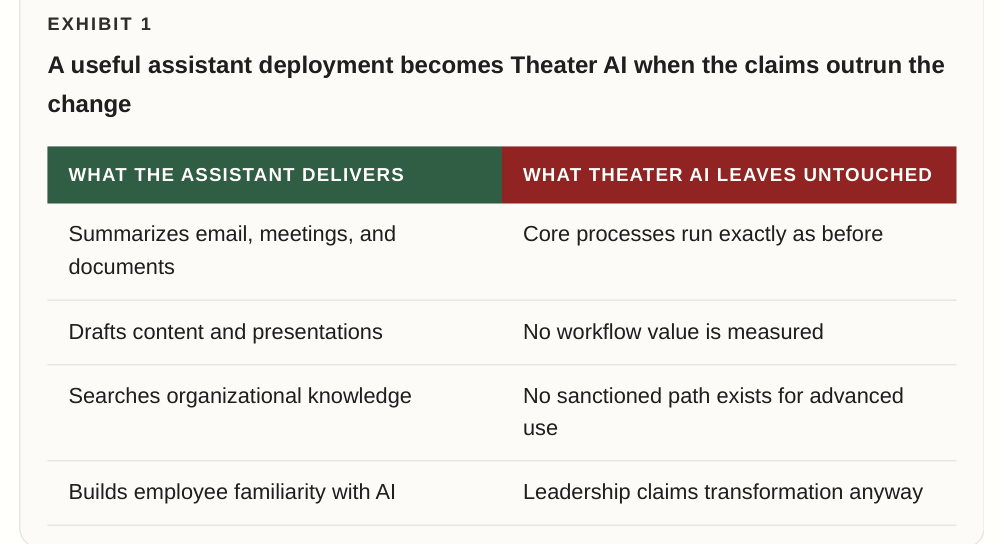
In many companies that sentence means email summaries, meeting recaps, document rewriting, and slide drafts. These are legitimate benefits, and Copilot is not the problem: Microsoft's own product direction runs far beyond summarization, toward human-agent teams and redesigned work. Theater AI describes a deployment choice, not a product limitation.
The issue is the gap between the claim and the operating reality. The highest-value processes, the ones that set cycle time, cost, and customer experience, remain manual. Leadership announces an AI transformation. The org chart, the workflows, and the quarterly numbers stay exactly where they were.
02Employees are ahead of policy
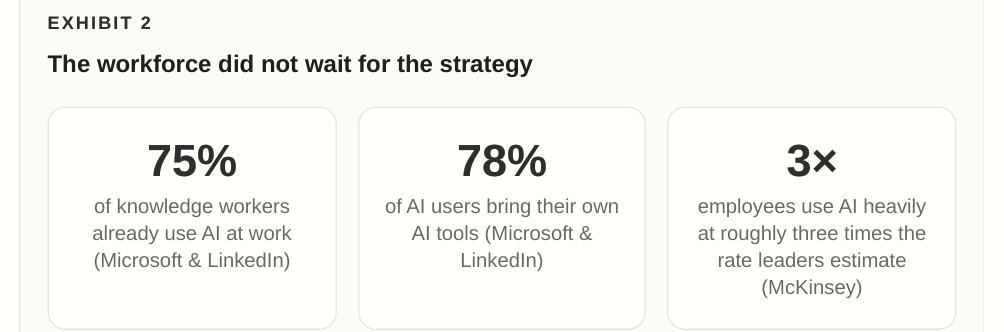
When the approved experience cannot perform the job employees know is possible, they find workarounds: personal accounts, manual retyping, screenshots, a phone held up to the monitor. The work still gets done with AI. It just gets done where security cannot see it, on tools the company has no agreement with, with data nobody is tracking. A ban produces invisibility, not safety, and a weak sanctioned alternative produces the same thing by a different route.
04The sanctioned alternative principle
A policy holds when restriction is paired with a usable path. Restrict where the risk is real: unmanaged personal accounts, prohibited data classes, high-risk autonomous actions, unreviewed external transmission. Enable where the value is real: approved models, sensitive values masked before any model sees them, cross-application work with a human approving what matters, every step audited. The objective is not AI everywhere. It is the right AI, for the right workflow, with the minimum necessary exposure.
A university we work with started exactly this way. The visible problem was staff using public AI tools nobody had approved; the written success measure of the pilot became "reduce uncontrolled use of public AI tools." The path there was not a tighter ban. It was giving administrators a sanctioned workspace that does real work, drafting and budget-transfer preparation with every student identifier masked, so the approved tool became the better tool.
05From assistant to workflow
The transition starts with a recurring business outcome that already crosses systems: invoice exception handling, claims intake, supplier onboarding, billing follow-up. Map the human steps and handoffs. Identify where AI can read, draft, compare, or act. Decide what the AI should see at each step, and mask the rest. Keep approval where the consequences are. Then measure the whole process, not the quality of a single prompt.
Month 1: pick one workflow where employees already use or request outside AI, and document its current cost, time, and risk. Month 2: design the sanctioned version: approved models, masked data, human approval points. Month 3: run it, compare the results, and publish them internally. A working workflow builds adoption in a way no slogan can.
06Where RedactSure fits
RedactSure exists so companies do not have to choose between narrow assistant use and uncontrolled personal AI. It provides the sanctioned environment where AI co-workers do cross-application work with every sensitive value masked at the render layer before any model sees it, user permissions unchanged, approvals on the record, and an audit trail that holds tokens rather than data. Real values live in hardware-encrypted enclaves with customer-held keys, unreadable even to RedactSure. The assistant you already own keeps its job. The work it could never touch finally gets done, in the open.
Sources
- Microsoft & LinkedIn, "AI at Work Is Here. Now Comes the Hard Part" , 75% of knowledge workers use AI at work; 78% bring their own tools. Original source Publisher or vendor account.
- McKinsey & Company, "Leaders Underestimate Employees' AI Use". Original source Publisher or vendor account.
- Deloitte, "The State of AI in the Enterprise 2026" , 34% truly reimagining the business. Original source Publisher or vendor account.
- Accenture, "Technology Vision 2025" , 13% report significant enterprise-level impact. Original source Publisher or vendor account.
- Microsoft, 2026 Work Trend Index , human-agent teams and work redesign. Original source Publisher or vendor account.
- Field observations are drawn from RedactSure customer and prospect conversations and are presented as recurring patterns, not statistical claims. Original source First-party RedactSure explanation.
See it on your workflow.
Bring one billing, collections, claims or patient-account workflow and your questions.
Book a demo