
White Paper · For Security & Technology Leaders
The Big Holes in Your Security Infrastructure in the Age of AI
Your board has mandated AI. Your security stack was architected before AI could attack it, or leak through it. Here's where the holes are, and how to close them without slowing the mandate.

Published · Updated
01The mandate is real, and it isn't waiting for security
Every executive board has issued some version of the same instruction: capture the efficiencies and business outcomes AI produces, and do it before competitors do. They're not wrong to push.
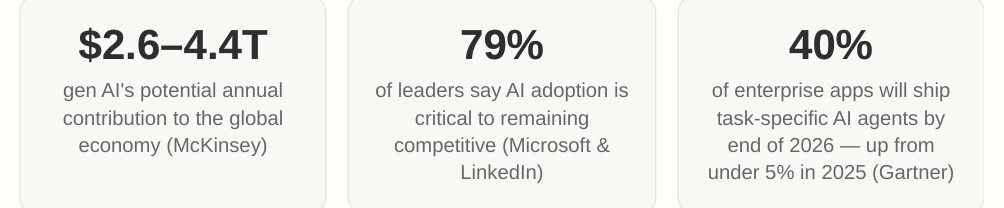
So the agents are coming: through the vendors you already buy from, through the business units, and through employees' browser tabs, whether you sanction them or not. The problem is what they're arriving into: an application and data security architecture designed, layer by layer, for a world where every attacker and every user was human.
02Your stack predates its adversary
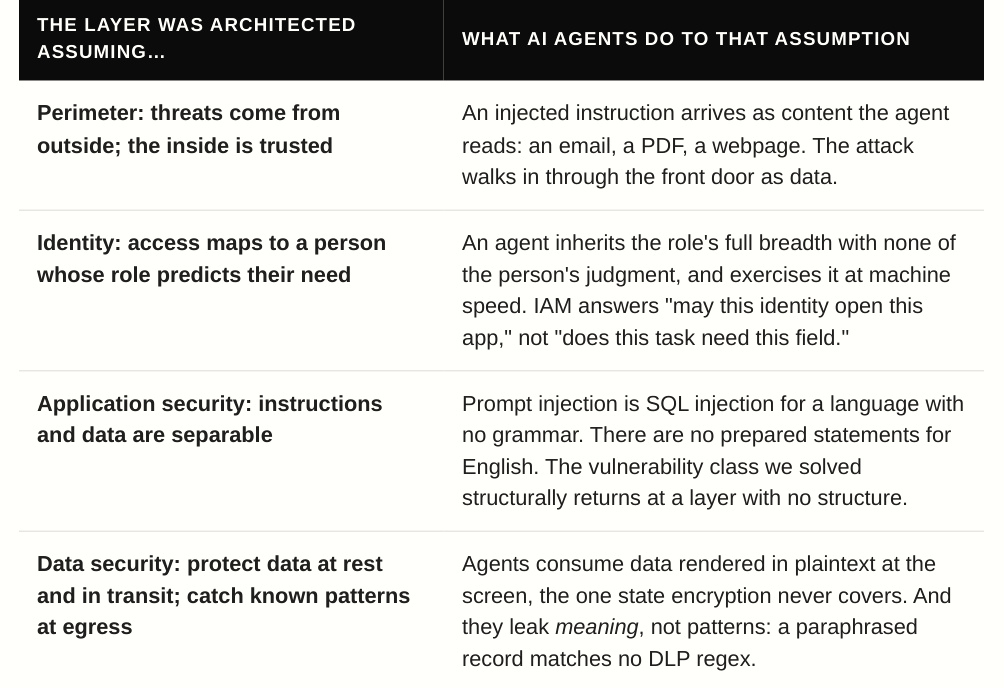
Each layer of the classical stack was built on an assumption about who uses it:
03Hole 1 · Your defenses were never designed for AI attackers
In late 2025, Anthropic disclosed that it had disrupted the first reported large-scale cyber-espionage campaign orchestrated by an AI agent: a state-sponsored group used an agentic AI to execute 80-90% of the attack autonomously, from reconnaissance and exploit development through credential harvesting, lateral movement, and exfiltration, against roughly thirty organizations, at thousands of requests per second.
Every response loop in your SOC assumes attacks unfold at the tempo of scarce, expensive human labor. That economics just inverted. Application security and cloud infrastructure, however well built, were never designed to withstand adversaries operating at AI speed and AI scale, and hardening the perimeter does not change the arithmetic. What changes it is having less worth stealing on the other side.
04Hole 2 · Your own sanctioned agent is a recruitable insider
The second hole is stranger: the attacker doesn't need to breach you at all. An agent with access to private data, exposure to untrusted content, and the ability to communicate externally (the lethal trifecta) can be recruited by anything it reads. A poisoned email in the queue it processes. A webpage it summarizes. OWASP ranks prompt injection as the top LLM application risk because it cannot be reliably prevented at the model layer.
Permissions don't help here, because permissions assume the authorized session behaves. A prompt-injected agent makes authorized reads, through granted access, for an attacker's purpose. No permission scheme in existence distinguishes an authorized read made for a good reason from the same read made for a bad one.
05Hole 3 · Shadow AI is already leaking, and a ban makes it invisible
While security deliberates, employees act: 78% of AI users bring their own AI tools to work. IBM now finds one in five data breaches involves shadow AI, adding roughly $670K to the average breach cost. The reflexive answer, blocking it, produces invisibility rather than safety: the work moves to personal accounts and phones, the logs go quiet, and the posture looks clean because nothing is measured. Microsoft's own Purview guidance concedes the deeper point: even sanctioned AI applications require controls to keep sensitive data from being pasted, uploaded, or sent. The vendor contract was never the security architecture.
06Hole 4 · The last mile was never guarded
Add the first three holes together and they point at the same place: the render layer, meaning what the reader actually sees. Data crosses the firewall encrypted, passes IAM, gets decrypted, and renders on a screen. There the entire stack stops. That was a sound design when the reader was a human with judgment and accountability. It is the single largest hole in the architecture now that the reader is a model.
You can't retrofit judgment into the model. You can only control what it sees.
07Closing the holes: what RedactSure adds
None of this means replacing your stack; every layer still does the job it was built for. It means adding the layer that was never built, above it. Seven things, in the order buyers ask about them:
- A secure, sanctioned place to do AI. One environment where employees and AI co-workers do real work, more capable than the shadow tools, so people stop routing around you. Pair it with generative-AI category blocking on the gateway you already own: corral first, automate second. Shadow-AI attempts get logged and redirected, which becomes your evidence for the board.
- Redaction at the render layer, with consistent secure tokens. Permissions decide who may open the record; RedactSure decides what the AI sees once it's open. Identifiers become consistent tokens (USER_001, SSN_001) before any model reads the screen. Because the tokens are consistent, the agent can still reason and finish the work. This covers the one state encryption never touches: data in use, at the point of consumption.
- Coverage across applications, including ones you don't administer. Field-level permissions exist only in systems you control. Workflows cross into payer portals, supplier sites, and SaaS tools where your team can't set a single permission. One policy travels with the work, across every screen, including screens rendered by other people's applications.
- A complete audit plane for AI. One queryable record of every LLM interaction: which user, which model, what permissions applied, what was redacted, what actions were taken and who approved them , exportable to your SIEM and holding tokens rather than sensitive data. AI governance stops being a policy PDF and becomes evidence.
- Security that survives a compromised model. Assume the injection succeeds. A perfectly hijacked agent exfiltrates NAME_001 and SSN_001: nothing to sell, nothing to report. Real values resolve only on approved destinations, at the moment of action. This is blast-radius control: the only defense that doesn't depend on every future model behaving perfectly.
- Human accountability on every consequential action. Application controls, data controls, and firewall controls all stay on duty; what agentic tools left out is a person who answers for the work. A named person grants the agent's access, confirms its redaction policy, can watch every run, and approves payments, submissions, and record changes before they move.
- Secure compute: even we can't see your data. Real values live in hardware-encrypted enclaves with customer-held keys. RedactSure itself has no access to your PHI or PII, so adopting us doesn't mean trading "trust the LLM vendor" for "trust a startup." There is nothing at our end to breach. Your controls answer "who may open the record." The age of AI asks four questions they can't: what did the AI see, where could it go, what did it do , and what does an attacker get?
08Where to start
Don't start with an enterprise program. Stand up the sanctioned environment for one department and one workflow where employees are already improvising with unsanctioned AI. Turn on category blocking for that pilot group only. Run 30 days and take three numbers to the board: shadow-AI attempts redirected, hours returned by the first automated workflow, and sensitive-data exposure events, which should read zero, with an audit trail to prove it. That's the AI mandate delivered and the holes closed, in the same motion.
Sources
- McKinsey & Company, gen AI economic-potential estimate , $2.6-4.4 trillion annual global contribution. Original source Publisher or vendor account.
- Microsoft & LinkedIn, Work Trend Index: "AI at Work Is Here" , 79% of leaders say AI adoption is critical to remaining competitive; 78% of AI users bring their own tools to work. Original source Publisher or vendor account.
- Gartner, "40% of Enterprise Apps Will Feature Task-Specific AI Agents by 2026". Original source Publisher or vendor account.
- Anthropic, "Disrupting the First Reported AI-Orchestrated Cyber Espionage Campaign" (November 2025). Original source Publisher or vendor account.
- IBM, "Cost of a Data Breach Report 2025" , shadow AI involvement in breaches and incremental cost. Original source Publisher or vendor account.
- OWASP, "LLM01:2025 Prompt Injection"; Top 10 for LLM Applications 2025. Original source Standards or industry-body guidance.
- Microsoft Purview, "Block Sensitive Data Going to Sanctioned AI Apps". Original source Publisher or vendor account.
See it on your workflow.
Bring one billing, collections, claims or patient-account workflow and your questions.
Book a demo