
Executive Brief
Secure AI That Crosses Every Silo
Every AI tool you've been pitched lives inside one department. The work , and the value , lives between them.

Published · Updated
01The AI you've been pitched is department-shaped
A finance AI. An HR AI. A procurement AI. A claims AI. Nearly every enterprise AI product on the market is shaped like one box on your org chart. Each one makes its department a little faster. Faster silos, same walls.
Your ERP vendor's agents are useful. SAP, Oracle, Salesforce, and Workday are all embedding real intelligence inside their platforms. But embedded AI stops at the edge of the application it lives in. And the reason your processes are slow was never inside any single application.
02The work lives between your systems
A 60-day purchase cycle is roughly two weeks of actual work and six weeks of departments waiting on each other. Invoice-to-cash, procure-to-pay, employee onboarding, claims: every one of these crosses ERP screens, banking portals, vendor portals, e-signature tools, HR systems, spreadsheets, and email. The delay isn't in the systems. It's in the handoffs between them. That's why AI adoption and AI results remain so far apart:

Employees adopted AI faster than any technology in memory, largely on their own accounts, outside sanctioned channels. Meanwhile the measured business impact stays thin, because sanctioned AI keeps getting deployed inside individual applications while the end-to-end process stays manual.
03Why AI was never allowed to cross
Your org chart was drawn, in part, to protect data. Finance guards the numbers. HR guards the records. Procurement guards the vendor terms. An AI that crosses those walls would need to see all of it, and nobody has trusted it with any of it. For good reason: an AI agent has no judgment, and it can be manipulated by content it merely reads. The attack class is known as prompt injection. Even Microsoft's own security guidance says that sanctioned AI applications still require controls to keep sensitive data from being pasted, uploaded, or sent.
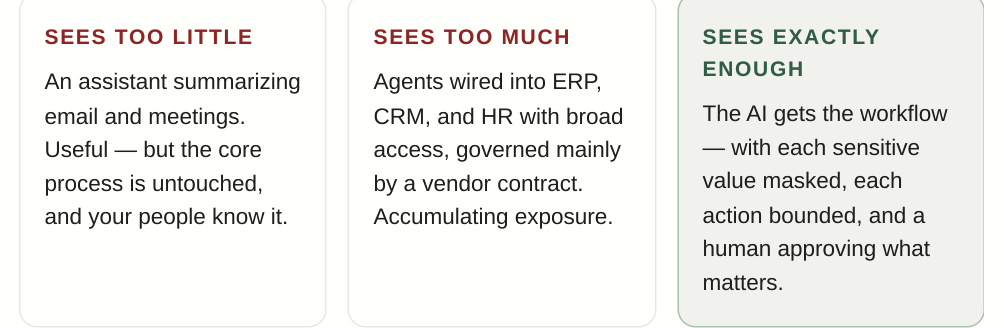
So companies land in one of two places. When a company tells me its AI strategy is to lock everything down, I know it isn't really doing anything with AI. The work went underground, not away. And when a company tells me its strategy is an assistant that organizes the inbox, that assistant sees too little to matter. An agent wired into everything sees too much. Either way, that's not a strategy.
04Secure AI that crosses , how it works
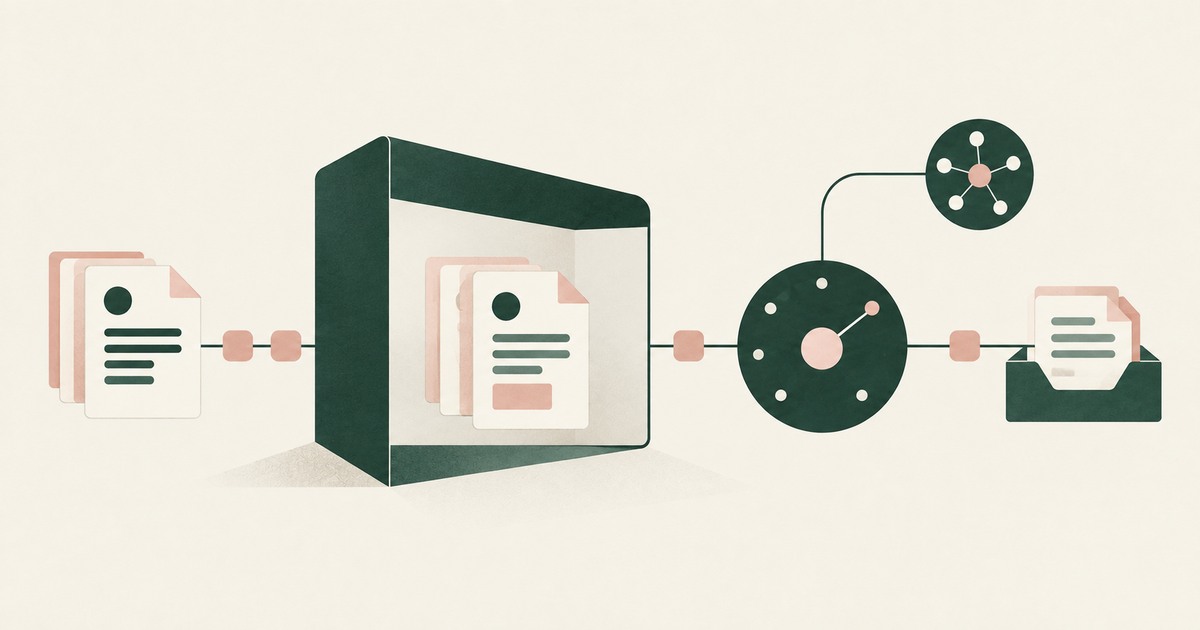
This is the question RedactSure was built to answer. AI co-workers do real work across your applications in a secure browser environment, and every sensitive value is masked before the AI sees it. The agent works on the business processes that matter across applications; it never reads a real record.
- Masked before the model. Names, SSNs, account numbers, and vendor terms are replaced with consistent tokens (USER_001, ACCT_001) at the render layer, before any model sees the screen.
- Resolved only where approved. Real values appear only on approved destinations, at the moment of action. They are blocked everywhere else.
- A human approves what matters. Vendor selection, payments, records: every consequential action queues for a named person's approval. The AI does the navigating; people keep the judgment.
- Everything on the record. Every step lands in an audit log that holds tokens rather than plaintext data.
This changes the security conversation, because even a successfully hijacked agent steals tokens, not data. And it changes the business conversation, because the walls between departments no longer have to be walls in front of the work.
05What one crossing workflow looks like
Take a purchase that today burns sixty days:
- A request arrives by email; the AI co-worker assembles the RFP comparison from vendor responses and contract terms.
- A manager approves the vendor selection.
- The co-worker logs the contract, onboards the contractor in the HR system, and sets up the vendor record in the ERP.
- It schedules milestone payments and classifies the spend in accounting.
- Finance approves before anything is paid.
Five applications. Two human approvals. No sensitive field ever visible to the model. The department heads didn't lose control of the process , they gained a queue they supervise instead of a swivel chair they operate.
06Where to start
Not enterprise-wide. Pick one workflow that already crosses three or more systems, ideally one where your people are already improvising with unsanctioned AI. Map the human steps. Decide what the AI should see at each one. Keep approvals where the consequences are. Measure cycle time before and after, and let the result, not a slogan, make the case for the next workflow.
Sources
- Microsoft & LinkedIn, "AI at Work Is Here. Now Comes the Hard Part" , 78% of AI users bring their own AI tools to work. Original source Publisher or vendor account.
- Deloitte, "The State of AI in the Enterprise 2026" , 34% of organizations truly reimagining the business with AI. Original source Publisher or vendor account.
- Accenture, "Technology Vision 2025" , 13% of executives report significant enterprise-level gen AI impact. Original source Publisher or vendor account.
- Microsoft Purview, "Block Sensitive Data Going to Sanctioned AI Apps". Original source Publisher or vendor account.
- OWASP, "LLM01:2025 Prompt Injection". Original source Standards or industry-body guidance.
See it on your workflow.
Bring one billing, collections, claims or patient-account workflow and your questions.
Book a demo