
RedactSure Perspectives · The Enterprise AI Operating Models
From Application AI to Workflow AI
Embedded AI is valuable. It is also bounded by the edge of the application it lives in, and the business outcome almost never is.

Published · Updated
01The rise of Application AI
SAP ships Joule agents with business-process context. Oracle provides AI Agent Studio inside Fusion. Salesforce positions Agentforce around data, reasoning, and actions. Workday deploys Illuminate agents across HR and finance. This wave is real and useful: native data, existing roles and permissions, integrated process knowledge, and controls the vendor maintains.
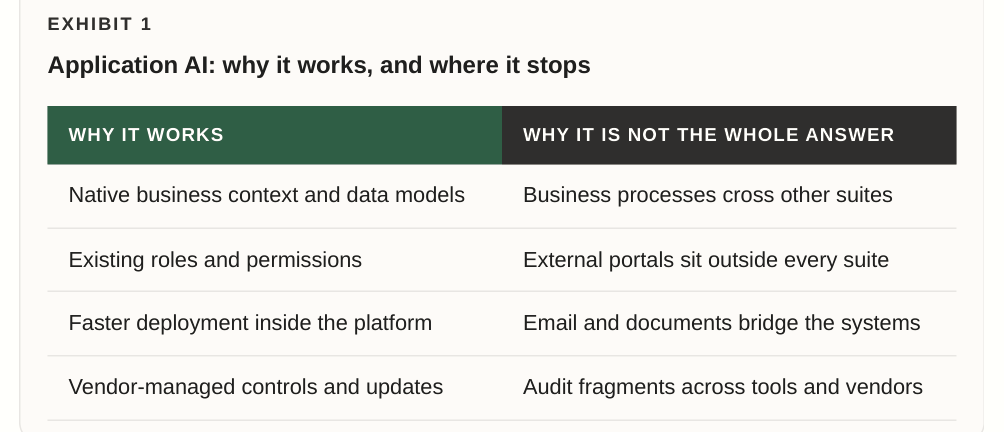
02The process does not stop at the application edge
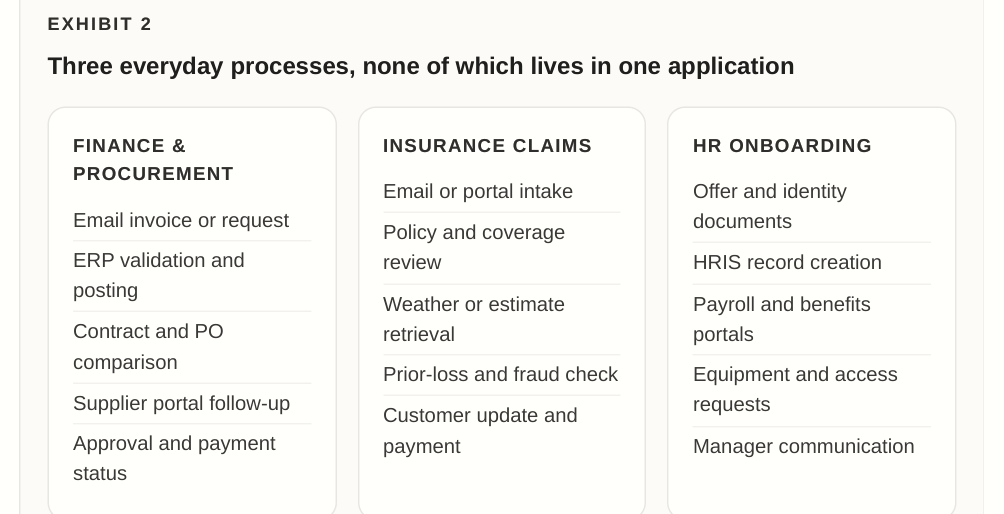
A purchase can begin in email, require terms from a PDF, supplier data from a portal, a purchase order in the ERP, approval in a second system, and payment status from a bank site. A 60-day purchase cycle is roughly two weeks of actual work and six weeks of departments waiting on each other, and the waiting lives in the handoffs no application owns. The same pattern runs through claims, billing, collections, onboarding, and customer service.
03Application-first versus outcome-first
Application-first design asks what the platform can do and improves a task inside it. Outcome-first design defines the complete business result, maps every system and handoff, then assigns AI and human work with controls. The two converge in a working architecture: native application agents perform platform-specific work, and a governed workflow layer coordinates the process across boundaries, passing the minimum context between systems and keeping one audit trail across all of them.
An operations leader at an Oracle customer told us he would rather build each automation himself, with custom code and a backend integration per workflow. For an engineering-minded team, that works. The question that settled the conversation was who builds and maintains the fiftieth one, and what the accounts-payable clerk does in the meantime. Workflow AI is how the people who are not engineers get governed automation.
04The browser is where the process converges
Cross-application work lands in the browser: the external portal with no API, the legacy screen, the supplier site, the bank login. That is where an AI co-worker can operate every step of a process the way a person would. It is also where governance has to live, because an agent in a browser session reads whatever the screen shows and can carry it beyond the application and its controls. Workflow AI therefore needs its controls at the interaction layer: sensitive values masked at the render layer before any model reads them, real values resolving only on approved destinations, a named human approving consequential actions, and every step logged as tokens.
05Avoid the next lock-in
Every platform vendor has an incentive to make its own environment the center of the agentic enterprise. Their capabilities can be excellent, and an enterprise that lets one application define every workflow will still be dependent on that vendor's roadmap, pricing, and boundaries. A cross-application workflow layer keeps the choice open: native agents where they are strongest, approved models of your choosing for reasoning, browser access for the portals nobody's suite covers. Use the vendors' strengths without surrendering ownership of the end-to-end workflow.
06Measure workflow value, not AI activity
- Time: cycle time and waiting, measured before and after, at the process level.
- Quality: errors, rework, and exception rates, with human intervention tracked.
- Economics: cost per transaction and capacity created, including risk reduction and audit effort.
- Discipline: separate assistant usage from completed business outcomes, and retire workflows that do not produce measurable value.
The migration path follows the measurement. Begin with Application AI where it solves a contained problem. Add one cross-application pilot where value is blocked by handoffs. Build reusable controls for masking, approvals, and audit. Then scale the operating model rather than recreating one-off agents.
07Where RedactSure fits
RedactSure is the governed workflow layer in this architecture: a sanctioned environment where AI co-workers execute work across applications and portals, with every sensitive value masked at the render layer before any model sees it, user permissions unchanged, approvals on the record, and a token-based audit trail across every system the process touches. Real values live in hardware-encrypted enclaves with customer-held keys, unreadable even to RedactSure. Your platform agents keep their jobs. The process finally gets one owner: you.
Sources
- Gartner, "40% of Enterprise Apps Will Feature Task-Specific AI Agents by 2026". Original source Publisher or vendor account.
- SAP, Joule Agents; Oracle, AI Agent Studio; Salesforce, Agentforce; Workday, Illuminate. Original source 1; Original source 2; Original source 3; Original source 4 Publisher or vendor account.
- McKinsey & Company, "The potential of gen AI in insurance" , up to 14× impact from end-to-end domain transformation versus individual use cases. Original source Publisher or vendor account.
- McKinsey & Company, "The State of AI: How Organizations Are Rewiring to Capture Value". Original source Publisher or vendor account.
- Field observations are drawn from RedactSure customer and prospect conversations and are presented as recurring patterns, not statistical claims. Original source First-party RedactSure explanation.
See it on your workflow.
Bring one billing, collections, claims or patient-account workflow and your questions.
Book a demo