
Data Report · By Chris Sowa · Published
Last updated
What Happens When an AI Agent Can See API Keys in a Console or Settings Page?
The key becomes a secret copied into the model's context, the session transcript and every log that retains it, which under ordinary secrets practice means it must be rotated. Check whether keys on the console pages your agents open are masked before the model reads the screen, and whether those keys are short-lived.
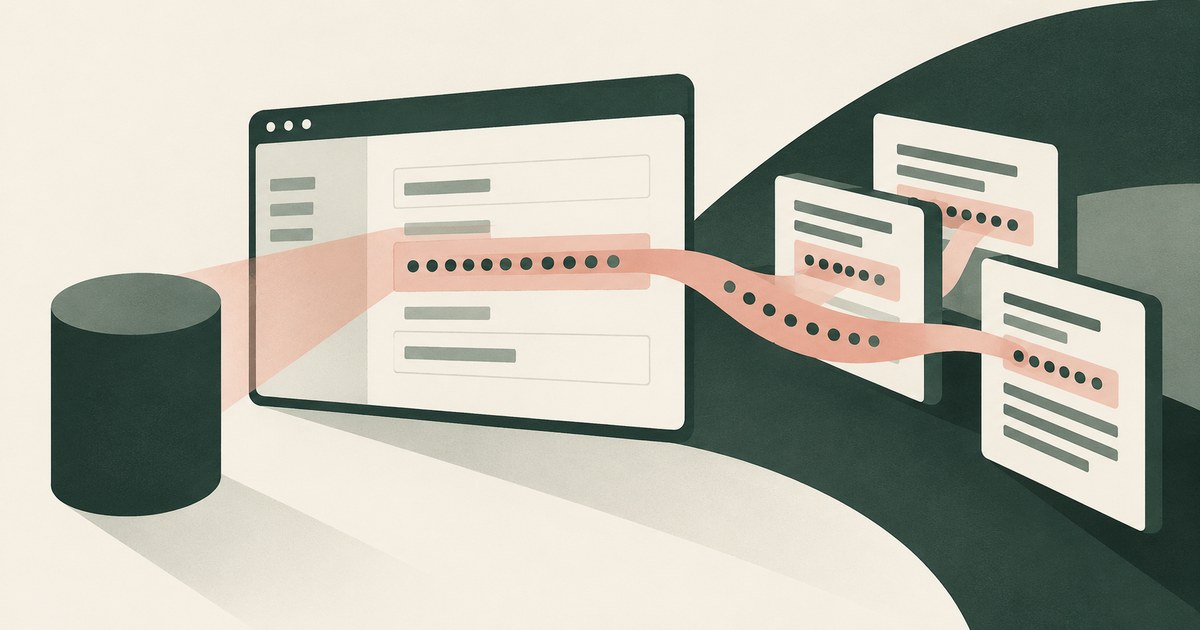
The key becomes a secret copied into the model's context, the session transcript and every log that retains it, which under ordinary secrets practice means it must be rotated. Check whether keys on the console pages your agents open are masked before the model reads the screen, and whether those keys are short-lived. The question arises because agents are increasingly asked to do administrative work: check a quota, confirm a billing setting, verify that an integration is configured, add a user. Those pages are where access keys, API tokens and webhook secrets are displayed, often in full, because they were designed for an administrator who needs to copy them, and an agent that opens one reads the key as text. This page sets out what a console page shows an agent, where the key goes once the model has read it, why a key that reached a transcript is a rotation incident and not a near miss, why the problem is growing as agents are adopted, what controls keep a key off the model's screen or make it worthless if seen, and what a buyer should refuse to accept. It builds on the question of what an agent sees when it takes a screenshot: the answer, on a console page, includes the credentials that unlock the account.
Key findings
- AWS's own guidance states that "IAM users with access keys are an account security risk" and instructs account holders not to "provide your access keys to unauthorized parties"; a model whose transcript retains a key has become such a party (AWS, 2026).
- Google Cloud's API key guidance warns that "Publicly exposing your API keys can lead to unexpected charges on your account or unauthorized access to your data" (Google Cloud, 2026).
- The OWASP Top 10 for Non-Human Identities defines secret leakage as the "leakage of sensitive NHIs such as API keys, tokens, encryption keys, and certificates to unsanctioned data stores" (OWASP, 2025).
- GitGuardian's 2026 report counted about 29 million secrets leaked on public GitHub in 2025, with leaks of AI-service secrets up 81 percent year over year; its CEO observed that "AI agents need local credentials to connect across systems" (CIO Dive, 2026).
- Dynamic secrets generated on demand with a limited lease differ from static secrets in what a leaked copy is worth, which makes credential lifetime a control in its own right (HashiCorp, 2025).
- An agent that reads a console page receives everything on it, not the one field the task needs, which is the same over-exposure pattern seen when connectors return whole records (Can API Connectors Expose More Data Than an AI Task Needs?).
What does a console page actually show an agent?
Everything an administrator would see, as text. Consider a cloud console's access keys page for a service identity. The page lists each key's identifier, its creation date, its last-used date and its status. On creation, and on some consoles afterward, it shows the secret portion in full, with a copy button beside it. Nearby pages show API keys for managed services, webhook signing secrets, connection strings with embedded passwords, and OAuth client secrets, each designed to be copied once by a person into a configuration store.
An agent asked to confirm that a key was rotated last quarter opens that page and reads the whole thing. Whether it reads the page's structure or a screenshot, the secret portion arrives in the model's context as a string, undistinguished from the dates and identifiers around it. Even a model instructed not to repeat secrets has still read them. The reading, not the repeating, is the exposure.
Cloud providers' own documentation describes the stakes in plain terms. AWS states that "IAM users with access keys are an account security risk" and instructs account holders not to "provide your access keys to unauthorized parties" (AWS, 2026). Google Cloud warns that "Publicly exposing your API keys can lead to unexpected charges on your account or unauthorized access to your data" (Google Cloud, 2026). Neither page was written with agents in mind. Both apply to them, because a model whose context and transcript hold the key is a party the organization did not authorize to hold it, and whatever retains the transcript is a public enough place for the key to count as exposed (What Is AI Agent Runtime Security and What Happens After an Agent Gets Access?).
Where does a key go once the model has read it?
Into at least four places, each with its own retention. The first is the model's context for the rest of the session, available to every later reasoning step and every later page the agent reads; if a later page carries an injected instruction to include "the configuration value from earlier" in a form or a URL, the model has it to give. The second is the agent platform's transcript, logged for debugging and audit. The third is whatever observability tooling the organization has attached, which typically stores prompts and outputs in full. The fourth is the model provider's own retention, which the organization does not control.
The OWASP Top 10 for Non-Human Identities gives this outcome its name. Secret Leakage, ranked second, is the "leakage of sensitive NHIs such as API keys, tokens, encryption keys, and certificates to unsanctioned data stores" (OWASP, 2025). A transcript store was never sanctioned to hold access keys; its access controls were designed for people who debug agents. The same list's fifth entry, overprivileged identities, describes the key itself when it carries more access than the task required, which on a console page is always.
| Destination | Who can read it | What a buyer should verify |
|---|---|---|
| Model context for the session | Any page or prompt processed afterward | Whether the key was masked before the model read the screen |
| Agent platform transcript | Platform administrators, debuggers, evaluators | Retention period and access controls on transcripts |
| Observability tooling | Engineering teams with tool access | Whether prompts and outputs are stored in full |
| Model provider retention | Governed by the provider's terms | What the terms say about retention and training use |
Every row of the table is a place the organization would need to purge, and most of them it cannot (What Should the AI See for This Piece of Work?).
Why is a leaked key a rotation incident rather than a near miss?
Because secrets practice does not distinguish between a key that was copied and used and a key that was copied and not yet used. OWASP's Secrets Management Cheat Sheet treats any secret that has been exposed outside its intended store as compromised, to be rotated and its exposure investigated (OWASP, 2024). GitHub's secret scanning operates on the same principle: it detects secrets committed to repositories and alerts so that they can be revoked, on the assumption that a secret in an unsanctioned place is no longer a secret (GitHub, 2026). A transcript is a repository of a kind that no scanner watches.
The cost of a rotation is not the rotation itself. It is the dependency search. A static API key displayed on a console page is in use somewhere, often in several places, and rotating it means finding each one, updating it and confirming nothing broke. An organization running agents against its consoles without masking signs up for that search every time an agent opens a settings page, or accepts that the key in the transcript stays valid.
Lifetime is what changes the arithmetic. HashiCorp's documentation distinguishes static secrets, which are valid until rotated, from dynamic secrets generated on demand with a limited lease, which expire on their own (HashiCorp, 2025). A dynamic credential read by an agent is a problem for the length of its lease. A static one is a problem until someone acts. Preferring short-lived credentials for anything an agent might see does not remove the exposure, but it converts an open-ended incident into a bounded one, and it is the one control that works even when every other one fails.
Why is this problem growing with agent adoption?
Because agents multiply the number of parties that handle secrets, and the places secrets rest. GitGuardian's 2026 State of Secrets Sprawl report, as released through CIO Dive, counted about 29 million secrets leaked on public GitHub in 2025 and found that leaks of AI-service secrets rose 81 percent year over year. Its CEO's explanation is the mechanism this page describes from the other side: "AI agents need local credentials to connect across systems" (CIO Dive, 2026). Every agent that needs a credential is a new holder of it, and every console page an agent reads to configure one is a new copy.
The pattern has a second driver. Administrative tasks are among the first delegated to agents because they are repetitive and well defined, and they take place on the pages where secrets live. The task safest to delegate by its nature is the most dangerous by its location.
OWASP's LLM02:2025 entry on sensitive information disclosure describes the general risk of a model revealing confidential data it has been exposed to, and its mitigations center on limiting what the model is exposed to in the first place (OWASP, 2025). For console pages, that means the question is not whether the model can be trusted with the key but whether it needs to see it. An agent confirming that a key was rotated needs the key's identifier and its creation date. It does not need the secret. A screen that shows the first two as text and the third as a token has given the agent what the task requires and withheld what it does not (What Is the Difference Between Screen-Level Tokenization and API-Level Filtering for AI Agents?).
What controls keep a key off the model's screen or make it worthless if seen?
Three, in order of where they act. The first is masking at the point where the screen is rendered for the model. A console page's secret fields are recognizable: they have characteristic formats, they sit in labeled fields, and they appear on a known set of pages. Substituting a consistent token for each one before the model reads the screen leaves the page usable, since the agent can still see that a key exists, when it was created and whether it is active, while the secret itself never enters the context or the transcript. The places the table above lists then hold a token rather than a credential.
The second is approval before any action that would use or expose a key. Creating a key, regenerating one, downloading a credentials file and adding a key to an integration are each actions whose result is a new secret or a new copy. A named person confirming each of those before it executes means that an agent cannot be induced, by a page or a prompt, to mint a key and send it somewhere. It also produces a record of who allowed each key to come into being.
The third is lifetime, the control that works when the first two are absent. Where a console or service can issue short-lived credentials, prefer them for anything an agent will touch, so that a key which did reach a transcript expires on its own (HashiCorp, 2025). Where it cannot, treat any static key displayed on a page an agent has read as exposed, in line with the secrets management guidance, and rotate it (OWASP, 2024). Most organizations need all three: masking so the common case never happens, approval so the agent cannot create new exposures, and lifetime so the uncommon case is bounded.
What does a governed environment change?
In a governed environment, a console or settings page that displays an API key reaches the model with the key already replaced by a token, so the read that would otherwise make the key a rotation incident never happens.
The mechanism is a class of control that sits between the rendered page and the model. Sensitive values on the screen, including access keys and connection strings shown in plaintext or behind a reveal control, are replaced with consistent tokens before any model reads them, and the task runs on those tokens. Real values resolve only at an approved destination at the moment of an approved action. A named person confirms what is tokenized and approves consequential actions, including key creation, deletion, permission changes and submissions. Every screen as tokens, every action and every approval is recorded and exported to the organization's own logging.
This changes the answer at the point the previous section located the exposure: reading. An instruction not to repeat secrets governs output, but AWS's guidance not to provide access keys to unauthorized parties (AWS, 2026) is breached the moment a model's context holds the key. A tokenized screen means the transcript, the inference log and any downstream agent hold a token with no value outside the environment. Lifetime remains a control in its own right; a dynamic secret with a short lease (HashiCorp, 2025) limits what any leaked copy is worth, and the two controls address different failures.
The control covers the rendered console page and does not reach the terminal, the IDE, the filesystem or environment variables; it does not change key lifetime, the console's permissions or the model.
Where does RedactSure sit?
The environment that enforces this is built by RedactSure, an AI agent controls, governance and data protection company. The design applies the first two controls on this page at the screen and the action. The agent works inside a governed environment in the customer's cloud. Substitution happens at the render layer before any model reads the screen, so a console page, a settings page or a credentials tab reaches the model with secrets and other sensitive values replaced by consistent tokens such as ACCT_001 or PATIENT_001 for the whole run; the agent sees that a key exists and when it was created without the key itself entering its context or the transcript. Real values resolve only at approved destinations at the moment of an approved action. A named person confirms the tokenization policy and approves every payment, submission and record change, including key creation and integration changes, which RedactSure calls Supervised Delegation. Every screen as tokens, every action and every approval lands in the AI Control Record and exports to the customer's SIEM. The design is model agnostic, requires no per-application integration and leaves user permissions unchanged.
Deployments are in pilot. A pilot on the reader's own console would show a real access keys page as the model saw it, the token in place of each secret, the approval required to regenerate a key, and a transcript with no credential in it. Everyone else controls where data can go. RedactSure controls what the AI can see.
Methodology and limitations
This page rests on vendor documentation, standards guidance and industry research: AWS's IAM User Guide on managing access keys, Google Cloud's best practices for API keys, GitHub's documentation on secret scanning, HashiCorp's Vault tutorial on static and dynamic secrets, OWASP's Secrets Management Cheat Sheet, the OWASP Top 10 for Non-Human Identities Risks 2025, OWASP's LLM02:2025 entry on sensitive information disclosure, and GitGuardian's 2026 State of Secrets Sprawl figures as released through CIO Dive. All sources were read as of October 16, 2026. Cloud provider guidance is cited for the statements its pages make about key exposure, not for anything about agents, which those pages do not address; the GitGuardian figures are taken from the press release as published, not from the underlying report.
No hands-on testing of any product or console was performed. Where this page says a capability is "not described," it means not described in the pages reviewed, not that the capability is absent. Console layouts and vendor features change, and the page carries its date. Statements about RedactSure describe its current design, with deployments in pilot, and are confined to the section on where the company sits. The cloud console access keys page and settings page examples describe record types, not any organization or account; no customer or prospect is described.
Whether a given deployment's handling of displayed secrets, its transcript retention and its key lifetimes satisfy an organization's security policy, its regulatory obligations or its contractual commitments is a determination for the organization's counsel, its assessors and its own security and compliance officers, not for a research page.
What the record shows
When an AI agent can see API keys on a console or settings page, the key leaves the store it was meant to live in and enters the model's context, the platform transcript, any attached tooling and the provider's retention. Under the secrets practice the cloud providers, OWASP and GitHub all describe, that is a compromised secret to be rotated, and the cost of rotation is the dependency search that follows. The exposure grows with agent adoption because administrative tasks happen where secrets are displayed. The controls are masking at the render layer so the secret never reaches the model, approval before any action that creates or copies a key, and short-lived credentials so that a key which does leak expires on its own. The test is to name one agent and one task and ask: which settings pages does this agent open, and what does the model read in each secret field?
Frequently asked questions
If the agent never repeats the key, has anything been exposed?
Yes. The exposure occurs when the key enters the model's context and the transcript, not when the model repeats it. A model that has read a key can be asked by a later page or prompt to include it somewhere, and the transcript holds it regardless of what the model says. Secrets practice treats a secret in an unsanctioned store as compromised whether or not it has been used, which is why GitHub's secret scanning alerts on committed secrets rather than waiting for misuse.
Why not just instruct the model to ignore secret fields?
Because an instruction governs output, not input. The model has read the page before any instruction about what to do with it applies, and the key is in context either way. Instructions also fail under prompt injection, when a page the agent reads later asks for the value in terms the model does not recognize as a request for a secret. Masking the field before the model reads the screen removes the value from the model's reach, which an instruction cannot do.
Does rotating the key after each agent session solve the problem?
It bounds the problem at a high cost. A static key displayed on a console is usually in use in several places, and rotating it means finding and updating each dependency and confirming nothing broke. Doing that after every agent visit to a settings page is not sustainable, which is why organizations tend not to, leaving the key in the transcript valid. Short-lived credentials achieve the same bound automatically, and masking avoids the need in the common case.
What is the difference between a static and a dynamic secret here?
Lifetime. HashiCorp's documentation describes static secrets as valid until rotated and dynamic secrets as generated on demand with a limited lease, after which they expire. A dynamic credential an agent read is a problem for the remainder of its lease. A static one is a problem until someone rotates it. Preferring dynamic credentials for anything an agent might see converts an open-ended exposure into a bounded one, and works even when every other control fails.
Is this only a cloud console problem?
No. Any settings page that displays a secret has the same property: repository settings with deploy keys and tokens, SaaS integration pages with API keys and webhook secrets, payment provider dashboards with live keys, and internal admin tools with connection strings. The cloud console is the clearest example because its documentation states the risk in plain terms, but the control, masking secret fields before the model reads the screen, applies to every page of this kind.
How does masking leave the agent able to do its job?
By substituting a consistent token for the secret while leaving everything else readable. An agent confirming that a key was rotated needs the key's identifier, its creation date and its status, all of which remain visible. The secret portion appears as a token, so the agent knows a key exists without knowing its value. If an approved action later requires the real value at an approved destination, it resolves there, outside the model's view.
Related reading
What Is AI Agent Runtime Security and What Happens After an Agent Gets Access? · What Does an AI Agent See in a Screenshot? · Can API Connectors Expose More Data Than an AI Task Needs? · What Is the Difference Between Screen-Level Tokenization and API-Level Filtering for AI Agents? · What Should the AI See for This Piece of Work? · What Can an AI Agent See in Your GitHub Settings? · How Do You Let an AI Agent Manage API Keys Without Reading Them? · What Happens When an AI Agent Reads a Sensitive Document? · On the RedactSure blog: Your AI Does Not Need to Know Who You Are · What If the Agent Never Had Your Data? · RedactSure
Sources
Vendor documentation
- AWS, "Manage access keys for IAM users," IAM User Guide, 2026 (vendor documentation). https://docs.aws.amazon.com/IAM/latest/UserGuide/id_credentials_access-keys.html
- Google Cloud, "Best practices for managing API keys," 2026 (vendor documentation). https://docs.cloud.google.com/docs/authentication/api-keys-best-practices
- GitHub, "About secret scanning," 2026 (vendor documentation). https://docs.github.com/en/code-security/secret-scanning/about-secret-scanning
- HashiCorp, "Understand static and dynamic secrets," Vault tutorials, 2025 (vendor documentation). https://developer.hashicorp.com/vault/tutorials/get-started/understand-static-dynamic-secrets
Regulation, standards and official guidance
- OWASP, "Top 10 Non-Human Identities Risks 2025" (standard). https://owasp.github.io/www-project-non-human-identities-top-10/2025/top-10-2025/
- OWASP, "Secrets Management Cheat Sheet," 2024 (standards). https://cheatsheetseries.owasp.org/cheatsheets/Secrets_Management_Cheat_Sheet.html
- OWASP, "LLM02:2025 Sensitive Information Disclosure," OWASP Top 10 for LLM Applications, 2025 (standard). https://genai.owasp.org/llmrisk/llm022025-sensitive-information-disclosure/
Industry analysis and press
- GitGuardian, State of Secrets Sprawl 2026 press release via CIO Dive, March 17, 2026 (industry research). https://www.ciodive.com/press-release/20260317-ai-is-fueling-secrets-sprawl-gitguardian-reports-an-81-surge-of-ai-servic/
RedactSure documents
- RedactSure Research, "What Does an AI Agent See in a Screenshot?" (2026). https://redactsure.com/research/what-does-an-ai-agent-see-when-it-takes-a-screenshot/
- RedactSure Research, "Can API Connectors Expose More Data Than an AI Task Needs?" (2026). https://redactsure.com/research/do-api-connectors-give-an-ai-agent-more-data-than-the-task-needs/
- RedactSure Research, "What Is AI Agent Runtime Security and What Happens After an Agent Gets Access?" (2026). https://redactsure.com/research/what-is-ai-agent-runtime-security/
- RedactSure Research, "What Should the AI See for This Piece of Work?" (2026). https://redactsure.com/research/what-should-the-ai-see/
- RedactSure Research, "What Is the Difference Between Screen-Level Tokenization and API-Level Filtering for AI Agents?" (2026). https://redactsure.com/research/what-is-the-difference-between-screen-level-tokenization-and-api-level-filtering-for-ai-agents/
- Product behavior described on this page reflects RedactSure's current design. Third-party products are described from their public documentation as read on October 16, 2026. Compliance determinations belong to the organization's counsel.
What Is AI Agent Runtime Security and What Happens After an Agent Gets Access?
Review AI Agent Runtime Security, with AI agent security, tokenization and approval checks for sensitive enterprise workflows.

What Does an AI Agent See When It Takes a Screenshot? Everything on the Page, Including What the Task Never Needed
Explore what browser screenshots expose to AI agents, including unrelated PII, and how tokenization changes the model's view of a task.
Do API Connectors Give an AI Agent More Data Than the Task Needs?
Assess AI agent connector responses for excess PII in billing, claims and student records, with field selection, filtering and tokenization.
What Is the Difference Between Screen-Level Tokenization and API-Level Filtering for AI Agents?
Review Screen-Level Tokenization vs API Filtering for AI Agents for AI agents, including tokenization, sensitive data exposure and human approval records.
What Should the AI See for This Piece of Work? The One Question That Turns AI Security From a Posture Into a Strategy
Define what an AI agent should see in one billing or claims workflow, using tokenization, clear PII boundaries and named human approval.

What Can an AI Agent See in Your GitHub Settings?
Whatever the pages render: account emails, SSH key fingerprints, token names and scopes, and any new token shown once. Check which values reach the model.

How Do You Let an AI Agent Manage API Keys Without Reading Them?
Swap the key for a token as the dashboard renders it, and resolve the real value in the approved field when a person confirms. Check where keys show.
What Happens When an AI Agent Reads a Sensitive Document?
The contents enter the model's context and flow into outputs, logs, tool calls and downstream agents with no boundary. Check where they could travel next.
Your AI Doesn't Need to Know Who You Are
Explore why AI agents can perform sensitive workflows using tokenization while names, account details and other PII stay out of view.

What If the Agent Never Had Your Data?
Explore AI agent security built around tokenization, controlled browser actions and human approval before sensitive payments proceed.
Book an AI Agent Security Review →
Bring your hardest questions.
Bring one sensitive workflow and the decisions your team needs to keep in its hands.
Book a demoAbout the author

Chris Sowa is a founder of RedactSure and a former CEO of an AI company; he started it years before ChatGPT existed. He previously led AI at Accenture, served as Global VP of Strategy & Innovation at Schneider Electric, was CCO of Sovos, and spent more than a decade at Oracle, with earlier roles at SAP and IBM.