
Data Report · By Chris Sowa · Published
Last updated
Can a Coding Agent Be Tricked Into Changing My CI Config?
Yes, if the agent can write to the workflow path: a changed workflow is text, and a step added to it can print the credentials the job is given on the next run. Check who may merge a workflow change and where the job's credentials live before an agent touches the pipeline.

An engineering team that lets a coding agent propose repository changes is also letting it propose pipeline changes, because continuous integration is a set of files. A pipeline's trigger, its runner, the permissions it grants and the commands it runs are declared in a workflow file stored beside the code, and that file drives the machinery that holds the project's deploy keys, registry tokens and cloud credentials. The edit does not have to look like a credential. An added step, a changed echo, a request at the end of a job: each is a few lines of YAML, and each runs on its own the next time the pipeline fires. A reviewer sees it in the same queue as a renamed variable.
The answer turns on two things. The first is who can change the workflow path and what has to happen before the change merges. The second is where the values sit that a workflow can reach, because a job that can read a credential can print it, and a credential the job never holds cannot be printed. What GitHub and other vendors document about credentials, tokens and runners limits the damage a changed workflow can do, so the decision a team faces is which changes need a second reviewer and which values the model should never see. One record type runs through the page: a workflow edit that echoes credentials.
Key findings
- GitHub's Actions secrets page tells authors to "Mask all sensitive information that is not a GitHub secret by using
::add-mask::VALUE," a filter on a run log rather than a limit on what a job can read (GitHub, Using, 2026). - GitHub's secure use reference calls a read-only default for
GITHUB_TOKEN"good security practice" and says to "Pin references to actions to a commit SHA in your workflow files" (GitHub, Secure, 2026). - Datadog reports that "37 percent of customers who send CloudTrail logs to Datadog are using IAM users in their GitHub Actions," a long-lived cloud credential inside the same run a workflow edit controls (Datadog, 2025).
- Sonatype reports that "56% of the malware discovered in Q1 2025 was related to data exfiltration," "a dramatic increase from 26% in Q4 2024" (Sonatype, 2025).
- A governed environment replaces the values chosen by policy with consistent tokens at the render layer, so the run page an agent reads shows GH_SECRET_001 where the string the job printed sat (RedactSure vs CrowdStrike: 2026 Comparison & Alternative).
- Meta describes a design in which the agent uses credentials through surrogate tokens it does not see, a separate Sentinel approves every network egress, and an activity log records both, none of which governs a workflow file the agent edits (What Would an Enterprise Version of Meta Muse Need?).
What does a governed browser environment cover when an agent edits CI?
The scope comes first because the answer depends on which part of the work the agent does. A governed browser environment covers what an agent reads and does on a rendered page: a repository's settings pages, its Actions and secrets pages, a pull request's file view, a run's log. It does not cover the terminal, the IDE, the local filesystem, direct API calls or MCP. The workflow edit itself usually happens outside that list, in a file write or an API call.
A permission prompt is what stands in front of that write. Anthropic's Claude Code documentation says to "Sandbox bash commands with filesystem and network isolation, reducing permission prompts while maintaining security," and then states that "the boundary is a permission prompt, so a Bash command you approve can still write anywhere your user account can" (Anthropic, 2026). The prompt asks a person to approve the write. It does not decide which values the workflow will reach once the write lands.
The pages are where the values appear. A run log renders every step's output, a secrets page lists the names a repository holds, and a pull request page renders the diff, so those are the pages a browser control can govern. They matter here because token pages carry password-equivalent material: GitHub tells users to treat access tokens like passwords and documents fine-grained tokens limited to specific repositories (What Can an AI Agent See in Your GitHub Settings?).
Why does a changed workflow reach the pipeline's credentials?
A workflow is text the pipeline executes with the repository's authority. The file names the credential a job needs, so an edit to the file is an edit to the list of values the job can read. GitHub masks the credentials it holds in a run log and tells authors to extend that masking to other values, and it records one limit on the protection: "secrets are not passed to the runner when a workflow is triggered from a forked repository" (GitHub, Using, 2026). Masking filters what is printed and does not limit what the job holds, and the fork rule covers a contributor outside the repository rather than a branch the team can merge.
A scan at push time does not catch it either. "Push protection acts as a frontline defense mechanism by scanning code for hardcoded secrets at the time of the push," which finds a literal string in a diff and not a step that prints an environment variable at run time (GitHub, Push, 2026). A step can encode a value, split it across two lines or send it in a request body, and none of those shapes is a hardcoded credential in the file.
The record for this page is a workflow edit that echoes credentials. A pull request adds three lines to a deploy workflow: a step that prints an environment variable to the run log, and a line that posts the same value to an address outside the repository. The diff reads like debugging left in by mistake. The next push runs the workflow, the job receives the credential the file names, and the step sends it. Nothing refused, because the pipeline was doing what the file said, and the value printed in the run log is what a model carries into whatever it reads next.
What do the vendors themselves say?
Four documentation sets bear on the question. GitHub's pages describe how a workflow receives credentials, what its token may do by default and how a personal token is scoped. Anthropic's page describes its coding agent's sandbox and where that agent's GitHub credentials sit, Firecracker's design document describes the isolation between a runner and its host, and Datadog's report measures how cloud credentials are used in Actions.
GitHub's token page says to "Treat your access tokens like passwords" and documents fine-grained tokens that can be "limited to only access specific repositories," which narrows a stolen token's reach without removing it from the page an agent reads (GitHub, Managing, 2026). Firecracker's design document states that the microVM is "designed to assure secure isolation using multiple layers," and that "All egress traffic from a guest is therefore considered untrusted, and should be filtered at the host-level" (Firecracker, 2026). The document says nothing about credentials inside the guest, so it bounds where a value can travel and not what a job can read.
The page that describes custody most precisely is Anthropic's: "GitHub credentials are stored encrypted on Anthropic's servers and never enter the session VM," and "the VM holds a short-lived credential scoped to that session" (Anthropic, 2026). That custody is recorded for Anthropic-hosted cloud sessions and not for a local run, so it covers the agent vendor's own GitHub token and not the repository's CI credentials.
| Dimension | GitHub, per its documentation | What a buyer should verify |
|---|---|---|
| Credential delivery | A job receives the credentials its workflow names; masking filters what the log prints | Which steps in a proposed diff can read the value |
| Fork triggers | Credentials are not passed to the runner when a workflow is triggered from a fork | Whether the rule covers a change merged on an internal branch |
| Workflow token | Read-only repository contents is documented as good practice for the default | Whether the default is set, and who may raise it |
| Third-party actions | Pin references to actions to a commit SHA | Whether a policy enforces the pin or each author chooses |
| Workflow review | Not described in the pages reviewed | A required reviewer on the workflow path |
| Use audit | Audit how credentials are used | Whether anyone reads the audit after a change |
Which workflow changes should require a second reviewer?
The review requirement belongs on the path, not on the size of the diff. A one-line change to a job's step list is the change that matters, while a long refactor of a test helper usually is not. A rule that requires an approving review before anything under that path merges, and names who may approve, turns the agent's edit into a proposal with a second name on it.
The research record treats authority as the lever. Progent's authors report that its privilege control "significantly reduces attack success rates while maintaining high utility," a result about what an agent may do rather than what it reads (Shi et al., 2026). The abstract gives no success rates, so the finding is directional.
Least privilege governs an agent's actions and credentials and not the content of the screen it reads, so an agent can satisfy every scope check and still hold the value it was shown (What Is Least Exposure?). The tether describes authority rather than capability, which is why an agent's merge carries the reviewer's name and the reviewer has to be someone who would refuse (What Is a Tethered Agent?).
A detector is a different layer. The LlamaFirewall paper describes "PromptGuard 2, a universal jailbreak detector that demonstrates clear state of the art performance" and reports stronger efficacy "at preventing indirect injections in general scenarios than previously proposed approaches" (Chennabasappa et al., 2025). That is a check on content entering the model, and the abstract gives no quantitative results, so it does not say whether the step in the diff will send a value out.
For the record above, the reviewer's question is not the size of the diff but whether any added step touches a credential, an outbound request or the job's permissions.
Where should CI credentials sit so a workflow change cannot reach them?
The durable answer is to stop giving the job a standing value, because a job that holds nothing a later edit can print is a job whose workflow file matters less. A pipeline can authenticate with a credential it obtains for one run, and OIDC settles how the pipeline authenticates, which makes the change a configuration step rather than a code change in the workflow file (How to Set Up S3 and GitHub With Cowork or Dots).
The second move is to shorten what remains. A token scoped to one repository and one purpose is worth less than a personal token that reaches everything the person can reach.
The third is a boundary on where a value can go. Egress filtering on the runner, the control Firecracker's document describes at the host level, limits the addresses a step can reach, though it does not decide whether the step may read the credential.
This is not a hypothetical route. An environmental injection attack on generalist web agents reached an attack success rate of up to 70 percent in stealing users' specific personal information, which is a measure of how much a rendered page hands to whoever can write on it (Can an AI Agent Sign Up for Developer Services Without Seeing Your Payment Card or Identity?).
The record above shows the order of operations: the deploy job takes a role for the length of the run, the workflow names no standing key, the runner allows egress only to the registry and the cloud endpoint, and the step that posts a value has nothing to post beyond the run's own token. The review rule stays, because a short-lived credential still arrives at a step a merged change can edit.
What does a governed environment change?
A governed environment changes what the model reads, not only what the agent may do. On a rendered page, values chosen by policy are replaced with consistent tokens before any model reads the screen, so a run log, a secrets page or a pull request view shows the model GH_SECRET_001 where the value sat. The token is stable for the whole run, which lets the agent quote it, compare it and draft a step that refers to it without ever holding the string.
Real values resolve only at the approved destination, at the moment a named person approves the action. That is the difference between a filter and a boundary. A filter on a log leaves the value in the job; a boundary leaves it in a store until an approval names where it may go. A named person confirms the tokenization policy and approves every consequential action, and a workflow change that would send a value out is one of them.
Every screen as tokens, every action and every approval, is written to a record the organization can export and read. The record answers the question an incident review asks first: what the model saw, what it did, and who approved it.
The scope is the rendered page. It does not govern the terminal, the IDE, the local filesystem, direct API calls or MCP, which is why the review rule and the short-lived credential above remain necessary. The environment decides what the model can see, the repository decides what the job can reach, and the two controls answer different questions, so a team needs both.
Methodology and limitations
This page rests on GitHub's documentation of Actions secrets, token permissions and push protection, Anthropic's security page for its coding agent, Firecracker's design document, vendor research from Datadog and Sonatype, two preprints on agent privilege and injection defense, and RedactSure research pages cited in the body. Vendor pages were read as of October 20, 2026, and each Sources line carries the date for its page. Quotations are the vendor's wording, and each recorded fact is cited to the page that states it, and only for the fact recorded for it.
RedactSure did not test any product hands-on. "Not described in the pages reviewed" means the documentation named in Sources was read and the behavior was not found there; it is not a claim about what a product does. Vendor features change and the page carries its date, so a release after that date is unreviewed until the checks are repeated. The preprints are cited for what their abstract pages state, not for rates those pages do not give, and the Datadog figure comes from a customer sample whose representativeness the report does not state. Statements about RedactSure describe its current design, and RedactSure is deploying now with enterprise and government customers. The example describes a record type, a workflow edit that echoes credentials, and not an organization.
Determinations about whether a pipeline, a token or a review rule meets a contractual, regulatory or audit requirement belong to counsel, assessors and the organization's own security and compliance officers. Nothing here replaces a test of the organization's own agent against its own repository, repeated after each change to the pipeline or the agent.
What the record shows
A workflow file is text the pipeline executes, so a change to it changes what the job can read and where the job can send what it reads. GitHub's documentation closes the fork route and offers masking, a read-only token default and commit pinning, which limit the damage a changed workflow can do without preventing the change. The controls that close the gap sit in two places: a required reviewer on the workflow path, which turns an agent's edit into a proposal someone can refuse, and a credential the job does not hold until an approved run needs it. RedactSure's environment adds the third, a rendered page that carries tokens rather than values, and the record of what the model read. Before trusting the setup, a team should test one agent and one workflow: ask it to fix a failing job, and check three things: whether its change needed an approver, which credential the job could read, and whether the model ever saw the string.
Frequently asked questions
Can a coding agent be tricked into changing the CI config that my pipeline runs?
Yes, when it can write to the workflow path and the change merges. The instruction does not have to be clever: an issue, a pull request comment or a line in a README can read as a task, and the agent adds the step that carries it out. The job then receives whatever credentials the workflow names. A required reviewer on that path turns the edit into a proposal, and a credential the job does not hold caps what the step could send.
What can a changed workflow do with a credential?
Print it, encode it, post it, or put it in a URL. Masking hides a value it recognizes from the log, and a value that leaves in a request never reaches a log line at all. A job that can read a credential can send it anywhere the runner can reach. That is why the fork rule matters, and why it does not cover a change merged to the repository's own branch. The exit that matters is the one the log never sees.
Does masking keep CI credentials out of the log?
It keeps recognized values out of the printed line, which is worth having and is not a boundary. GitHub masks the credentials it holds and tells authors to add ::add-mask::VALUE for other values. A value that is encoded, split or sent elsewhere may not match the string the filter knows. Read a masking rule as a reduction in exposure, not a limit on what a job can read. A filter on output is not a boundary around the value. The boundary has to sit where the value is stored.
Should a workflow change require a different reviewer from the one who asked for it?
It needs a reviewer who can read the job's steps and knows what the repository's credentials are for, and it needs a rule that puts that person in front of the change before it merges. Size is a poor signal: the smallest diff can add the step that sends a token out. Name the workflow path in the rule, so the review does not depend on someone noticing the file. A path rule is the cheapest place to put that decision. The rule should name the file.
Where should CI credentials live instead of in the workflow file itself?
In a store the job reaches for a single run, not in a value the workflow carries. A pipeline can authenticate through OIDC and receive a credential scoped to that run, so an edit merged later has nothing durable to print. Keep egress filtered at the host as well, because a value that is present and a host that can receive it are two conditions, and the second is cheaper to bound. The shorter the credential's life, the less a merged edit can do with it.
Would a governed environment change what the agent sees on a run page?
It would render tokens in place of values, so an agent reading a run log or a secrets page works with GH_SECRET_001 where the string sat. The real value would resolve only at a destination a named person approved, and the screen as the model saw it would be part of an exported record. A review rule shows the diff; the record shows what the model read before it wrote the diff. That record is the part a diff cannot show.
Related reading
What Is Least Exposure? · What Is a Tethered Agent? · What Can an AI Agent See in Your GitHub Settings? · How to Set Up S3 and GitHub With Cowork or Dots · Can an AI Agent Sign Up for Developer Services Without Seeing Your Payment Card or Identity? · What Would an Enterprise Version of Meta Muse Need? · RedactSure vs CrowdStrike: 2026 Comparison & Alternative · Can a Coding Agent Be Tricked Into Installing a Malicious Package? · Can a GitHub Issue Hijack My Coding Agent? · What Can a Hijacked Coding Agent Do With My GitHub Token? · On the RedactSure blog: Your AI Strategy Is Probably Wrong · What If the Agent Never Had Your Data? · RedactSure
Sources
Peer-reviewed research and preprints
-
Chennabasappa, Nikolaidis, Song et al. (Meta), "LlamaFirewall: An open source guardrail system for building secure AI agents," arXiv:2505.03574 (preprint, May 2025). https://arxiv.org/abs/2505.03574
-
Shi, He, Wang et al., "Progent: Securing AI Agents with Privilege Control," arXiv:2504.11703 (preprint, v3 May 2026). https://arxiv.org/abs/2504.11703
Vendor documentation
-
GitHub, "Using secrets in GitHub Actions," GitHub Docs (vendor documentation; read October 20, 2026). https://docs.github.com/en/actions/security-for-github-actions/security-guides/using-secrets-in-github-actions
-
GitHub, "Managing your personal access tokens," GitHub Docs, 2026 (vendor documentation). https://docs.github.com/en/authentication/keeping-your-account-and-data-secure/managing-your-personal-access-tokens
-
Firecracker, "Design," firecracker-microvm repository docs (vendor documentation; read October 20, 2026). https://github.com/firecracker-microvm/firecracker/blob/main/docs/design.md
-
Anthropic, "Security," Claude Code Docs (vendor documentation; read October 20, 2026). https://code.claude.com/docs/en/security
Regulation, standards and official guidance
-
GitHub, "Secure use reference," GitHub Actions documentation (vendor documentation; read October 20, 2026). https://docs.github.com/en/actions/reference/security/secure-use
-
GitHub, "Push protection," GitHub Docs (vendor documentation; read October 20, 2026). https://docs.github.com/en/code-security/secret-scanning/introduction/about-push-protection
Industry analysis and press
-
Sonatype, "Nearly 18,000 Malicious Packages Discovered in Q1," April 2, 2025 (vendor research). https://www.sonatype.com/en/press-releases/18000-new-malicious-packages-discovered-in-q1
-
Datadog, "State of DevSecOps 2025" (vendor research). https://www.datadoghq.com/state-of-devsecops-2025/
RedactSure documents
-
RedactSure Research, "What Is Least Exposure?" (2026). https://redactsure.com/research/what-is-least-exposure/
-
RedactSure Research, "What Is a Tethered Agent?" (2026). https://redactsure.com/research/what-is-a-tethered-agent/
-
RedactSure Research, "What Can an AI Agent See in Your GitHub Settings?" (2026). https://redactsure.com/research/what-can-an-ai-agent-see-in-your-github-settings/
-
Product behavior described on this page reflects RedactSure's current design. Third-party products are described from their public documentation as read on October 20, 2026. Compliance determinations belong to the organization's counsel.

What Is Least Exposure? Reading the Principle, the Gap It Closes and the Published Numbers Behind It
Least Exposure is a security approach for AI agents that gives each task only the data it needs, applied before any model reads the screen.

What Is a Tethered Agent? The Plain-Words Name for an Agent a Named Person Answers For
A tethered agent stays tied to a named person for the whole run: that person grants access, sees what the agent sees and approves consequential actions.

What Can an AI Agent See in Your GitHub Settings?
Whatever the pages render: account emails, SSH key fingerprints, token names and scopes, and any new token shown once. Check which values reach the model.
How to Use Claude Cowork or OpenAI Dots to Safely Set Up Amazon S3 With GitHub: OIDC, Not Keys, and a Named Person on Every Policy
Set up AWS S3 with GitHub using Claude Cowork or OpenAI Dots with zero keys in reach: GitHub Actions assumes a role via OIDC and a person approves saves.
Can an AI Agent Sign Up for Developer Services Without Seeing Your Payment Card or Identity?
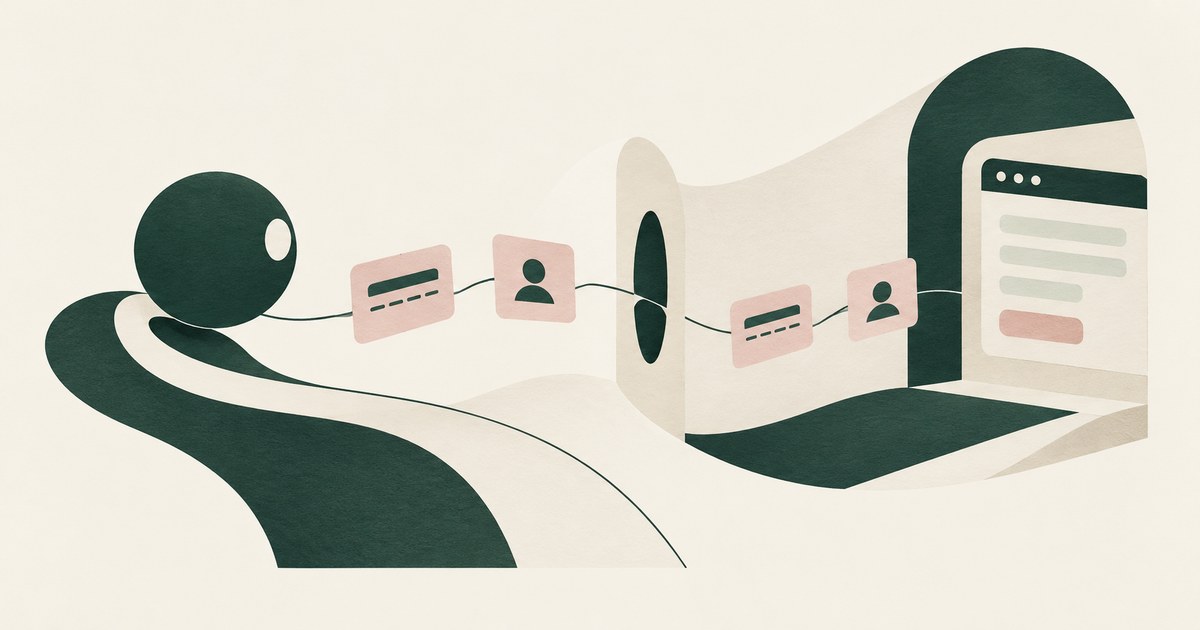
Yes, if card and identity fields reach the agent as tokens and real values are inserted only at checkout after approval. Check how the payment step works.

What Is the Enterprise Version of Meta Muse? There Isn't One From Meta, and Here Is What It Would Have to Add
Meta does not make one. Muse is Meta's personal agent, running in a dedicated cloud machine with vaulted credentials and approvals; enterprise needs more.
RedactSure vs CrowdStrike: 2026 Comparison & Alternative
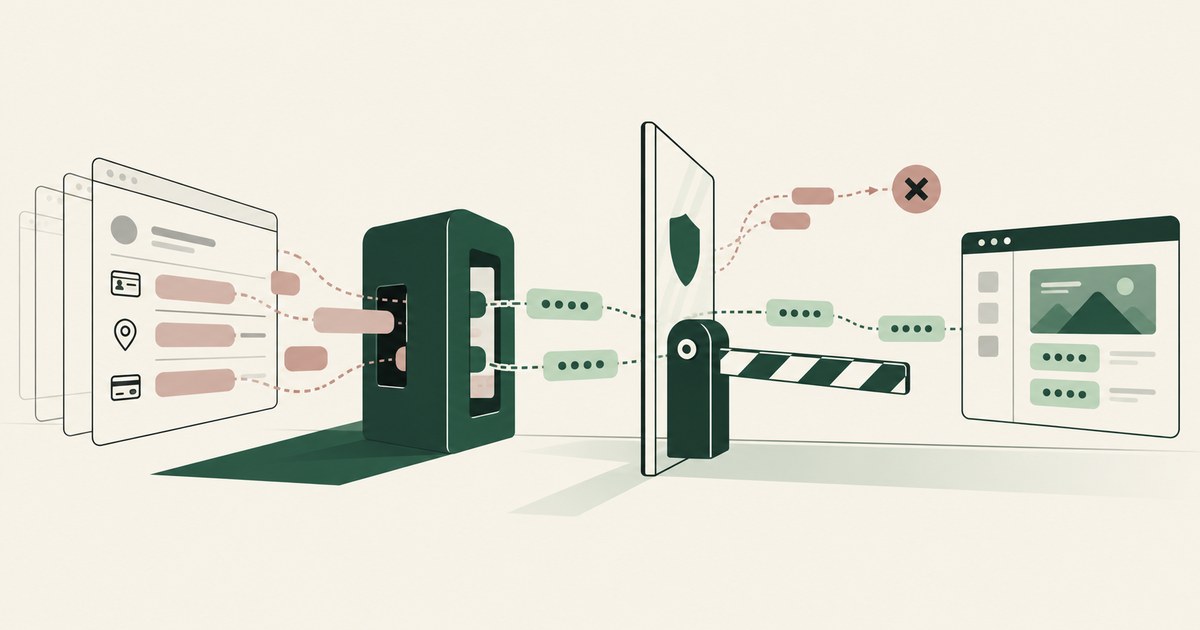
CrowdStrike returns allow or block at the point of execution, while RedactSure replaces values on the rendered screen before a model reads it.
Can a Coding Agent Be Tricked Into Installing a Malicious Package?
Yes, when a dependency arrives as text the agent acts on: a typosquatted or invented package runs inside the agent's environment.
Can a GitHub Issue Hijack My Coding Agent?
Yes, when the agent treats issue text as its task: anyone who can file an issue supplies instructions. Check who can file issues and what the token allows.
What Can a Hijacked Coding Agent Do With My GitHub Token?
Whatever the token it holds allows, so the reach of the token is the blast radius. Check each token's scope and whether the agent needs it at all.
Your AI Strategy Is Probably Wrong
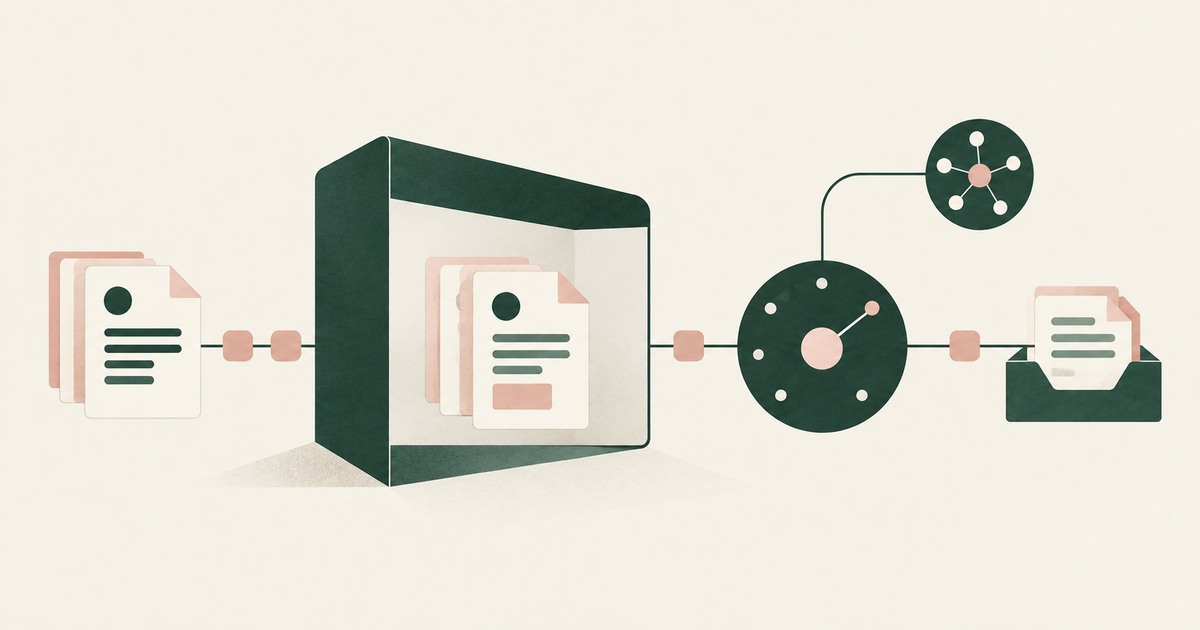
Compare AI agent operating models for billing and claims, from isolated assistants to governed workflows with tokenization and approval.

What If the Agent Never Had Your Data?
Explore AI agent security built around tokenization, controlled browser actions and human approval before sensitive payments proceed.
How RedactSure Keeps a Workflow Edit From Reading Your Run Log
Every control reviewed above acts on the CI change from outside the agent, and none of them changes what the agent read while it worked.
The environment that enforces this is built by RedactSure, an AI agent controls, governance and data protection company.
Before: the agent opens a run log, reads the token a step printed, and drafts an edit that refers to it. Inside the governed environment: the log page renders GH_SECRET_001, the agent edits the step against the token, and the real value resolves only for the destination a named reviewer approved.
RedactSure is deploying now with enterprise and government customers. Datadog's report puts 37 percent of a customer sample on IAM users in Actions.
Everyone else controls where data can go. RedactSure controls what the AI can see.
See it on your own workflow
A workflow edit is dangerous when the run log hands the agent a printed token. Bring a CI change your team delegates and see, with test values, what the model reads in the log and who approves the edit. Book a demo