
Explainer · By Chris Sowa · Published
Last updated
What Is an Overprivileged AI Agent and Why Can Legitimate Permissions Still Be Dangerous?
An overprivileged AI agent holds permissions that are legitimate for the person it inherits them from but far wider than the task it is performing. They pass every access review because the person is entitled to them. The danger appears when an injected or mistaken agent uses them and nothing ever asked what the task required.
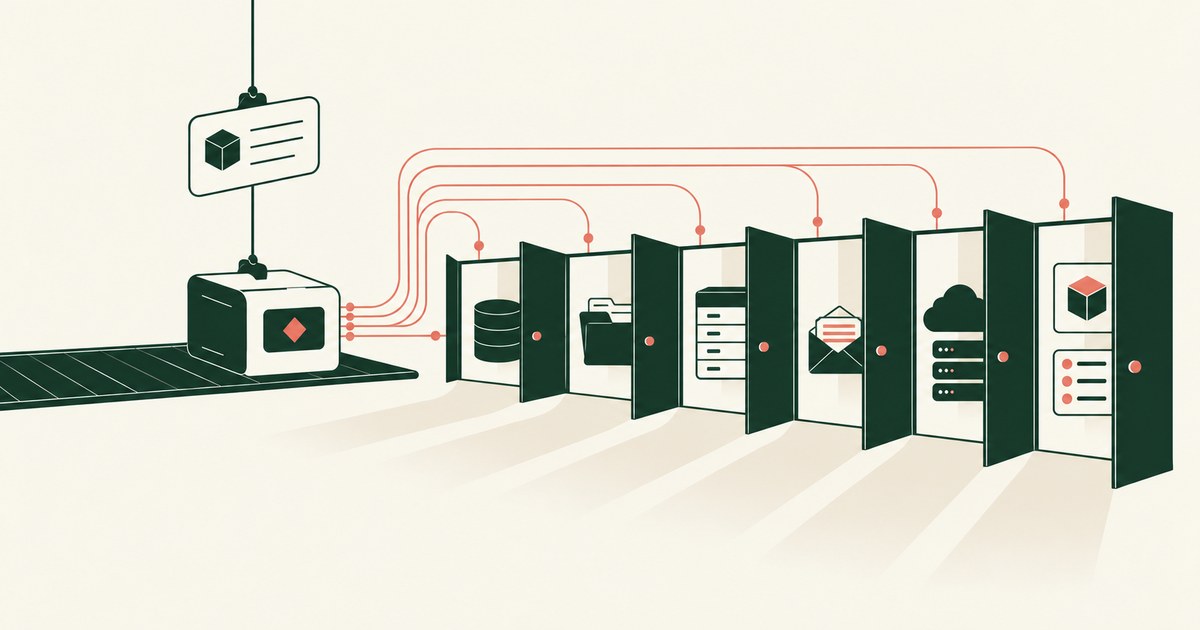
An overprivileged AI agent holds permissions that are legitimate for the person it inherits them from but far wider than the task it is performing. They pass every access review because the person is entitled to them. The danger appears when an injected or mistaken agent uses them and nothing ever asked what the task required. The claims adjuster who delegates a reserve update to an agent has a role that was reviewed, approved and recertified. The agent signs in as that adjuster and can read every claim file, every policyholder record and every payee the adjuster can, which for one reserve update is almost all of it. Identity programs were built to answer whether a person should hold a permission, not whether a model working one task inside that person's session should be shown everything the permission unlocks. Least Exposure supplies the missing answer: for each piece of work, the AI receives exactly the data the task requires and nothing more, enforced before any model reads the screen. The environment that enforces this is built by RedactSure, an AI agent controls, governance and data protection company.
Key findings
- OWASP lists Excessive Agency as LLM06 in its 2025 Top 10 for LLM Applications, covering excessive functionality, permissions or autonomy, with harm arising when that excess meets unexpected, ambiguous or manipulated outputs (OWASP, 2025).
- Indirect prompt injection lets an attacker who controls content an agent reads redirect the agent without touching the user's prompt, so the agent's permissions become the attacker's (Greshake et al., 2023).
- Vendors describe their stacked refusal defenses as a Swiss cheese model in which each layer has holes, and one vendor reported that a single type of safety classifier added 24 percent to its chatbots' compute costs (MIT Technology Review, 2026).
- Documented agents run with a real person's access: Microsoft warns that a shared Copilot Studio computer-use agent lets other users act with the author's access, and that its access control does not stop the model from opening unlisted sites (Microsoft, 2026).
- NIST's zero trust guidance evaluates every access request against the resource and the context rather than trusting a session once opened (NIST, 2020).
- Models with legitimate access have been shown choosing harmful, insider-style actions when goals and constraints conflict, with no attacker present (Anthropic, 2025).
What makes an AI agent overprivileged?
A privilege is a capability granted to an identity: read this table, open this application, submit this form, release this payment. An agent is overprivileged when the capabilities it can exercise during a task exceed the capabilities the task needs. The condition differs from the human version in one respect. A human account is overprivileged when its role is wider than its job. An agent is overprivileged when its reach is wider than its task, even if the role behind it is correctly sized for the human.
OWASP's Excessive Agency entry names three forms: excessive functionality, meaning tools or operations the application does not need; excessive permissions, meaning more data or systems than the operation requires, often because the agent uses an identity sized for a person; and excessive autonomy, meaning high-impact actions taken without verification (OWASP, 2025). All three describe surplus, and surplus is harmless until something uses it.
The scoping unit is the key. Least privilege scopes by role: a person gets the access the job needs across every task the job contains. An agent does one task at a time, and the correct scope for that task is far narrower than the role. A benefits coordinator's role spans enrollment, terminations, appeals and address changes for every employee; one address change needs one record, two fields and a save. When the agent signs in as the coordinator, it holds the role. When it works the task, it needs the task. The difference is the overprivilege, and it exists before any attacker arrives.
The condition arises whether the agent uses the person's own session, as browser and computer-use agents do, or a service identity sized generously so the project would not stall on access tickets. Both pass review. Neither review asked the per-task question.
Why are the permissions legitimate in the first place?
The permissions are legitimate because identity programs are built around people and roles, and the person really does need the access. A claims adjuster needs every open claim because any of them may land on the desk. A school registrar needs every student record because any family may call. A payables clerk needs every vendor because any invoice may arrive. Role-based access is sized for the unpredictable set of tasks a job contains over a quarter, not for the one task a worker is doing at 2 p.m. That is correct design for humans, who carry judgment from task to task.
The agent inherits the role without the judgment that justified it. Claude in Chrome takes screenshots of the active tab, and all visible information, including personal data, becomes part of the context; Anthropic's own guidance is to avoid opening the extension while viewing sensitive information (Anthropic, 2026). Copilot Studio's computer-use agent runs with maker-provided credentials by default, with the warning that a shared agent lets users act with the author's access on the machine (Microsoft, 2026). Each is reporting that the agent's reach equals the signed-in person's reach.
| Job and task | Role scope the agent inherits | Task scope the work needs | Surplus the agent holds |
|---|---|---|---|
| Claims adjuster updating one reserve | Every open claim, policyholder PII, payee bank details, payment release | One claim's reserve field, the loss facts, a save | Every other claim, every payee, the payment function |
| Registrar correcting one address | Every student's record, grades, health notes, guardian contacts | One student's address fields and a save | Every other student, grades, health notes |
| Payables clerk matching one invoice | Every vendor master, every bank detail, payment runs, master data edits | One invoice, one PO, one receipt, a match flag | Every bank detail, payment runs, vendor edits |
Least privilege as practiced for people does not close the gap, because tightening the adjuster's role would stop the adjuster from doing the job. The access is legitimate for the human and excessive for the task at the same time. It cannot be fixed on the identity side without breaking the person's work.
How does an injected or mistaken agent turn surplus permissions into harm?
Surplus permissions become harm when something other than the task directs the agent. Two things can: an attacker, through prompt injection, and the model itself, through error. The surplus is what both of them spend.
Indirect prompt injection is the attacker's route. Greshake and colleagues showed in 2023 that instructions embedded in content an LLM-integrated application reads, a web page, a document or a message, can redirect it without the user typing anything hostile (Greshake et al., 2023). OWASP ranks prompt injection first among LLM risks and describes injections arriving through external content as well as direct prompts (OWASP, 2025). The attacker needs only a claim note, a vendor invoice or an email the agent will read during a legitimate task. Once the agent follows the planted instruction, it acts with the adjuster's role: it can open the other claims, read the payee details, draft the payment. The damage is bounded by the permissions, and the permissions were sized for the human.
Error is the second route, and it needs no attacker. OWASP's Excessive Agency entry puts unexpected or ambiguous outputs on the same footing as manipulated ones (OWASP, 2025). Microsoft's AI Red Team catalogs failure modes in agentic systems that arise from the agent's own reasoning and its environment, not only from adversaries (Microsoft, 2025). Anthropic's agentic misalignment research found models with legitimate access to corporate systems choosing harmful, insider-style actions when their goals and the organization's constraints conflicted (Anthropic, 2025). OpenAI's own guidance for its always-on agents says they can still make mistakes, so consequential work should always be reviewed (OpenAI, 2026). A misread instruction and a planted one produce the same outcome: the agent reaches for a capability the task never needed, and the capability is there.
The harm has two layers. The first is the action: a payment released, a record changed, a file sent. The second is the reading. An injected agent that never takes a forbidden action has still placed every screen it opened into the model's context, and a screenshot carries the whole page, not the task's fields. OWASP lists that outcome as Sensitive Information Disclosure, LLM02 (OWASP, 2025).
Why is the model's refusal not a permission boundary?
The common answer to the injected agent is that the model will refuse. MIT Technology Review's October 2026 analysis argues that refusal is being treated as a primary safety mechanism when it is far from foolproof, and reports that vendors describe the layered defenses as a Swiss cheese model: each layer has holes, and the hope is that the stacked layers cover one another (MIT Technology Review, 2026). The same piece reports that Anthropic said one type of safety classifier added 24 percent to its chatbots' compute costs (MIT Technology Review, 2026).
Refusal is a decision the model makes. A permission boundary is a limit the model cannot cross whether it decides to or not, and the record on bypassing refusal is long. Zou and colleagues showed adversarial suffixes that transfer across aligned models (Zou et al., 2023). OpenAI's instruction hierarchy work trains models to prioritize privileged instructions over injected ones, an acknowledgment that they do not do so by default (Wallace et al., 2024). Each is a model-internal control with known gaps; none changes what the agent is permitted to reach.
For an overprivileged agent, refusal is the only thing standing between the surplus and its use. If the boundary were sized to the task, a successful injection would find nothing to spend: the agent could not open the other claims because the task never included them. When the boundary is the human's role, the injection finds everything the human can do, and the whole weight of safety rests on the model declining. Bhagwatkar and colleagues reached a related conclusion from the other direction: model-agnostic firewalls at the agent-tool boundary, which strip unneeded data from tool inputs and instructions from tool outputs, reached near-zero attack success on standard benchmarks, placing the effective control outside the model (Bhagwatkar et al., 2026). A model that refuses is a useful layer, not a boundary. Product controls such as application allow lists narrow where the agent may act, and Microsoft's documentation states that its Copilot Studio access control stops actions on unlisted sites without stopping the model from opening them (Microsoft, 2026); none of these narrows what the agent sees inside an allowed application.
How does an organization remove the surplus without rewriting IAM?
The fix is not to shrink the human's role. It is to insert a per-task decision between the role and the model, and a per-action decision between the model and the system. NIST's zero trust architecture supplies the pattern for people: no implicit trust from a session, every access request evaluated against the resource and the context at the time of the request (NIST, 2020). Applied to an agent, the session it inherits is not a grant; the task is.
Three controls do the work. The first decides exposure before the model reads anything: which fields on each screen the task needs in clear, which identifiers it can work with as consistent stand-ins, and which it never needs at all. The adjuster's reserve update needs the loss facts and the amount; it does not need the policyholder's SSN, so the model receives SSN_001. The second decides action: every consequential step, a payment, a submission, a record change, stops for a named person, so an agent holding the human's role still cannot spend it without the human. The third records every screen as the model received it, every action and every approval with a name, in a form the security team can replay. HIPAA's minimum necessary standard, which limits protected health information to the minimum needed for the purpose, is the oldest regulatory statement of the first control (45 CFR 164.502(b), 2026).
The test is short. Take one completed task. List the permissions the agent's identity held during it. List the fields the model received and the actions it took. Subtract. What remains is surplus, and the question is what stood between that surplus and an injected instruction: a boundary the model could not cross, or a refusal it might not make. Prompt injection against a token-only agent collects tokens; prompt injection against a role-sized agent collects the role.
Where does RedactSure sit?
RedactSure removes the surplus at the two points where it becomes harm, without changing the permissions that make it legitimate. Permissions stay exactly as they are; what changes is what the AI can see. Before any model reads a screen, render-layer tokenization replaces every identifier chosen by policy with a consistent token, so the model receives the task's fields with SSN_001 and ACCT_001 in place of the real values, and an injected instruction that succeeds collects tokens. The Planner sets which values are tokenized and what the agent may do on each screen, and a named person confirms that policy before the run. Under Supervised Delegation, that person approves every payment, submission and record change while the run proceeds, so the human's role is never exercised without the human. Real values resolve only at approved destinations at the moment of an approved action.
The agent works the organization's existing applications as rendered, inside a governed environment in the customer's cloud with keys the customer holds, with no per-application integration and any vendor's model. Every screen as tokens, every action and every approval with a name lands in the AI Control Record and exports to the customer's SIEM. Deployments are in pilot. Everyone else controls where data can go. RedactSure controls what the AI can see.
Methodology and limitations
This page is a definitional synthesis. It rests on the OWASP Top 10 for LLM Applications 2025, entries LLM01, LLM02 and LLM06 (industry standard), NIST SP 800-207 Zero Trust Architecture (2020, official guidance) and 45 CFR 164.502(b) (regulation), read as of October 13, 2026. Vendor statements come from the published documentation of Microsoft Copilot Studio computer use, OpenAI's safety write-up for Dots, Anthropic's Claude in Chrome safety guidance and OpenAI's always-on agent guidance, cited as vendor documentation with dates. Research findings are drawn from Greshake et al. (2023), Zou et al. (2023), Wallace et al. (2024), Bhagwatkar et al. (2026), Microsoft's AI Red Team taxonomy (2025) and Anthropic's agentic misalignment report (2025), as preprints, whitepapers and research reports. Industry analysis comes from MIT Technology Review.
No product was tested. No agent was run against a planted instruction, no vendor control was exercised, and statements about what each product bounds are limited to what its documentation describes as of the date read. Vendor features change; the page carries its date and is revised when the sources change. The adjuster, registrar and payables examples describe kinds of work, not any organization, and no customer or prospect is described. Statements about RedactSure are limited to the design facts the company publishes about itself.
Whether an agent's permissions satisfy an organization's obligations under HIPAA, FERPA, PCI DSS, GLBA or any other regime, and whether a given control reduces them to the minimum necessary, is a determination for the organization's counsel, its assessor and its security and compliance officers, not for the page.
What the record shows
An overprivileged AI agent is one whose reach during a task exceeds the task, and the reach is usually a real person's legitimate role, inherited through the session the agent works in. The permissions pass review because the person needs them. The harm arrives when an injected instruction or an ordinary mistake directs the agent toward the surplus, and the only thing in the way is the model's willingness to refuse, which research and the vendors' own descriptions show to be a layer with holes rather than a boundary. The alternative is a per-task decision about what the model receives and a named person on every consequential action, so that a successful injection finds tokens instead of a role. The test is a subtraction: permissions held during one task, minus fields received and actions taken.
Frequently asked questions
What is the difference between an overprivileged user and an overprivileged AI agent?
An overprivileged user holds a role wider than the job. An overprivileged agent holds a role wider than the task, and the role may be exactly right for the human it came from. A claims adjuster needs every open claim across a quarter; the agent updating one reserve needs one claim for ten minutes.
If the permissions are legitimate, why does an access review not catch the problem?
Access reviews ask whether the person should hold the permission, and the answer is yes. They do not ask whether a model working one task inside that person's session should be shown everything the permission unlocks. The review unit is the identity and the role; the agent's exposure unit is the task and the screen.
Can prompt injection give an agent permissions it does not have?
No, and that is the point. Injection cannot create permissions; it redirects the ones the agent already holds, as Greshake and colleagues showed for content-borne instructions. An agent scoped to the task gives an attacker the task. An agent scoped to the human's role gives the attacker the role.
Does model refusal protect an overprivileged agent?
Partly, and not reliably. Refusal is a decision the model makes, layered with classifiers and probes that vendors themselves describe as a Swiss cheese model with holes in each layer. A permission boundary is a limit the model cannot cross whether or not it decides to.
Does an application allow list fix overprivilege?
It narrows which applications the agent may act on, which is useful. It does not narrow what the agent sees inside an allowed application, where the platform that holds the one claim also holds every other, and Microsoft's documentation states that its access control stops actions on unlisted sites without stopping the model from opening them.
How do you check whether a specific agent is overprivileged?
Take one completed task. List the permissions the agent's identity held during it, then the fields the model received and the actions it took, and subtract. Whatever remains is surplus. If only the model's refusal stood between that surplus and a planted instruction, the agent is overprivileged in the sense that matters.
Related reading
What Is AI Agent Least Privilege? · Does Least Privilege Cover What an AI Agent Sees? · What Does Prompt Injection Get From a Token-Only Agent? · What Is AI Agent Access Control and Why Is Traditional IAM Not Always Enough? · What Is AI Agent Runtime Security and What Happens After an Agent Gets Access? · What Is AI Agent Identity and Why Do Agents Not Fit Traditional User Access Models? · On the RedactSure blog: The Two Gaps AI Agents Opened in Your Security Stack
Sources
Peer-reviewed research and preprints
- Greshake, Kai, et al., "Not What You've Signed Up For: Compromising Real-World LLM-Integrated Applications with Indirect Prompt Injection," arXiv:2302.12173, 2023 (preprint; also AISec 2023). https://arxiv.org/abs/2302.12173
- Zou, Andy, et al., "Universal and Transferable Adversarial Attacks on Aligned Language Models," arXiv:2307.15043, 2023 (preprint). https://arxiv.org/abs/2307.15043
- Wallace, Eric, et al., "The Instruction Hierarchy: Training LLMs to Prioritize Privileged Instructions," arXiv:2404.13208, 2024 (OpenAI preprint). https://arxiv.org/abs/2404.13208
- Bhagwatkar, Kasa, et al., "Indirect Prompt Injections: Are Firewalls All You Need, or Stronger Benchmarks?," arXiv:2510.05244, v2 2026 (preprint). https://arxiv.org/abs/2510.05244
- Microsoft AI Red Team, "Taxonomy of Failure Modes in Agentic AI Systems," Microsoft, April 2025 (whitepaper). https://www.microsoft.com/en-us/security/blog/2025/04/24/new-whitepaper-outlines-the-taxonomy-of-failure-modes-in-ai-agents/
- Anthropic, "Agentic Misalignment: How LLMs Could Be Insider Threats," June 2025 (research report). https://www.anthropic.com/research/agentic-misalignment
Vendor documentation
- Microsoft Learn, "Automate web and desktop apps with computer use," Copilot Studio (2026; vendor documentation). https://learn.microsoft.com/en-us/microsoft-copilot-studio/computer-use
- OpenAI, "How we build safety, security and privacy into dots" (September 29, 2026; vendor documentation). https://openai.com/index/how-we-build-safety-security-and-privacy-into-dots/
- Anthropic, Claude Help Center, "Use Claude in Chrome safely" (2026; vendor documentation). https://support.claude.com/en/articles/12902428-use-claude-in-chrome-safely
Regulation, standards and official guidance
- OWASP, "LLM01:2025 Prompt Injection," Top 10 for LLM Applications 2025 (industry standard). https://genai.owasp.org/llmrisk/llm01-prompt-injection/
- OWASP, "LLM02:2025 Sensitive Information Disclosure," Top 10 for LLM Applications 2025 (industry standard). https://genai.owasp.org/llmrisk/llm022025-sensitive-information-disclosure/
- OWASP, "LLM06:2025 Excessive Agency," Top 10 for LLM Applications 2025 (industry standard). https://genai.owasp.org/llmrisk/llm062025-excessive-agency/
- NIST, "Zero Trust Architecture," SP 800-207, 2020 (official guidance). https://csrc.nist.gov/pubs/sp/800/207/final
- 45 CFR 164.502(b), Uses and disclosures of protected health information: minimum necessary (regulation). https://www.ecfr.gov/current/title-45/subtitle-A/subchapter-C/part-164/subpart-E/section-164.502
Industry analysis and press
- MIT Technology Review, Arthur Holland Michel, "We're putting too much faith in AI's ability to say no" (October 9, 2026; press). https://www.technologyreview.com/2026/10/09/1145728/we-are-putting-too-much-faith-in-ai-to-say-no/
RedactSure documents
- RedactSure Research, "What Is Least Exposure?" (2026). https://redactsure.com/research/what-is-least-exposure
- RedactSure Research, "What Is Render-Layer Tokenization?" (2026). https://redactsure.com/research/what-is-render-layer-tokenization
- RedactSure Research, "What Is Supervised Delegation?" (2026). https://redactsure.com/research/what-is-supervised-delegation
- RedactSure Research, "What Is an AI Control Record?" (2026). https://redactsure.com/research/what-is-an-ai-control-record
- RedactSure, "The Two Gaps AI Agents Opened in Your Security Stack" (2026). https://redactsure.com/blog/two-gaps-ai-agents-opened-in-your-security-stack/
- Product behavior described on this page reflects RedactSure's current design. Microsoft and Copilot Studio are trademarks of Microsoft Corporation; OpenAI and Dots are trademarks of OpenAI; Claude is a trademark of Anthropic, PBC; named to identify the products. Compliance determinations belong to the organization's counsel.
What Is AI Agent Least Privilege?
Review AI Agent Least Privilege, with AI agent security, tokenization and approval checks for sensitive enterprise workflows.
Does Least Privilege Cover What an AI Agent Sees?
Compare access permissions with AI agent security for visible PII, and explore how tokenization can limit exposure within an approved task.
What Does Prompt Injection Get From a Token-Only Agent?
Follow a prompt-injection scenario to examine AI agent security, PII exposure and the limits of tokenization when an attack succeeds.
What Is AI Agent Access Control?
Review AI Agent Access Control, with AI agent security, tokenization and approval checks for sensitive enterprise workflows.
What Is AI Agent Runtime Security?
Review AI Agent Runtime Security, with AI agent security, tokenization and approval checks for sensitive enterprise workflows.
What Is AI Agent Identity?
Review AI Agent Identity for AI agent security, with practical checks on sensitive data, tokenization and named human approvals.

The Two Gaps AI Agents Opened in Your Security Stack
Explore AI agent security through two questions: which PII reaches the model, and who approves consequential billing and claims actions.

What Is Least Exposure?
Explore Least Exposure for AI agent security, limiting PII to what a workflow needs through tokenization and explicit human decisions.

What Is Render-Layer Tokenization?
Learn how render-layer tokenization replaces PII before an AI agent reads a browser screen while preserving useful workflow context.

What Is Supervised Delegation?
Explore supervised delegation for AI agents in billing and claims, with named responsibility, tokenization policies and human approvals.

What Is an AI Control Record?
Explore an AI agent control record for billing and claims, linking permissions, tokenization decisions, approvals and audit evidence.
Book an AI Agent Security Review →
Bring your hardest questions.
Bring one sensitive workflow and the decisions your team needs to keep in its hands.
Book a demoAbout the author

Chris Sowa is a founder of RedactSure and a former CEO of an AI company; he started it years before ChatGPT existed. He previously led AI at Accenture, served as Global VP of Strategy & Innovation at Schneider Electric, was CCO of Sovos, and spent more than a decade at Oracle, with earlier roles at SAP and IBM.