
Explainer · By Chris Sowa · Published
Last updated
What Is AI Agent Least Privilege?
AI agent least privilege applies the classic principle to an agent and stretches it further, covering system reach, data visibility, action authority, and how long permissions last. An agent whose account passes a permission review can still read a full record, submit a change no person approved, and keep standing access between unrelated tasks.
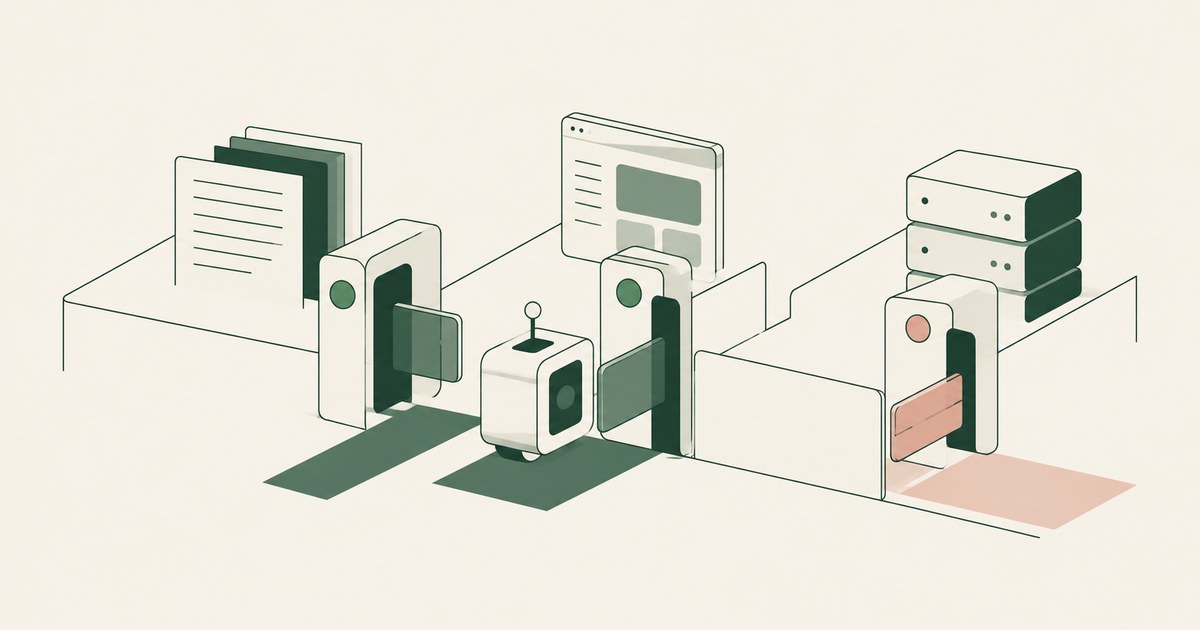
AI agent least privilege applies the classic principle to an agent and stretches it further, covering system reach, data visibility, action authority, and how long permissions last. An agent whose account passes a permission review can still read a full record, submit a change no person approved, and keep standing access between unrelated tasks. In its original form, least privilege says a user or process should hold only the access needed to complete its function. For an agent, access alone is an incomplete description, because an agent with a narrow account can still read a very wide record, and an agent with read access can still cause harm if it can also submit, pay, or delete. The extended definition covers what the agent is allowed to see, what it is allowed to do, and how long its permissions last while it reasons and acts across several systems. The visibility dimension is the principle of Least Exposure: for each piece of work, the AI receives exactly the data the task requires and nothing more, enforced before any model reads the screen. The environment that enforces this is built by RedactSure, an AI agent controls, governance and data protection company.
Key findings
- NIST SP 800-53 defines the least privilege control, AC-6, as employing the principle that users are assigned only the authorizations needed to accomplish assigned tasks (NIST, 2020).
- NIST SP 800-207 builds zero trust on least privilege per request access decisions, granting access for a session and a purpose rather than as a standing entitlement (NIST, 2020).
- For an agent, privilege has at least four dimensions: system reach, data visibility, action authority, and duration. The classic definition in SP 800-53 covers the first; controlling one dimension leaves the others open.
- OWASP treats the action dimension as its own risk, Excessive Agency, LLM06 in the 2025 Top 10, covering excessive functionality, permissions, and autonomy (OWASP, 2025).
- Agents commonly act through a person's session, so account level least privilege can be fully satisfied while the agent still reads and acts far beyond its task (Does Least Privilege Cover What the AI Sees?).
What does least privilege mean before agents?
Least privilege is one of the oldest ideas in access control. NIST SP 800-53 Rev. 5 states the control directly: the organization employs the concept of least privilege, allowing only authorized access for users, or processes acting on behalf of users, that is necessary to accomplish assigned tasks (NIST, 2020). Its enhancements add the operational habits that keep the principle real over time, including reviewing user privileges, restricting access to privileged functions, and logging the use of privileged functions (NIST, 2020).
Zero trust architecture took the same idea and removed standing trust. NIST SP 800-207 describes zero trust as a set of concepts aimed at minimizing uncertainty in enforcing accurate, least privilege, per request access decisions, in a network assumed to be compromised (NIST, 2020). Two consequences follow. Access is granted per session and per request rather than as a permanent property of an account, and the decision considers context such as identity, asset state, and behavior rather than network location alone.
Both formulations were written for a world of users, services, and processes with defined functions. Their unit of analysis is the authorization: who may reach what. That unit still matters for agents, and nothing in the extended definition replaces it. An agent should run under an identity with scoped permissions, in a controlled environment, with its actions logged. The extension is narrower: for an actor that reads content and then decides what to do with it, authorization to reach a system is only the outer boundary of the problem.
Why does an agent need a wider definition?
An agent differs from a conventional process in three ways that strain the classic definition. First, it consumes unstructured content. A batch job reads defined fields. An agent reads a screen, a thread, a document, and its effective data intake is everything in that material, including values nobody enumerated in an access policy. Second, it chooses its own next steps within a task. A script's actions are fixed in advance. An agent can decide to open a related record, follow a link, or copy a value into another system, and each choice is an exercise of privilege that no static permission list described. Third, it is persuadable. Content it reads can influence what it does next, which means its privileges can be steered by a third party who controls a document, a web page, or a message in its path (OWASP, 2025).
Take a concrete case. An agent is given a service account that can open one claims application and nothing else. By account standards, least privilege is satisfied. Inside that application, the agent opens a claim and reads the claimant's full history, bank details, medical attachments, and internal notes, because the screen shows them. It then drafts a message and, having write access to the application, submits a status change. Every step used an authorized function. Yet the agent saw far more than the task required and took a consequential step without a person deciding. Both failures are least privilege failures in substance. Neither appears in an account permission review.
The wider definition therefore treats visibility and action authority as privileges in their own right, subject to the same discipline: grant only what the task needs, for the duration of the task, and be able to show what was granted.
What are the four dimensions of agent privilege?
| Dimension | Governing question | Typical failure |
|---|---|---|
| System reach | Which applications and functions may the agent use? | A general account with broad application access |
| Data visibility | Which values may the model receive while working? | Full records presented for a narrow step |
| Action authority | Which changes may the agent make without approval? | Submission or payment treated as part of reading a record |
| Duration and scope | How long do these grants last, and for which tasks? | Standing access that persists between unrelated jobs |
System reach is the classic dimension, handled with scoped identities, network controls, and an isolated environment. Data visibility is the dimension existing programs most often leave unmanaged. It concerns the content of the model's context: which values are real, which are replaced, and which are withheld entirely for this task.
Action authority separates reading from changing. Many deployments blur the two because both are delivered through the same interface and the same session. Separating them means an agent can be permitted to prepare work widely while being permitted to commit very little: it may assemble a payment, draft a submission, or stage a record change, and stop for a person at the point of commitment. Duration completes the picture. A grant that is appropriate during a supervised run is not automatically appropriate overnight, across a queue of unrelated tasks, or after the workflow has changed. Per request and per session thinking from zero trust applies here directly (NIST, 2020).
Reviewing the four dimensions separately also clarifies ownership. Platform teams usually own system reach. Workflow owners are better placed to judge visibility and action authority, because they know what the task needs. Duration is a policy decision about supervision and risk appetite. A review that assigns all four to one team tends to produce a technically tidy answer that is wrong about the work.
How does least privilege apply to what an agent sees?
Visibility privilege is granted at the level of the task and the screen, not at the level of the application. The method is to decide, for each step, which values the model requires in readable form, which it requires only as consistent placeholders, and which it does not require at all. Values needed only for tracking, such as an identifier used to match the same person across screens, can be replaced with a consistent token. Values needed only at a destination, such as an account number for a payment, can be withheld from the model's context and resolved at the destination under approval. Values that are the substance of the reasoning, such as amounts, dates, and statuses, normally remain readable.
This is where least privilege and data minimization meet, and the two should not be conflated. Minimization is the privacy principle that data involved should fit the purpose. Visibility least privilege is the enforcement habit that turns that principle into a per task grant, reviewed and recorded. One is a value, the other is a control. An organization can hold the value sincerely and still lack the control.
There is an evidentiary benefit to framing visibility as privilege. Privileges are things organizations already know how to inventory, approve, review, and revoke. If the set of values an agent may see is treated as a grant, it acquires an owner, a justification, and a review date. If it is treated as an incidental side effect of opening a screen, it acquires none of those, and nobody can answer the simple question of why the agent was able to see a given record in full.
How is agent least privilege reviewed in practice?
A practical review asks for artifacts rather than intentions. For system reach: the identity the agent runs under, its entitlements, and evidence that it cannot reach systems outside its workflow. For visibility: a sample of what the model received for a real task, plus the policy that produced that sample. For action authority: the list of actions the agent may commit alone, which in a well controlled deployment is short or empty for consequential actions, and the approval mechanism for the rest. For duration: how a run starts, who starts it, what ends it, and what happens to access between runs.
The NIST AI Risk Management Framework provides the surrounding process, with Govern assigning accountability and Measure expecting risks to be tracked with evidence (NIST, 2023). OWASP's Excessive Agency entry is a useful test for the action dimension, asking whether functionality, permissions, or autonomy exceed what the application needs, and recommending that an agent's possible actions be limited to the minimum necessary (OWASP, 2025).
Reviewers should also test the failure path. What happens when the agent encounters a screen it was not configured for, a value in an unexpected format, or an instruction embedded in a document asking it to widen its own access? Least privilege that only holds on the expected path is a partial control. The expected answer is that the agent stops, asks, or proceeds with less rather than more, and that the event appears in the run record.
Where does RedactSure sit?
RedactSure puts the four part review into operation without changing the permissions a user already holds. Its AI co-workers gain no broader account access, so system reach stays exactly where the organization's identity program put it. Data visibility shrinks to the task through render-layer tokenization: every identifier chosen by policy is replaced by a consistent token before any model reads the screen, and the model receives the task's fields with SSN_001 and ACCT_001 in place of the real values. Real values resolve only at approved destinations at the moment of an approved action. The Planner sets which values are tokenized and what the agent may do on each screen, and a named person confirms that policy before the run.
Action authority and duration are handled by Supervised Delegation: consequential authority is granted one approved action at a time rather than for a lingering session, and a named person approves every payment, submission and record change. Every screen as tokens, every action and every approval lands in the AI Control Record and exports to the customer's own SIEM, which is the artifact set a privilege review asks for. Keys stay with the customer, the environment is model agnostic, and no per-application integration is required. Deployments are in pilot. Everyone else controls where data can go. RedactSure controls what the AI can see.
Methodology and limitations
This page rests on NIST publications that define least privilege and zero trust: SP 800-53 Revision 5, control AC-6 and its enhancements, and SP 800-207, Zero Trust Architecture, both official guidance published in 2020. It also rests on the NIST AI Risk Management Framework 1.0 (2023, official guidance) for governance and measurement expectations, and on the OWASP Top 10 for LLM Applications 2025, entries LLM01 Prompt Injection and LLM06 Excessive Agency, a community standard, for the action and persuasion risks. All sources were read as of October 13, 2026 and are cited from their published text. The four dimension model is a synthesis for applying those sources to agents; it is not a taxonomy published by any of the cited bodies, and it is presented as an analytical tool rather than a standard.
No product was tested and no permission configurations were audited. The claims application example describes a record type and a pattern of access, not any organization, customer or prospect. Vendor features and standards revisions change; the page carries its date and is revised when the cited documents change. Statements about RedactSure are limited to design facts the company publishes about itself, and deployments are described as in pilot.
Whether an agent's entitlements, visibility grants, action authority or session duration satisfy a given control framework is a determination for the organization's counsel, its assessor, and its security and compliance officers, not for a research page. The questions set out above are the questions those reviewers can put to a deployment; the answers belong to them.
What the record shows
Least privilege still begins where NIST puts it: a user or process should hold only the authorizations its assigned tasks require. For an AI agent, that sentence is necessary and no longer sufficient, because authorizations describe only what an account may open. An agent's real privilege also includes what it is shown inside the records it may open, what it is allowed to do once it is there, and how long those permissions persist while it reasons across systems. Controlling any one of those dimensions and leaving the others wide produces an agent that passes an access review and still reads, acts, or lingers far beyond its purpose. The session problem makes this concrete: an agent working through a person's session can satisfy account level least privilege completely while operating well past its task. The test is to ask for one real run and three artifacts: what the model received for one screen, which actions the agent could commit without a named person, and when its access ended.
Frequently asked questions
If our accounts already follow least privilege, are our agents covered?
Not necessarily. Least privilege at the account level governs which systems and records an identity may open. An agent commonly acts through a person's session, inheriting that person's entitlements, so the account review can pass while the agent reads entire records to perform narrow steps and submits actions the task never called for. The gap is not in the account; it is in the dimensions the account review never examined, namely what the agent sees inside records, what it may do there, and how long its permissions last.
What does duration mean as a dimension of privilege?
Duration is how long a permission persists. A standing entitlement remains available whether or not any current task needs it, while a per request or per session grant, the pattern NIST builds zero trust on, exists for a purpose and expires with it. Agents make duration easy to overlook because a run can stretch across screens and systems, and permissions granted for the first step tend to be present at the last. Reviewing duration means asking when each permission ends, and whether anything in the run depends on it lasting longer.
Where does excessive agency fit into least privilege?
Excessive agency is the action dimension of the problem, named as a risk in the OWASP Top 10 for LLM Applications: LLM06. It covers functionality, permissions, and autonomy beyond what the task requires: tools the agent can call but never needs, actions it can complete unconfirmed, and latitude to decide matters the organization never meant to delegate. Least privilege framed only around reading misses this, which is why an agent review must examine what the agent may do with the same care as what it sees.
Does zero trust already cover AI agents?
Partly. Zero trust supplies the per request, per session habit that fits the duration dimension, and its identity and context checks fit system reach. It does not describe what a model receives once a request is granted. A zero trust decision can approve an agent's access to a claims screen and say nothing about whether the model needed the claimant's bank details and medical attachments to do the step. Visibility has to be granted separately, at the task level, before the model reads the screen.
Who should own the review of an agent's privileges?
Different dimensions have different natural owners. Platform or identity teams own system reach, because it is scoped identities, network controls and the isolated environment. Workflow owners are better placed to judge data visibility and action authority, because they know which values a step needs and which actions carry consequence. Duration is a policy decision about supervision and risk appetite. Assigning all four to one team tends to produce an answer that is tidy about the systems and wrong about the work.
How is visibility granted at the task level in practice?
For each step, decide which values the model needs in readable form, which it needs only as consistent placeholders, and which it does not need at all. Identifiers used to match a person across screens become tokens such as PATIENT_001. Values needed only at a destination, such as an account number for a payment, stay out of the model's context and resolve at the destination under a named person's approval. Amounts, dates and statuses usually stay readable. The grant gets an owner, a justification and a review date.
Related reading
Does Least Privilege Cover What the AI Sees? · What Is AI Agent Data Minimization? · What Is AI Agent Action Governance? · What Is Human-in-the-Loop Approval for AI Agents? · What Is Screen-Level Tokenization? · What Is AI Agent Prompt Injection? · How to Prevent AI Agents From Accessing Too Much Sensitive Data · How to Map All the Data an AI Agent Can Reach · How to secure AI agents? · What Is AI Agent Access Control and Why Is Traditional IAM Not Always Enough? · What Is an Overprivileged AI Agent and Why Can Legitimate Permissions Still Be Dangerous? · On the RedactSure blog: Accountable AI and Workflow Governance
Sources
Regulation, standards and official guidance
- NIST, "Security and Privacy Controls for Information Systems and Organizations," SP 800-53 Revision 5, control AC-6 (2020; official guidance). https://csrc.nist.gov/pubs/sp/800/53/r5/upd1/final
- NIST, "Zero Trust Architecture," SP 800-207 (2020; official guidance). https://csrc.nist.gov/pubs/sp/800/207/final
- NIST, "Artificial Intelligence Risk Management Framework (AI RMF 1.0)," NIST AI 100-1 (2023; official guidance). https://www.nist.gov/itl/ai-risk-management-framework
- OWASP, "LLM01:2025 Prompt Injection," OWASP Top 10 for LLM Applications (2025; community standard). https://genai.owasp.org/llmrisk/llm01-prompt-injection/
- OWASP, "LLM06:2025 Excessive Agency," OWASP Top 10 for LLM Applications (2025; community standard). https://genai.owasp.org/llmrisk/llm062025-excessive-agency/
RedactSure documents
- RedactSure Research, "What Is Least Exposure?" (2026). https://redactsure.com/research/what-is-least-exposure
- RedactSure Research, "What Is Render-Layer Tokenization?" (2026). https://redactsure.com/research/what-is-render-layer-tokenization
- RedactSure Research, "What Is Supervised Delegation?" (2026). https://redactsure.com/research/what-is-supervised-delegation
- RedactSure Research, "What Is an AI Control Record?" (2026). https://redactsure.com/research/what-is-an-ai-control-record
- RedactSure, "Accountable AI and Workflow Governance" (2026). https://redactsure.com/blog/accountable-ai-and-workflow-governance/
- Product behavior described on this page reflects RedactSure's current design. NIST and OWASP are cited as the publishers of the standards and guidance named above; no third-party product is named.

Does Least Privilege Cover What an AI Agent Sees?
Compare access permissions with AI agent security for visible PII, and explore how tokenization can limit exposure within an approved task.
What Is AI Agent Data Minimization?
Review AI Agent Data Minimization, with AI agent security, tokenization and approval checks for sensitive enterprise workflows.
What Is AI Agent Action Governance?
Review AI Agent Action Governance, with AI agent security, tokenization and approval checks for sensitive enterprise workflows.

What Is Human-in-the-Loop Approval for AI Agents?
Review Human-in-the-Loop Approval for AI Agents, with AI agent security, tokenization and approval checks for sensitive enterprise workflows.

What Is Screen-Level Tokenization?
Review Screen-Level Tokenization, with AI agent security, tokenization and approval checks for sensitive enterprise workflows.
What Is AI Agent Prompt Injection?
Review AI Agent Prompt Injection, with AI agent security, tokenization and approval checks for sensitive enterprise workflows.
How to Limit Sensitive Data Access for AI Agents
Review Limit Sensitive Data Access for AI Agents, with AI agent security, tokenization and approval checks for sensitive enterprise workflows.
How to Map All the Data an AI Agent Can Reach
Review Map All the Data an AI Agent Can Reach, with AI agent security, tokenization and approval checks for sensitive enterprise workflows.
How to secure AI agents?
Review secure AI agents for AI agent security, with practical checks on sensitive data, tokenization and named human approvals.
What Is AI Agent Access Control?
Review AI Agent Access Control, with AI agent security, tokenization and approval checks for sensitive enterprise workflows.
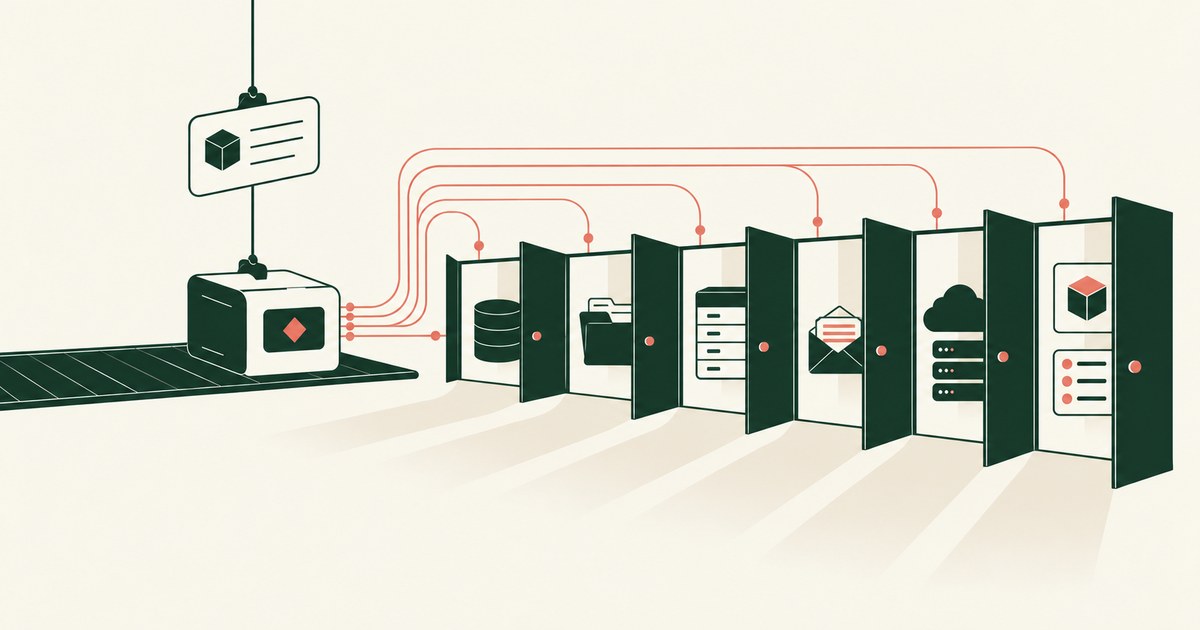
What Is an Overprivileged AI Agent?
Review an Overprivileged AI Agent, with AI agent security, tokenization and approval checks for sensitive enterprise workflows.

Accountable AI and Workflow Governance
Explore AI agent governance for billing and claims, with named supervisors, data masking, approval boundaries and a useful audit record.

What Is Least Exposure?
Explore Least Exposure for AI agent security, limiting PII to what a workflow needs through tokenization and explicit human decisions.

What Is Render-Layer Tokenization?
Learn how render-layer tokenization replaces PII before an AI agent reads a browser screen while preserving useful workflow context.

What Is Supervised Delegation?
Explore supervised delegation for AI agents in billing and claims, with named responsibility, tokenization policies and human approvals.

What Is an AI Control Record?
Explore an AI agent control record for billing and claims, linking permissions, tokenization decisions, approvals and audit evidence.
Book an AI Agent Security Review →
Bring your hardest questions.
Bring one sensitive workflow and the decisions your team needs to keep in its hands.
Book a demoAbout the author

Chris Sowa is a founder of RedactSure and a former CEO of an AI company; he started it years before ChatGPT existed. He previously led AI at Accenture, served as Global VP of Strategy & Innovation at Schneider Electric, was CCO of Sovos, and spent more than a decade at Oracle, with earlier roles at SAP and IBM.