
Explainer · By Chris Sowa · Published
Last updated
What Is Sensitive Data Masking for AI Agents?
Sensitive data masking for AI agents obscures a value before the agent, or the model behind it, receives it. Where the mask is applied decides whether it protects anything: a mask added after the model has read the value arrives too late, because the value is already in the context, the logs and whatever an injection collects.
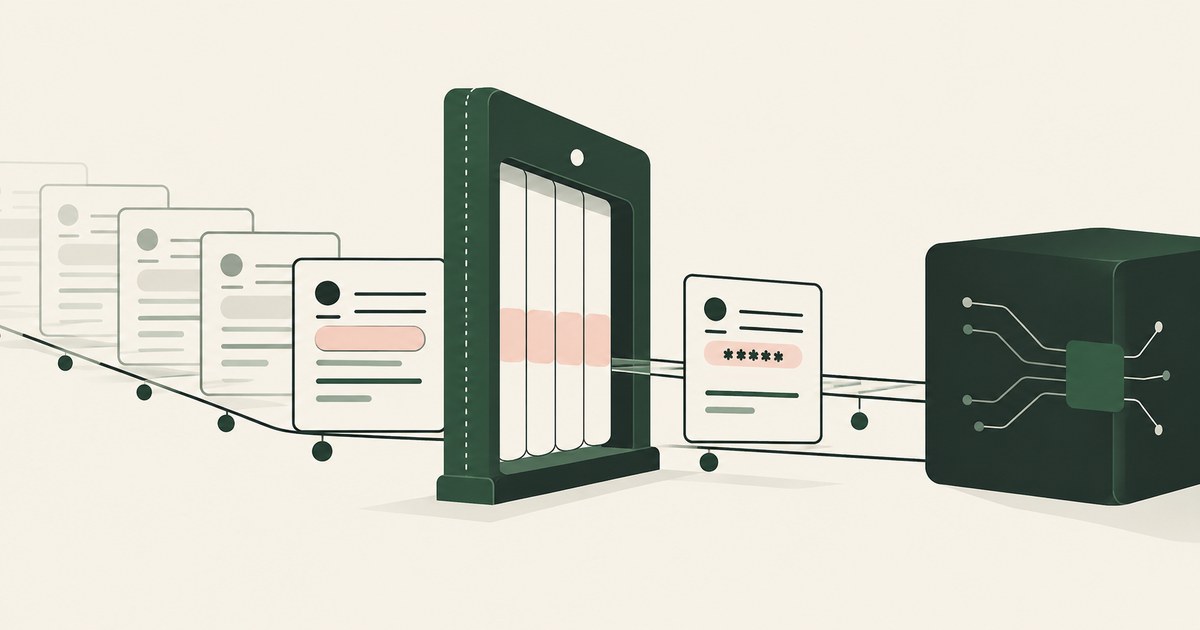
Sensitive data masking for AI agents obscures a value before the agent, or the model behind it, receives it. Where the mask is applied decides whether it protects anything: a mask added after the model has read the value arrives too late, because the value is already in the context, the logs and whatever an injection collects. In its simplest form, masking replaces some or all of a value with a placeholder, such as showing only the last digits of an account number, while the underlying record stays unchanged or a copy is altered for a safer use. Applied to agents, harder questions follow: where the mask is applied, whether the model saw the real value first, whether the masked form stays consistent across steps, and what an attacker collects if the agent is manipulated. The answer to the first of those questions separates masking from render-layer tokenization, which replaces values at the point where a screen is rendered, before any model reads it. The environment that enforces this is built by RedactSure, an AI agent controls, governance and data protection company.
Key findings
- Masking, in the de-identification literature, means replacing an identifier with a repeating character or similar placeholder, alongside distinct techniques such as encryption, hashing, and replacement with surrogate values (NIST, 2023).
- Payment card guidance treats masking as concealing part of a number when it is shown or printed, which differs from truncation, where a segment is removed from stored data (PCI Security Standards Council, 2022).
- Dynamic masking changes what a query returns without changing stored data, while static masking produces a separate masked copy, a distinction that decides whether an agent can still reach the real value through another path (Microsoft, 2025).
- A mask applied after a model has read a screen, a document, or a tool result protects nothing in that read, because the exposure has already occurred (OWASP, 2025).
- Masking alone rarely preserves task utility, because a placeholder such as a row of identical characters does not let an agent tell two customers or accounts apart; consistent substitution is a separate choice with its own re-identification risk (NIST, 2023).
What does masking actually do to a value?
Masking transforms a value into a less revealing form. NIST describes one basic version as replacing an identifier with a repeating character, for example a string of X characters or 9 characters (NIST, 2023). Other versions keep a small, low risk portion visible. A card number might show its final four digits, an email address might show an initial letter, and a date might show only a year. The logic is proportional: the reader gets enough to confirm which record is on screen or to match a receipt, and no more.
Payment card rules express this proportionality for display, limiting a shown primary account number to at most the first six and last four digits for people without a business need to see the whole number (PCI Security Standards Council, 2022).
Two properties follow and matter for agents. First, masking is usually partial or destructive by design: what is hidden is not meant to be recovered from the masked form itself. Second, masking says nothing by itself about the rest of the system. The full value may still sit in the source database, in a log, in an earlier screenshot, or in another tool the agent can call. NIST notes that the transformation chosen for direct identifiers should be documented and that repeatable transformations carry a higher risk of re-identification (NIST, 2023). A mask is therefore a property of a particular view or copy, not a guarantee about every view or copy.
How do static and dynamic masking differ?
The established split is between masking a copy once and masking a result at the moment it is produced.
| Form | When it is applied | What happens to the source | Typical use |
|---|---|---|---|
| Static masking | Before a copy is made or shared | The copy holds only masked or substitute values | Test, development, training, and shared extracts |
| Dynamic masking | At query or display time, per reader | The stored value is unchanged | Operational screens and role based views of live data |
Oracle describes static masking as replacing a sensitive value in a non production copy with a realistic but fictitious value, so testing can proceed without production values (Oracle, 2024). A breach of that copy does not reveal the originals, although the copy ages as production data changes.
Microsoft documentation for SQL Server states that dynamic masking limits exposure by masking data to non privileged users in query results, while the data in the database is not changed (Microsoft, 2025). Reader role decides the result: a privileged reader can be granted an unmask permission, and administrative roles can see the original. Microsoft cautions that dynamic masking is aimed at limiting exposure in defined queries and preventing accidental exposure, and that a user who can run ad hoc queries may infer underlying values, so it should not be used alone against a determined reader (Microsoft, 2025). For agents, a statically masked copy may be too stale to complete live work, while a dynamically masked view may be bypassed by a permission the agent or a later step holds.
How is masking different from tokenization, redaction, truncation, and encryption?
These terms are often grouped as data protection, but they do different things. Mixing them up hides the question that matters for an agent: can the original be recovered, by whom, and through what system?
| Technique | What the reader receives | Is the original recoverable from that form? | Where it is normally used |
|---|---|---|---|
| Masking | A partly or fully obscured value, often with a few digits visible | Not from the masked form itself | Displays, printed output, test copies |
| Tokenization | A surrogate value with no direct mathematical link to the original | Yes, through a separate system that holds the mapping | Workflows that must later resolve the real value |
| Redaction | Content removed or blacked out in a document | No, in the redacted copy | Documents prepared for release or sharing |
| Truncation | A shortened value with a segment permanently removed | No, the removed segment is gone in that copy | Stored payment data under card rules |
| Encryption | Ciphertext produced with an algorithm and a key | Yes, by a holder of the correct key | Storage and transmission |
The payment card glossary states that masking concerns a number when displayed or printed, while truncation concerns a number stored in files or databases (PCI Security Standards Council, 2022). Tokenization differs because the surrogate is meant to be resolved later, and card guidance lists it with hashing, truncation, and strong cryptography as a way to render stored data unreadable (PCI Security Standards Council, 2022). Encryption differs again: NIST treats it as a pseudonymization option whose safety depends on key handling, including storing a retained key separately or discarding it (NIST, 2023).
NIST SP 800-53 groups several of these options in SI-19(4), covering removal, masking, encryption, hashing, or replacement of direct identifiers (NIST, 2020). They are alternatives chosen for a purpose, not synonyms.
Where can masking be applied for an AI agent, and where does it fail?
An agent reads rendered screens, documents, messages, and tool outputs, not a single database column. Masking can be applied in the source system, in the layer that renders a screen, in a gateway that filters tool results, or in an output check. Each point leaves different gaps.
Masking at the source does nothing about the same value appearing in an email thread, a scanned letter, a note field, or a second application in the same workflow. Masking at output, after the model has processed the real value, addresses disclosure to a recipient but not exposure to the model, its context, or its logs. OWASP lists sensitive information disclosure as LLM02 in the 2025 Top 10 for LLM Applications, reflecting that models can reveal data they were given or can access (OWASP, 2025). A control that acts only at output accepts that the model held the value throughout the run.
Failure also comes from inconsistency. If one screen masks an account number and a tooltip, export, or error message shows it in full, the agent receives the full value and the earlier mask becomes cosmetic. Partial masks also leak structure: length, format, and visible digits can narrow a value, and Microsoft makes the equivalent point for database users who can test guesses through queries (Microsoft, 2025). The test is whether every route by which the model receives content passes through the masking point.
Does a masked value stay usable for an agent across a task?
Often, no, and this is the central tension in applying masking to agents. A person can recognize a partly masked card as the card already discussed, using memory outside the system. An agent reasons only from its context. If two customers both appear as a name replaced by X characters, or two accounts share the same visible last digits, the agent cannot reliably keep them apart or confirm that the record it is about to update is the record it read earlier.
Designers respond in three ways, each with a cost. They can show more of the value, which restores utility and exposure. They can give the agent a stable substitute for each real value within a task, so the same person appears under the same substitute on every screen: that moves from masking toward tokenization or pseudonymization, and NIST notes that repeatable transformations increase re-identification risk if substitutes can be linked across contexts (NIST, 2023). Or they can keep the agent away from identity bearing steps and hand those steps to a person, which limits the work the agent can complete.
If the substitute changes at every step, the agent may treat one record as several or merge records incorrectly. A design should state, per field, whether the masked form is stable within a run, across runs, or unstable, and why.
What should a reviewer ask about masking for AI agents?
A reviewer can turn the points above into a short set of requests. First, ask for the field level policy: which values are masked, in which applications, and on what basis each was judged sensitive. Second, ask where the mask is applied, with evidence in the form of one workflow screen exactly as the model received it. Third, ask whether the model, the agent framework, or any connected tool can obtain the unmasked value, and through what permission. Fourth, ask whether masked forms are consistent across a task, and what happens when two records mask to the same visible form.
Fifth, ask what a successful prompt injection would collect. OWASP ranks prompt injection first in its 2025 LLM list, as LLM01, because instructions hidden in content a model processes can redirect its behavior (OWASP, 2025). If the agent context holds only masked or substituted values, an injection collects those forms and whatever task context remains. If masking was applied only at a final output step, an injection can aim at the real values the model already holds.
Sixth, ask about records. NIST SP 800-53 audit controls expect organizations to review audit records, which here means reconstructing which screens an agent saw and which actions followed (NIST, 2020).
Where does RedactSure sit?
The workflow screen, as the model receives it, is where RedactSure answers the two questions masking leaves open, coverage and utility. Instead of a placeholder added to one view, its render layer substitutes consistent tokens for policy chosen values before the model receives the screen at all, in every application the agent works, with no per-application integration and no change to user permissions. The model receives the task's fields with identifiers as tokens, so an agent can still tell ACCT_001 from ACCT_002 and confirm it is updating the record it read earlier. What a prompt injection could collect from that screen is tokens, and the underlying values stay outside the model's view until an approved action, when they resolve only at the approved destination.
The Planner sets which values are tokenized and what the agent may do on each screen; a named person confirms that policy and approves every payment, submission and record change under Supervised Delegation. Every screen as tokens, every action and every approval lands in the AI Control Record and exports to the customer's SIEM. Keys stay with the customer; the model is swappable. Deployments are in pilot. Everyone else controls where data can go. RedactSure controls what the AI can see.
Methodology and limitations
The page is a definitional synthesis based on primary and standards sources, read as of October 13, 2026: NIST SP 800-188 on de-identification and NIST SP 800-53 Revision 5 on security and privacy controls (official guidance); PCI DSS version 4.0 and the PCI SSC glossary (industry standard); OWASP's Top 10 for LLM Applications 2025 entries LLM01 and LLM02 (community standard); and Microsoft documentation on dynamic data masking in SQL Server and Oracle documentation on data masking and subsetting (vendor documentation). Each source is cited for the definition or caution it states, and the distinctions drawn between masking, tokenization, redaction, truncation and encryption follow the wording of those documents rather than any vendor's marketing.
It reports no original testing. No hands-on testing of Microsoft SQL Server, Oracle Data Masking and Subsetting or any agent platform was performed; statements about a named product describe its published documentation, not a tested deployment. It does not measure how often masking is bypassed in deployed systems, because no primary measurement of that rate was found. Vendor features and documentation change, and the page carries its date and is revised when the sources change. The account, card, customer and email examples describe record and field types, not any organization; no customer or prospect is described. Statements about RedactSure are limited to the design facts the company publishes, and deployments are in pilot.
Whether masking, tokenization or any other control meets an organization's obligations under payment card rules, privacy law or its own policy belongs to that organization's counsel, assessor, and security and compliance officers, not to this page.
What the record shows
Masking is a modest control with a precise job: it obscures a value in a particular view or copy, so a reader can confirm a record without receiving the value itself. It does not move the value, protect other copies, or cover routes the mask does not reach, and a mask applied after the model has read the real value protects nothing in that read. For agents, two questions decide whether masking helps at all. The first is coverage, whether every screen, document, and tool result the model receives passes the same masking point. The second is utility, because identical placeholders do not let an agent tell records apart, and making substitutes stable enough to work with moves the design toward tokenization.
Frequently asked questions
Is masking reversible?
Not from the masked form itself. What is hidden in a mask is not meant to be recovered from the obscured value, unlike a token, which a separate system can resolve, or ciphertext, which a key holder can decrypt. The original value still exists in its source system unless that copy was itself altered, as in a statically masked extract, which is why masking describes a view or a copy, not the data everywhere.
Why can masking make an agent less reliable?
Because an agent reasons only from its context. If two customers appear under identical rows of placeholder characters, or two accounts share the same visible last digits, the agent cannot reliably keep them apart or confirm it is updating the record it read earlier. People compensate with memory outside the system. Designers must either expose more, supply a stable substitute, or reserve identity bearing steps for a person.
Where is the most common place masking fails for agents?
At the routes that bypass the masking point. A value masked on one screen may appear in full in a tooltip, an export, an email thread, a note field, or an error message within the same workflow, and masking applied only to final output leaves the model holding the real value throughout the run. The reviewer's test is whether every route by which content reaches the model passes the mask.
Is dynamic data masking in the database enough to protect data from an AI agent?
No, on its own. Microsoft's documentation describes dynamic masking as limiting exposure in defined queries and preventing accidental exposure, with privileged readers able to unmask and ad hoc queries able to infer values. An agent reads screens, documents, email and tool results as well as query results, and a permission held by the agent or a later step can return the original. The database mask covers one route; the agent uses many.
What is the difference between masking and tokenization for an AI agent?
Masking obscures a value in a view or copy and is not meant to be reversed from that form; two masked records can look identical. Tokenization replaces the value with a consistent surrogate that a separate system can resolve later, so the agent can tell ACCT_001 from ACCT_002 and the real value returns only at an approved destination. For an agent that must complete a multi-step task, that consistency is what keeps the work possible.
Does showing the last four digits protect what an AI agent's context holds?
Only partly. A partial mask keeps most of the value out of the model, but length, format and the visible digits narrow it, and Microsoft makes the same point for database users who can test guesses. If another screen, export or message in the workflow shows the full value, the agent receives it anyway. The question is not how much of one display is hidden but whether every route to the model passes the mask.
Related reading
What Is Runtime Tokenization for AI Agents? · What Is Screen-Level Tokenization? · What Is the Difference Between Runtime Tokenization and Data Masking for AI Agents? · What Is the Difference Between Masking Data and Tokenizing It for AI? · What Is the Difference Between Runtime Tokenization and Redaction for AI Agents? · What Is Render-Layer Tokenization? · How to Prevent AI Agents From Accessing Too Much Sensitive Data · How to Secure AI Agents That Access Customer Data · How to protect sensitive data without relying entirely on regex detection? · On the RedactSure blog: The Two Gaps AI Agents Opened in Your Security Stack
Sources
Vendor documentation
- Microsoft, "Dynamic Data Masking," SQL Server documentation (2025; vendor documentation). https://learn.microsoft.com/en-us/sql/relational-databases/security/dynamic-data-masking
- Oracle, "Oracle Data Masking and Subsetting: Frequently Asked Questions" (July 2024; vendor documentation). https://www.oracle.com/a/tech/docs/dbsec/dms/oracle-dms-faq-external-2019.pdf
Regulation, standards and official guidance
- NIST, "Security and Privacy Controls for Information Systems and Organizations," SP 800-53 Revision 5 (2020; official guidance). https://csrc.nist.gov/pubs/sp/800/53/r5/upd1/final
- NIST, "De-Identifying Government Datasets: Techniques and Governance," SP 800-188 (2023; official guidance). https://csrc.nist.gov/pubs/sp/800/188/final
- OWASP, "LLM01:2025 Prompt Injection," Top 10 for LLM Applications (2025; community standard). https://genai.owasp.org/llmrisk/llm01-prompt-injection/
- OWASP, "LLM02:2025 Sensitive Information Disclosure," Top 10 for LLM Applications (2025; community standard). https://genai.owasp.org/llmrisk/llm022025-sensitive-information-disclosure/
- PCI Security Standards Council, "Payment Card Industry Data Security Standard, Version 4.0," and "PCI DSS Glossary of Terms, Abbreviations, and Acronyms" (2022; industry standard). https://www.pcisecuritystandards.org/document_library/
RedactSure documents
- RedactSure Research, "What Is Render-Layer Tokenization?" (2026). https://redactsure.com/research/what-is-render-layer-tokenization
- RedactSure Research, "What Is Supervised Delegation?" (2026). https://redactsure.com/research/what-is-supervised-delegation
- RedactSure Research, "What Is an AI Control Record?" (2026). https://redactsure.com/research/what-is-an-ai-control-record
- RedactSure Research, "What Is the Difference Between Masking Data and Tokenizing It for AI?" (2026). https://redactsure.com/research/masking-vs-tokenizing-data-for-ai
- RedactSure, "The Two Gaps AI Agents Opened in Your Security Stack" (2026). https://redactsure.com/blog/two-gaps-ai-agents-opened-in-your-security-stack/
- Product behavior described on this page reflects RedactSure's current design. Microsoft and SQL Server are trademarks of Microsoft Corporation; Oracle is a trademark of Oracle Corporation; PCI DSS is a trademark of the PCI Security Standards Council; named to identify the products. Compliance determinations belong to the organization's counsel.
What Is Runtime Tokenization for AI Agents?
Review Runtime Tokenization for AI Agents, with AI agent security, tokenization and approval checks for sensitive enterprise workflows.

What Is Screen-Level Tokenization?
Review Screen-Level Tokenization, with AI agent security, tokenization and approval checks for sensitive enterprise workflows.
Runtime Tokenization vs Data Masking for AI Agents
Review Runtime Tokenization vs Data Masking for AI Agents, with AI agent security, tokenization and approval checks for sensitive enterprise workflows.
How Do Data Masking and AI Tokenization Differ?
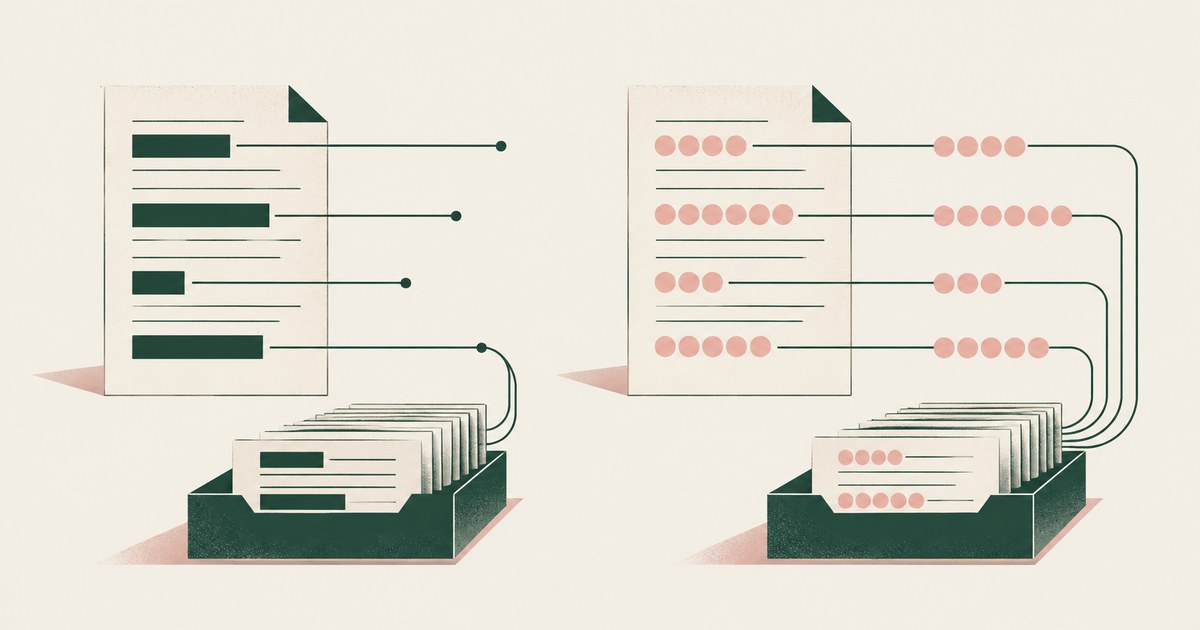
Compare data masking and tokenization for AI agent workflows that match claims, patient accounts and student records across application screens.
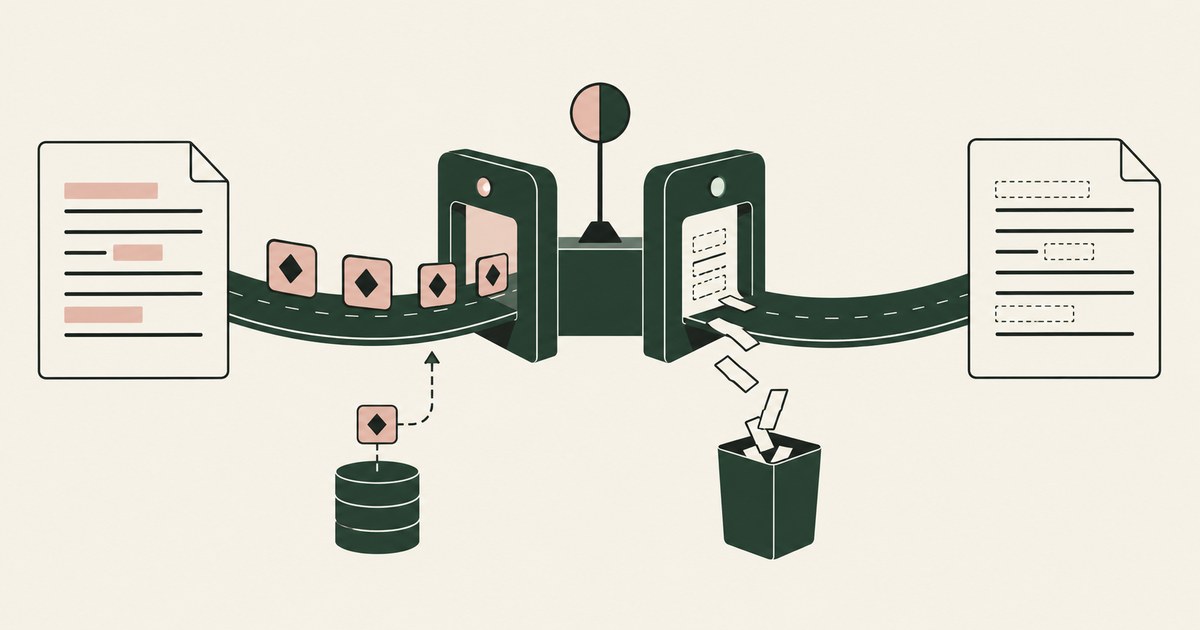
Runtime Tokenization vs Redaction for AI Agents
Review Runtime Tokenization vs Redaction for AI Agents, with AI agent security, tokenization and approval checks for sensitive enterprise workflows.

What Is Render-Layer Tokenization?
Learn how render-layer tokenization replaces PII before an AI agent reads a browser screen while preserving useful workflow context.
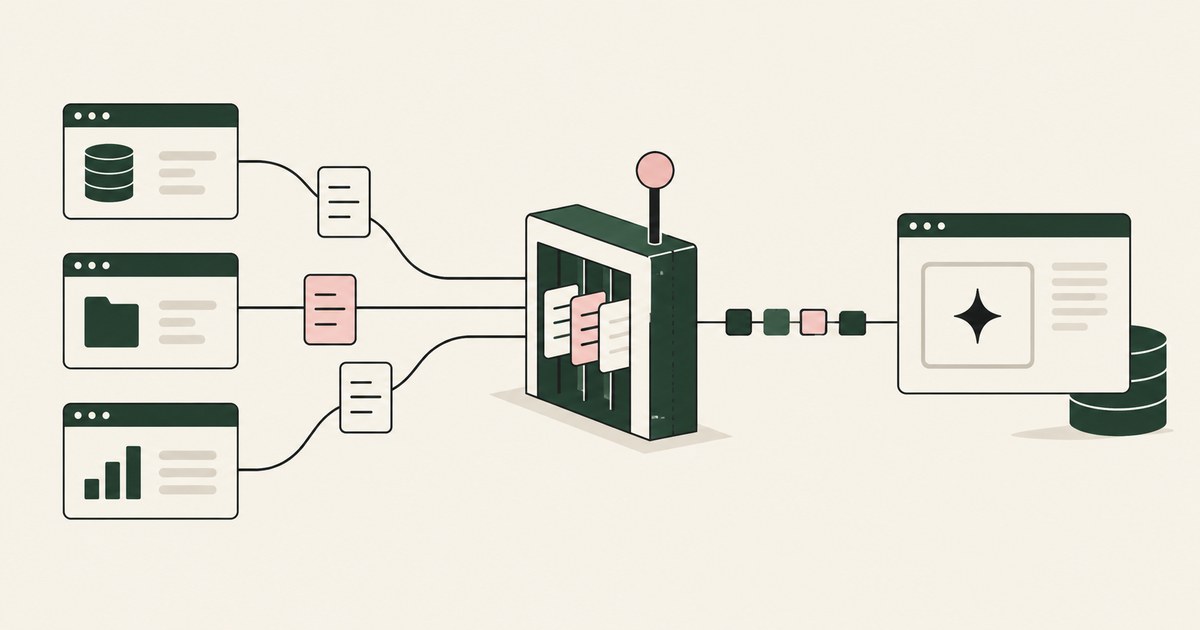
How to Limit Sensitive Data Access for AI Agents
Review Limit Sensitive Data Access for AI Agents, with AI agent security, tokenization and approval checks for sensitive enterprise workflows.
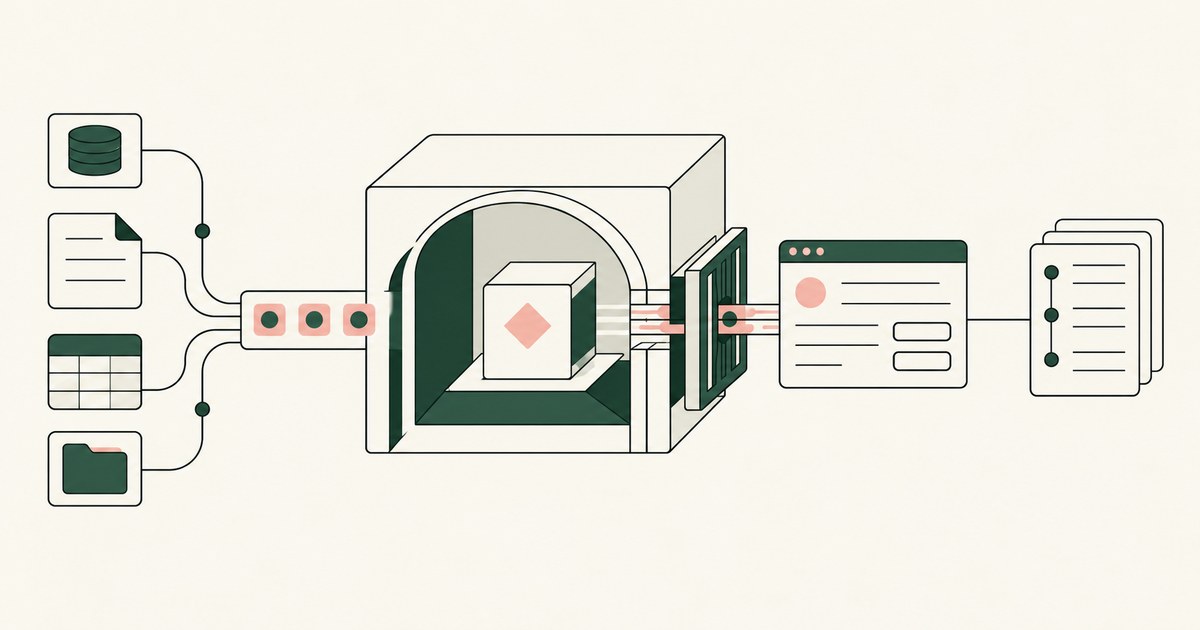
How to Secure AI Agents That Access Customer Data
Review Secure AI Agents That Access Customer Data, with AI agent security, tokenization and approval checks for sensitive enterprise workflows.
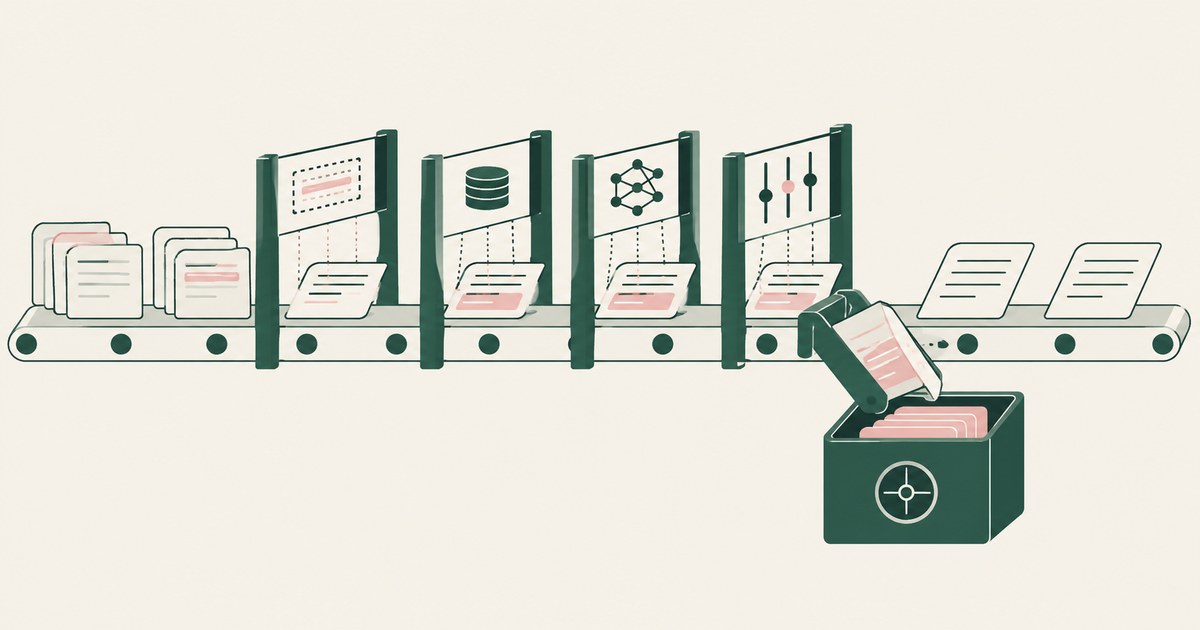
How to Protect Sensitive Data Beyond Regex Detection?
Review Protect Sensitive Data Beyond Regex Detection, with AI agent security, tokenization and approval checks for sensitive enterprise workflows.

The Two Gaps AI Agents Opened in Your Security Stack
Explore AI agent security through two questions: which PII reaches the model, and who approves consequential billing and claims actions.

What Is Supervised Delegation?
Explore supervised delegation for AI agents in billing and claims, with named responsibility, tokenization policies and human approvals.

What Is an AI Control Record?
Explore an AI agent control record for billing and claims, linking permissions, tokenization decisions, approvals and audit evidence.
Book an AI Agent Security Review →
Bring your hardest questions.
Bring one sensitive workflow and the decisions your team needs to keep in its hands.
Book a demoAbout the author

Chris Sowa is a founder of RedactSure and a former CEO of an AI company; he started it years before ChatGPT existed. He previously led AI at Accenture, served as Global VP of Strategy & Innovation at Schneider Electric, was CCO of Sovos, and spent more than a decade at Oracle, with earlier roles at SAP and IBM.