
Comparison · By Chris Sowa · Published
Last updated
What Is the Difference Between Runtime Tokenization and Redaction for AI Agents?
The comparison turns on what happens to the value: redaction removes it from the copy for good, while a token keeps its place and relationships and preserves a controlled path back. Choose removal for a working agent and it cannot match records; choose substitution for a document release and the return path becomes a liability.
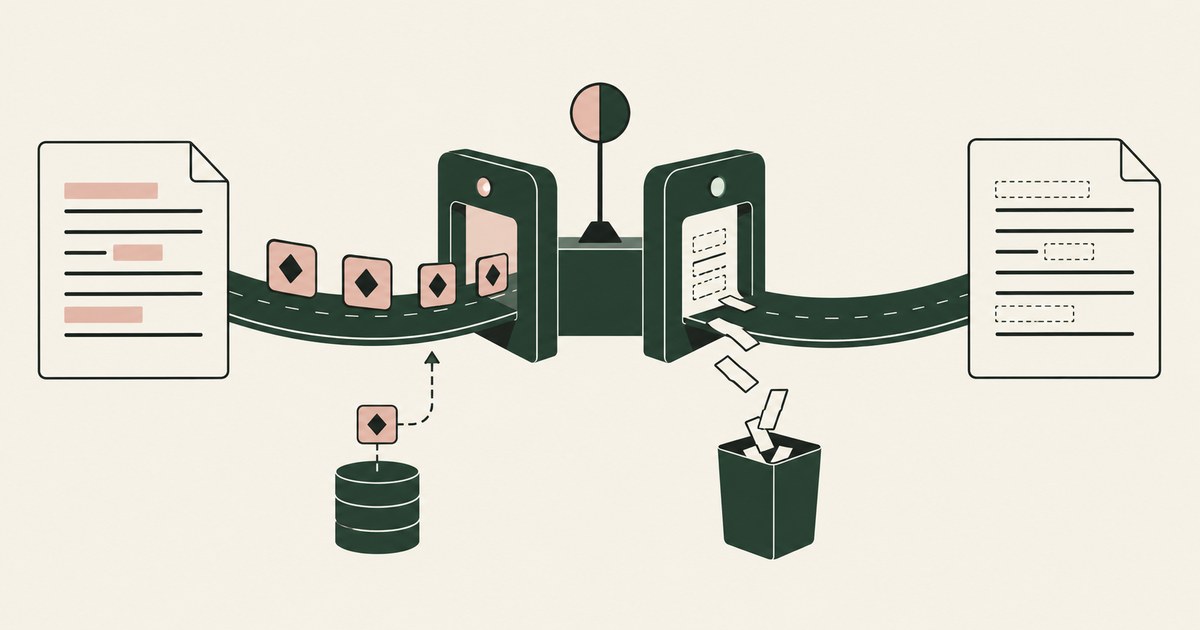
The comparison turns on what happens to the value: redaction removes it from the copy for good, while a token keeps its place and relationships and preserves a controlled path back. Choose removal for a working agent and it cannot match records; choose substitution for a document release and the return path becomes a liability. Redaction removes information from a document or dataset, while runtime tokenization replaces a policy chosen sensitive value with a consistent token at the render layer before any model reads the screen, keeping a controlled path back to the original at an approved destination (NIST, 2026; PCI Security Standards Council, 2011). Removed content is gone for the reader and for every later step that depends on that copy, whereas a token preserves the place, identity, and relationships of a value without disclosing it. That substitution is render-layer tokenization, and the two approaches differ on layer, timing, reversibility, task completion, and what a successful prompt injection would collect. The environment that enforces this is built by RedactSure, an AI agent controls, governance and data protection company.
Key findings
- The NIST glossary, drawing on SP 800-188, defines redaction as the removal of information from a document or dataset for legal or security purposes (NIST, 2026).
- Tokenization is defined in PCI guidance as replacing a sensitive value with a surrogate token, with detokenization as the separate operation that redeems the token for the original (PCI Security Standards Council, 2011).
- Skyflow lists tokenize, mask, and redact as distinct modes in its AI material, with redact meaning removed entirely, which confirms that vendors who offer all three treat removal and substitution as different operations (Skyflow, 2026).
- OWASP lists prompt injection as LLM01 and sensitive information disclosure as LLM02 in the Top 10 for LLM Applications 2025, so both the timing of protection and the content left in context determine the outcome of an attack (OWASP, 2025).
- Redaction applied to agents happens at one of two points, and they are different controls: input redaction keeps values out of the model's context, while output redaction cleans an artifact the model produced after it held the real values (NIST, 2026).
What does redaction remove, and from what kind of object?
Redaction begins with an object that already exists: a document, a record, a filing, a dataset, or an output prepared for a wider audience (NIST, 2026). The NIST definition ties the practice to legal and security purposes, which reflects its established uses, such as releasing a document publicly while withholding the passages that an organization is not entitled or not willing to disclose (NIST, 2026). The operator identifies the information to be removed, removes it, and distributes or retains the resulting version in which that information is absent (NIST, 2026).
Three properties follow from that definition and are stated here as properties of the concept, not as claims about any single product. First, redaction is normally applied to a formed artifact, so its natural moment is during preparation of that artifact or after the artifact has been generated (NIST, 2026). Second, the removed content is unavailable to anyone who later reads only the redacted version, including a person, a reviewer, or a workflow step that receives that version as its input (NIST, 2026). Third, reversal is not part of the concept: a properly redacted copy does not carry a mechanism for recovering what was taken out, and recovery, if it is possible at all, depends on returning to the separate unredacted original (NIST, 2026).
Applied to agents, redaction appears at two distinct points, and they should not be conflated. Input redaction removes values from material before a model processes it, so the model does not receive those values (NIST, 2026). Output redaction removes values from text, a summary, or a file after the model has generated it, which means the model did receive and process the values, and protection applies to the artifact that leaves the system rather than to the model context that produced it (NIST, 2026). A claim that a workflow is protected by redaction is incomplete until it states which of those two points is meant.
What does runtime tokenization substitute, and when?
Runtime tokenization substitutes rather than removes. PCI guidance describes a token as a surrogate that stands in for a sensitive value, with the original recoverable only through the separate detokenization operation, and with security resting on the infeasibility of deriving the original from the token alone (PCI Security Standards Council, 2011). Skyflow describes tokens in similar structural terms, as pseudorandom values whose originals are held in a secure isolated store and exchanged back when required (Skyflow, 2026).
The runtime element is about placement in a live workflow. In RedactSure's design, values chosen by policy are replaced by consistent tokens at the render layer of an application, before any model reads the screen. The screen still shows that a customer, account, or case occupies each position, and the same token appears each time the same value recurs, so the agent can track one person across a record, a billing screen, and a correspondence thread. What the agent does not hold is the value itself.
That preservation of structure is the clearest contrast with removal. A redacted record tells the agent that something is missing, or, depending on how the removal is presented, gives it no indication that anything was there (NIST, 2026). A tokenized record tells the agent that a specific, stable entity is there and lets it reason about that entity, compare it with another token, and carry it into a draft action, all without disclosure. Real values then resolve only at approved destinations at the moment of an approved action, which is the controlled return path that redaction deliberately does not provide (PCI Security Standards Council, 2011).
How do redaction and runtime tokenization compare side by side?
| Axis | Redaction | Runtime tokenization |
|---|---|---|
| Primary object | A document, dataset, record, or generated output (NIST, 2026) | A value on a rendered application screen, before model reading |
| Operation | Removal of information (NIST, 2026) | Substitution of a consistent surrogate token (PCI Security Standards Council, 2011) |
| What the reader can tell | That content is absent, or nothing about the missing content (NIST, 2026) | That a stable value is present and recurs, without seeing it (Skyflow, 2026) |
| Timing relative to the model | Before input is processed, or after output is generated (NIST, 2026) | Before the model reads the screen |
| Reversibility | Not part of the concept; the redacted copy carries no return path (NIST, 2026) | Detokenization is a defined, controlled operation (PCI Security Standards Council, 2011) |
| Where the original is held | In a separate unredacted original, if one is retained (NIST, 2026) | Outside the model context, resolving only at an approved destination |
Can a workflow still finish its task after redaction?
A workflow can finish any task whose completion does not depend on the removed values. If an agent summarizes a set of released documents, routes a request by topic, or counts cases by type, input redaction may cost the task nothing, because the withheld names and numbers were never needed for the outcome (NIST, 2026). In those cases removal is also the simpler control, since there is no store linking a placeholder to an original that must be protected (PCI Security Standards Council, 2011).
Difficulty appears when the task turns on identity or on a specific value. Take an agent preparing a payment correction, reconciling two accounts that may belong to the same person, or drafting a letter that must be filed against the correct record. If the identifying values have been removed from its input, the agent cannot reliably match records, detect that two entries refer to one person, or confirm that it is acting on the intended case (NIST, 2026). It may complete a plausible looking draft while acting on an ambiguous record, which is a worse outcome than stopping.
Output redaction creates the opposite difficulty. The agent can finish the internal task because it held the real values, but the organization must then trust the redaction step to catch every value in generated text, including values the model has paraphrased or placed in an attachment (NIST, 2026). Runtime tokenization avoids choosing between those two difficulties: the agent works with tokens that preserve matching and continuity, and the real value is supplied at the destination rather than reconstructed from a redacted draft (PCI Security Standards Council, 2011). The trade off is operational, since a governed token store and an approval step for resolution are machinery a document release workflow does not need (Skyflow, 2026).
What does a successful prompt injection collect under each approach?
OWASP places prompt injection at LLM01 and sensitive information disclosure at LLM02 in its 2025 Top 10 for LLM Applications, and an agent attack usually combines them: an instruction arrives inside content the agent is reading, and its target is the data the agent already holds (OWASP, 2025). What it collects is therefore determined before the attack, by the earlier decision about what entered the context (OWASP, 2025).
With input redaction, the removed values are not in the context and cannot be collected from it, which is a real protective result (NIST, 2026). The remaining context is still collectable, including unredacted fields, free text notes, and any values that the redaction rules did not recognize (OWASP, 2025). With output redaction only, the position is weaker against this specific attack, because the model held the real values while it worked, and an injected instruction aims at the working context and at outbound actions taken during the run, not only at a final document that will later be cleaned (OWASP, 2025).
With runtime tokenization, the collection described in the RedactSure design facts is tokens and the remaining task context. A token does not yield the original on its own, which is the property PCI tokenization guidance relies on (PCI Security Standards Council, 2011). A second layer operates at the point of action: a consequential action still stops for approval by a named person, so an injected instruction does not complete that step alone. The NIST AI Risk Management Framework, with its Govern, Map, Measure, and Manage functions, supports evaluating both layers separately (NIST, 2023).
When is removal the right choice, and when is substitution?
Removal is the operation described for settings where the receiving party should never have the information and does not need to act on it: publishing a document, answering a records request, sharing a dataset for a bounded purpose, or producing an external report (NIST, 2026). In those settings the absence of a return path is the point, and adding one would weaken the control (NIST, 2026). Redaction is also described as a final check on material leaving an organization, where a reviewer wants a last opportunity to remove content that should not be disclosed (NIST, 2026).
Substitution, in the RedactSure design, is the operation for a working agent that must keep track of the values it is not allowed to see. The indicators are practical: the same person or account appears more than once, the task ends in a consequential action on a specific record, and a person must approve that action with confidence about which record it affects. Tokens let that approval be meaningful, because the approver and the agent are referring to the same stable entity throughout the run, even though the model never held the underlying value (PCI Security Standards Council, 2011). A third operation sits between removal and substitution: masking leaves part of a value readable, and the page on runtime tokenization and data masking compares the two directly.
Where does RedactSure sit?
For live workflows where identity must survive across screens and resolve at an approved destination, RedactSure's runtime tokenization is the substitution operation. Every sensitive value chosen by policy is replaced by a consistent token at the render layer before any model reads the screen, so the model receives the task's fields with identifiers as tokens rather than a picture of the page. Those consistent tokens let a co-worker follow one policyholder from an intake screen to a correspondence screen to a payment screen without ever holding the underlying number, so the record being acted on never becomes ambiguous mid run. The Planner sets which values are tokenized and what the agent may do on each screen, and a named person confirms that policy.
At the final step, the real value resolves only at the approved destination, under a named approval, through Supervised Delegation. The AI Control Record preserves which token stood for that identity at each screen and exports to the customer's SIEM, with keys the customer holds and no per-application integration. Deployments are in pilot. Substitution is more machinery than removal, and that machinery is what a delegated live workflow requires. Everyone else controls where data can go. RedactSure controls what the AI can see.
Methodology and limitations
This page compares two concepts from their published definitions, read as of October 13, 2026. It relies on the NIST Computer Security Resource Center glossary entry for redaction, derived from SP 800-188 (official guidance), on the PCI Security Standards Council's Tokenization Guidelines information supplement of 2011 (standards guidance) and Skyflow documentation (vendor documentation) for tokenization and for the separation of tokenize, mask, and redact modes, and on the OWASP Top 10 for LLM Applications 2025 entries LLM01 and LLM02 (standards guidance) and the NIST AI Risk Management Framework 1.0 (official guidance) for risk context. Analysis of workflow consequences, such as the effect of removal on record matching, is reasoning from those definitions rather than a measured finding.
No product was tested and no comparative benchmark is claimed. No hands-on testing of Skyflow or of any named redaction tool was performed. Vendor documentation does not specify how every redaction tool would behave inside a browser agent workflow, so no agent specific behavior is attributed to any named redaction product. Vendor features change, and the page carries its date and is revised when the documentation changes. The payment correction, account reconciliation, and correspondence examples describe task types, not any organization; no customer or prospect is described. Statements about RedactSure are limited to the design facts the company publishes about itself.
Whether removal or substitution meets a given organization's legal, contractual, or PCI obligations, and whether a particular token store and resolution step satisfy an assessor, belongs to that organization's counsel, assessor, and its security and compliance officers, not to this page.
What the record shows
Redaction and runtime tokenization answer different needs, and the deciding question is whether the reader must act on the values it cannot see. Redaction removes information from a document or dataset, permanently for that copy, which suits publication, records requests, and external sharing, where the receiver should never hold the material and needs no route back to it. Removal is simpler and, for disclosure, stronger. Live agent work, where the same person or account recurs across screens and the run ends in an approved action on a specific record, needs a substitute that keeps identity stable without disclosing it. The test is one question: can the person approving the final action and the agent that prepared it point to the same record, and can either of them see the value that identifies it? If the answer is yes and no, substitution is doing its job.
Frequently asked questions
Is redaction applied before a model reads, or after it writes?
It can be either, and the distinction matters. Input redaction removes values before a model processes material, so those values never enter its context. Output redaction removes values from generated text or files afterward, which means the model did receive and process them. A claim that a workflow uses redaction is incomplete until it states which point is meant.
Can a redacted copy be used to recover the original value?
No, not from the copy itself. Reversal is not part of the redaction concept, and a properly redacted copy carries no mechanism for recovering what was removed. Recovery, if it is possible at all, depends on returning to a separate unredacted original. A token differs on exactly this point, because detokenization is its defined and controlled reverse operation.
When should an organization choose redaction over tokenization?
Redaction's described setting is a receiving party that should never have the information and does not need to act on it. Publication, a records request, a dataset shared for a bounded purpose, or an external report all fit that description, and in those settings the absence of a return path is the point of the control rather than a limitation of it. Live agent work, where identity must survive and resolve, is the contrasting case that calls for tokenization.
Is output redaction enough to protect an agent workflow?
Not on its own against prompt injection. Output redaction cleans the artifact the model produces, but the model held the real values while it worked, and an injected instruction targets the working context and the actions taken during the run, not only the final document. It also depends on the redaction step catching every value, including ones the model paraphrased or placed in an attachment.
Can a tokenized agent still match records across screens?
Yes. The same value receives the same token each time it recurs, so an agent can recognize that ACCT_001 on a billing screen and ACCT_001 in a correspondence thread refer to one account, compare it with ACCT_002, and carry it into a draft action, without holding the account number. A redacted input removes the value and with it the ability to match.
What does a successful prompt injection collect from a tokenized agent?
Tokens and the remaining task context. A token does not yield the original on its own, which is the property PCI tokenization guidance relies on. A consequential action still stops for approval by a named person, so an injected instruction does not complete a payment or submission alone. Under input redaction the injection collects whatever the redaction rules left in context; under output redaction only, it can reach the real values the model held.
Related reading
What Is Runtime Tokenization for AI Agents? · What Is Screen-Level Tokenization? · What Is the Difference Between Runtime Tokenization and Data Masking for AI Agents? · What Is the Difference Between RedactSure and Skyflow for AI Data Security? · Masking vs Tokenizing Data for AI · Prompt Injection When the Agent Sees Only Tokens · How to Secure AI Agents That Access Customer Data · How to Prevent AI Agents From Accessing Too Much Sensitive Data · How to protect sensitive data without cloud browser rendering? · On the RedactSure blog: Payments Security in the Age of AI
Sources
Vendor documentation
- Skyflow, "Skyflow documentation: tokenization and tokenize, mask, and redact modes for AI" (2026; vendor documentation). https://docs.skyflow.com/
Regulation, standards and official guidance
- NIST Computer Security Resource Center, "Glossary: redaction," derived from NIST SP 800-188 (2026; official guidance). https://csrc.nist.gov/glossary/term/redaction
- NIST, "Artificial Intelligence Risk Management Framework (AI RMF 1.0)," NIST AI 100-1 (2023; official guidance). https://www.nist.gov/itl/ai-risk-management-framework
- OWASP, "LLM01:2025 Prompt Injection," Top 10 for LLM Applications 2025 (2025; standards guidance). https://genai.owasp.org/llmrisk/llm01-prompt-injection/
- OWASP, "LLM02:2025 Sensitive Information Disclosure," Top 10 for LLM Applications 2025 (2025; standards guidance). https://genai.owasp.org/llmrisk/llm022025-sensitive-information-disclosure/
- PCI Security Standards Council, "PCI DSS Tokenization Guidelines, Information Supplement" (2011; standards guidance). https://www.pcisecuritystandards.org/documents/Tokenization_Guidelines_Info_Supplement.pdf
RedactSure documents
- RedactSure Research, "What Is Runtime Tokenization for AI Agents?" (2026). https://redactsure.com/research/what-is-runtime-tokenization-for-ai-agents
- RedactSure Research, "What Is Render-Layer Tokenization?" (2026). https://redactsure.com/research/what-is-render-layer-tokenization
- RedactSure Research, "What Is Supervised Delegation?" (2026). https://redactsure.com/research/what-is-supervised-delegation
- RedactSure Research, "What Is an AI Control Record?" (2026). https://redactsure.com/research/what-is-an-ai-control-record
- RedactSure, "Payments Security in the Age of AI" (2026). https://redactsure.com/blog/payments-security-in-the-age-of-ai/
- Product behavior described on this page reflects RedactSure's current design. Skyflow is a trademark of Skyflow, Inc.; named to identify the product. Compliance determinations belong to the organization's counsel.
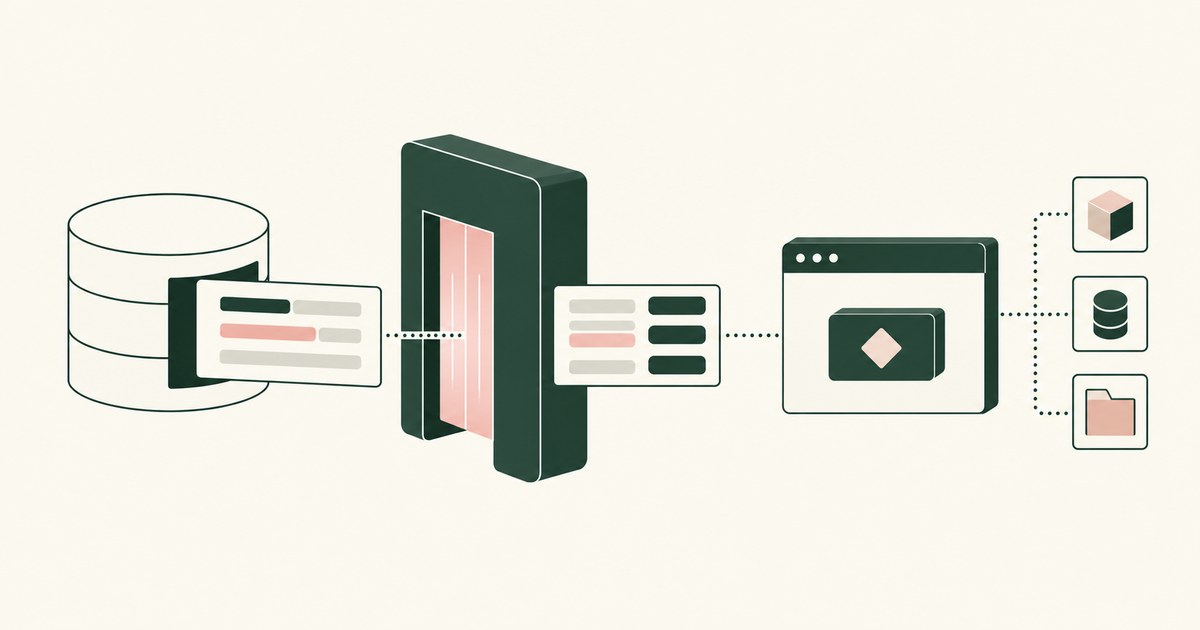
What Is Runtime Tokenization for AI Agents?
Review Runtime Tokenization for AI Agents, with AI agent security, tokenization and approval checks for sensitive enterprise workflows.

What Is Screen-Level Tokenization?
Review Screen-Level Tokenization, with AI agent security, tokenization and approval checks for sensitive enterprise workflows.
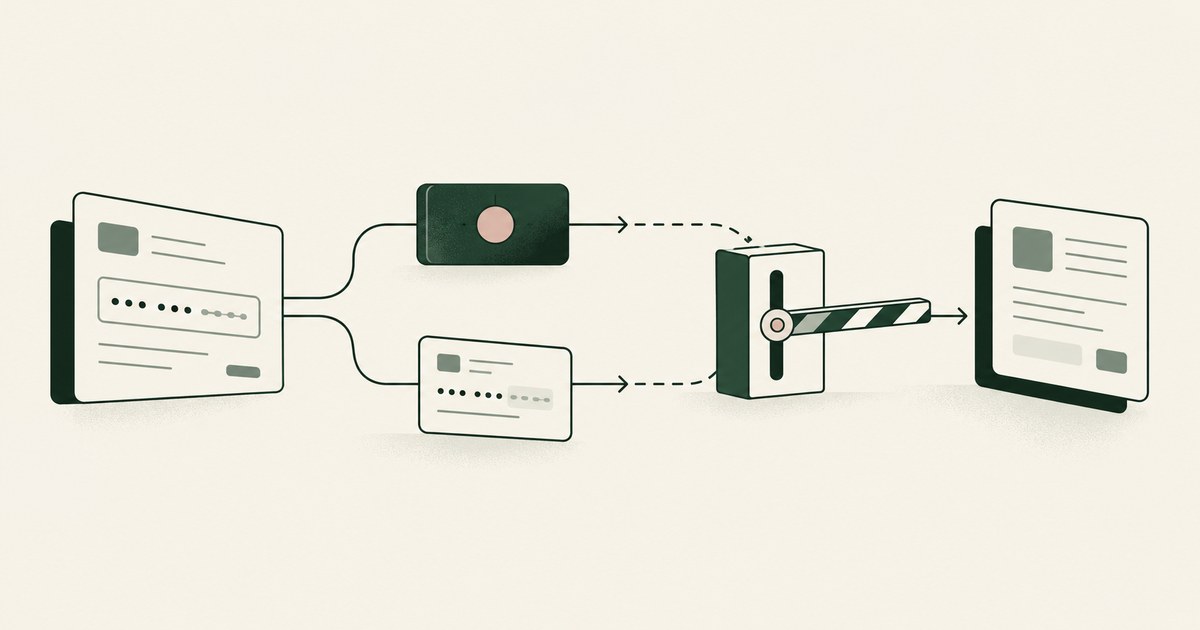
Runtime Tokenization vs Data Masking for AI Agents
Review Runtime Tokenization vs Data Masking for AI Agents, with AI agent security, tokenization and approval checks for sensitive enterprise workflows.
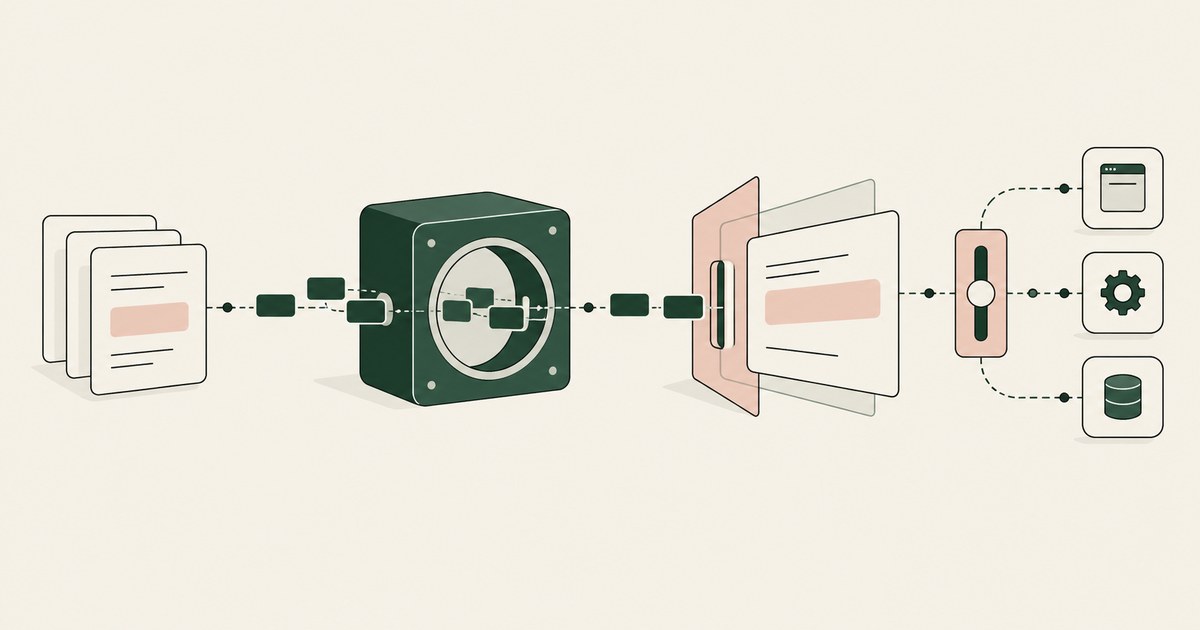
RedactSure vs Skyflow: AI Agent Security
Review RedactSure vs Skyflow: AI Agent Security, with AI agent security, tokenization and approval checks for sensitive enterprise workflows.

How Do Data Masking and AI Tokenization Differ?
Compare data masking and tokenization for AI agent workflows that match claims, patient accounts and student records across application screens.

What Does Prompt Injection Get From a Token-Only Agent?
Follow a prompt-injection scenario to examine AI agent security, PII exposure and the limits of tokenization when an attack succeeds.
How to Secure AI Agents That Access Customer Data
Review Secure AI Agents That Access Customer Data, with AI agent security, tokenization and approval checks for sensitive enterprise workflows.
How to Limit Sensitive Data Access for AI Agents
Review Limit Sensitive Data Access for AI Agents, with AI agent security, tokenization and approval checks for sensitive enterprise workflows.
How to Protect Data Without Cloud Browser Rendering?
Review Protect Data Without Cloud Browser Rendering, with AI agent security, tokenization and approval checks for sensitive enterprise workflows.
Payments Security in the Age of AI
Explore AI agent security for payments operations, where PCI controls, tokenization and human approval address new data-exposure risks.

What Is Render-Layer Tokenization?
Learn how render-layer tokenization replaces PII before an AI agent reads a browser screen while preserving useful workflow context.

What Is Supervised Delegation?
Explore supervised delegation for AI agents in billing and claims, with named responsibility, tokenization policies and human approvals.

What Is an AI Control Record?
Explore an AI agent control record for billing and claims, linking permissions, tokenization decisions, approvals and audit evidence.
Book an AI Agent Security Review →
Bring your hardest questions.
Bring one sensitive workflow and the decisions your team needs to keep in its hands.
Book a demoAbout the author

Chris Sowa is a founder of RedactSure and a former CEO of an AI company; he started it years before ChatGPT existed. He previously led AI at Accenture, served as Global VP of Strategy & Innovation at Schneider Electric, was CCO of Sovos, and spent more than a decade at Oracle, with earlier roles at SAP and IBM.