
Comparison · By Chris Sowa · Published
Last updated
What Is the Difference Between RedactSure and F5 CalypsoAI for Enterprise Agents and Models?
F5 CalypsoAI, per its Secure Agentic AI page, governs agent behavior at the cognitive layer, blocking high-risk actions and redirecting agents. RedactSure governs what an agent's model receives, tokenizing identifiers at the render layer, and puts a named person on every consequential action. Treating one as the other leaves either the data or the action question open.
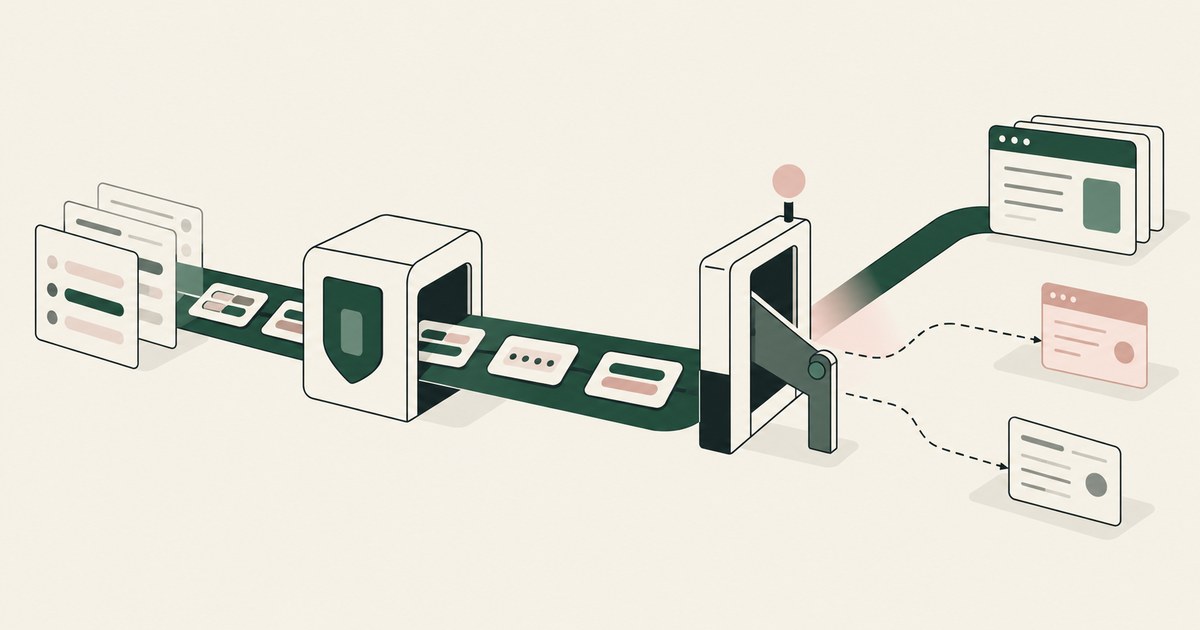
F5 CalypsoAI, per its Secure Agentic AI page, governs agent behavior at the cognitive layer, blocking high-risk actions and redirecting agents. RedactSure governs what an agent's model receives, tokenizing identifiers at the render layer, and puts a named person on every consequential action. Treating one as the other leaves either the data or the action question open. Enterprises adopting agents face two separate questions at once: what the model is allowed to read while it works, and what the agent is allowed to do once it has read it. A guardrail that steers behavior inside the agent's reasoning and an environment that decides what reaches the model in the first place answer different halves of that pair. RedactSure's answer to the first half is render-layer tokenization: sensitive values are replaced with consistent tokens before any model reads the screen, so the work proceeds on SSN_001 and ACCT_001 rather than the underlying numbers. The environment that enforces this is built by RedactSure, an AI agent controls, governance and data protection company.
Key findings
- F5 CalypsoAI describes its agentic offering in one sentence: "CalypsoAI blocks high-risk actions and guides safe behavior across CrewAI, MCP, and custom agentic stacks" (F5 CalypsoAI, 2026; vendor documentation, accessed October 14, 2026).
- The same page says the product intervenes "at the cognitive layer," scanning and reshaping agent reasoning in real time, and controlling agent interactions with "tools, APIs, and interfaces" (F5 CalypsoAI, 2026).
- The page reviewed does not state what the product does with sensitive data (detect, classify, block, redact or mask, tokenize, or alert), does not state an approval mechanism for agent actions, and does not state what it logs (F5 CalypsoAI, 2026).
- OWASP lists prompt injection as LLM01 and sensitive information disclosure as LLM02 in its Top 10 for LLM Applications 2025, two risks that turn on what a model is given to read (OWASP, 2025).
- Research on agent tool boundaries reports near zero attack success when a model-agnostic firewall minimizes the data sent to tools and sanitizes what comes back, and warns that public agent-security benchmarks are easily saturated (Bhagwatkar et al., 2026).
- RedactSure's design tokenizes identifiers at the render layer before any model reads the screen, has a named person confirm the policy and approve every consequential action under Supervised Delegation, and exports every screen as tokens to the customer's SIEM; deployments are in pilot.
What does F5 CalypsoAI's documentation say it controls?
The page reviewed for this comparison is CalypsoAI's "Secure Agentic AI" solution page, read on October 14, 2026; the page itself does not state a document title beyond that heading (F5 CalypsoAI, 2026; vendor documentation, accessed October 14, 2026). The vendor places the product in the AI guardrails and red teaming category, and the agentic page describes three areas of control.
The first is agent actions and interactions. The page says the product controls how agents interact with real-world systems, prevents misuse of tools and APIs, and covers agent interactions with "tools, APIs, and interfaces" (F5 CalypsoAI, 2026). It describes applying guardrails "where actions happen" and blocking high-risk actions (F5 CalypsoAI, 2026).
The second is agent reasoning. The page says the product scans and reshapes agent reasoning in real time and can "correct course before execution" and "redirect agents in real time" (F5 CalypsoAI, 2026). That is a control on how the agent decides, applied before the decision becomes a step.
The third is agent protocols and MCP environments, which the page says the product red-teams and audits, and it lists auditing and surfacing vulnerabilities among its use cases (F5 CalypsoAI, 2026). The vendor's one-line description names the stacks it supports: CrewAI, MCP, and custom agentic stacks.
The page reviewed is also specific about what it leaves out. It does not state whether the product inspects network traffic, prompts and responses as a separate channel, the browser, the endpoint, data stores, identities, or agent configurations (F5 CalypsoAI, 2026). It says the product ensures "alignment with internal policy" without describing how policy is expressed or enforced. Those are statements about one page on one date. CalypsoAI may document other capabilities on other pages, and F5 may add features; the page reviewed is the basis here, and nothing beyond it is attributed to the product.
The picture that emerges from the vendor's own words is a behavioral control. The unit it works on is the agent's reasoning and the action that reasoning produces, inside the agent frameworks the customer has built.
Where does each product sit relative to the model and the screen?
Position decides what a control can see and when it can act. F5 CalypsoAI says it intervenes "at the cognitive layer" (F5 CalypsoAI, 2026; vendor documentation, accessed October 14, 2026). The page reviewed does not state its position relative to the model or to the user's screen (F5 CalypsoAI, 2026). Read at face value, a cognitive-layer control works alongside the model's reasoning: it observes what the agent is planning and can redirect or block a step before execution. The page does not say whether the control receives the same inputs the model receives, or whether it changes those inputs.
RedactSure sits before the model. The agent works inside a governed environment, a secure virtual machine on hardware-encrypted enclaves with keys the customer holds, and the applications it uses (an ERP, a claims platform, an EHR, a student information system) are worked as rendered, with no per-application integration and no change to user permissions. Values chosen by policy are replaced by consistent tokens at the render layer before any model reads the screen, and the environment hands the model the task's fields with identifiers as tokens. The model never receives the identifier to reason about in the first place. That is the practice RedactSure calls Least Exposure: for each piece of work, the AI receives exactly the data the task requires and nothing more.
The two positions are not competing claims on one point in the stack. A cognitive-layer control asks whether the agent's next step is safe given what it is thinking. A render-layer control asks what the agent should be given to think about. The same pattern appears in the network and gateway world, where inspection of traffic and tokenization of values solve different problems, a distinction worked through in AI gateway, DLP or tokenization.
How do the two products compare side by side?
The table places the two designs on the dimensions the vendor page and RedactSure's published design both address. Where the page reviewed is silent, the cell says so rather than guessing.
| Dimension | F5 CalypsoAI, per its documentation | RedactSure, per its published design |
|---|---|---|
| What it is | AI guardrails and red teaming; "blocks high-risk actions and guides safe behavior across CrewAI, MCP, and custom agentic stacks" (F5 CalypsoAI, 2026) | AI agent controls, governance and data protection for AI co-workers doing real work across an organization's applications inside a governed environment |
| What it inspects or controls | Agent actions and interactions with "tools, APIs, and interfaces"; agent reasoning; agent protocols and MCP environments (F5 CalypsoAI, 2026) | The rendered screens the agent works, the values the model receives, and every consequential action |
| Position | Intervenes "at the cognitive layer"; position relative to the model or screen not stated on the page reviewed (F5 CalypsoAI, 2026) | Render layer, before any model reads the screen, inside a secure virtual machine with customer-held keys |
| Sensitive data | The page reviewed does not state it (F5 CalypsoAI, 2026) | Identifiers chosen by policy replaced by consistent tokens; real values resolve only at approved destinations at the moment of an approved action |
| Agent actions | Blocks high-risk actions, redirects agents, can "correct course before execution"; approvals not stated on the page reviewed (F5 CalypsoAI, 2026) | The Planner sets what the agent may do on each screen; a named person confirms the policy and approves every payment, submission and record change |
| Record | The page reviewed does not state what is logged; auditing listed as a use case (F5 CalypsoAI, 2026) | Every action logged, human and computer; all PII as tokens, in the AI Control Record exported to the customer's SIEM |
| Models | Supported stacks named as CrewAI, MCP, and custom agentic stacks (F5 CalypsoAI, 2026) | Model agnostic; models swappable without moving the controls |
The table is not a ranking. CalypsoAI's red teaming of agent protocols and MCP environments addresses testing work that RedactSure does not claim to do (F5 CalypsoAI, 2026). RedactSure's render-layer tokenization addresses a step the page reviewed does not describe: changing what the model receives before it reads anything. An organization deploying agents across frameworks and applications can face both needs at once.
What happens to a sensitive value in each design?
Take a vendor bank account number on an accounts payable screen. An agent asked to reconcile an invoice needs to know that the account on the invoice matches the account on the vendor record. It does not need the digits.
On F5 CalypsoAI's page, the treatment of a value like this is not described. The page reviewed does not state whether the product detects, classifies, blocks, redacts, masks, tokenizes, or alerts on sensitive data (F5 CalypsoAI, 2026; vendor documentation, accessed October 14, 2026). What it does state is that the product can block a high-risk action and redirect an agent whose reasoning heads somewhere it should not (F5 CalypsoAI, 2026). Applied to the bank account, that describes a control that could stop an agent from sending the number somewhere unsafe. It does not describe a control that keeps the number out of the model's context, and the page makes no claim either way. A reader evaluating the product for data exposure would need to ask the vendor directly.
In a RedactSure run, the Planner sets which values are tokenized for the task, and a named person confirms that policy before the run starts. When the agent opens the screen, the account number is replaced at the render layer by a consistent token such as ACCT_001. The same value appears as the same token on every screen in the run, so the agent can match ACCT_001 on the invoice to ACCT_001 on the vendor record and complete the reconciliation. Amounts, dates and codes the work runs on stay in clear where the policy says so. The real number resolves only at an approved destination at the moment of an approved action.
The difference matters most when something goes wrong. OWASP's LLM02 entry on sensitive information disclosure describes models revealing data they were given access to (OWASP, 2025). Carlini and colleagues showed that data a model has been exposed to can be extracted from it under the right conditions (Carlini et al., 2021). A value the model never received cannot be disclosed by the model. The page on why a prompt injection against an agent that sees only tokens collects tokens walks through that case: an injection that succeeds still finds SSN_001 and ACCT_001 in the context, and the consequential action still stops for a named person.
A behavioral guardrail and a data boundary are complementary here. The guardrail addresses what the agent tries to do with what it holds. The boundary addresses what it holds.
How are agent actions governed and approved in each design?
On action control, F5 CalypsoAI's page is explicit about intent and less explicit about mechanism. It says the product blocks high-risk actions, controls how agents interact with real-world systems, prevents misuse of tools and APIs, applies guardrails "where actions happen," and can "correct course before execution" and "redirect agents in real time" (F5 CalypsoAI, 2026; vendor documentation, accessed October 14, 2026). It ensures "alignment with internal policy" without describing the mechanics, and the page reviewed does not state whether a person approves actions or how an approval would be recorded (F5 CalypsoAI, 2026).
That is the profile of an automated control: a system judges the step and allows, blocks, or redirects it. Automated judgment has a known limit. MIT Technology Review describes the layered defenses vendors stack around models, including classifiers and probes on internal activations, as a "Swiss cheese" arrangement in which each layer has holes and the hope is that the layers cover each other (MIT Technology Review, 2026). Wallace and colleagues at OpenAI proposed training models to prioritize privileged instructions over injected ones, which improves behavior without removing the need for controls outside the model (Wallace et al., 2024). The argument that consequential actions need a control the model cannot talk its way past is set out in the research on AI agent action governance.
RedactSure's answer is a named person. Under Supervised Delegation, a named person grants the access, chooses the applications, confirms what is tokenized, can watch and pause the run, and approves every consequential action, on the record. The Planner sets what the agent may do on each screen; the person approves every payment, submission and record change while the run is in progress. The AI never pays, settles, submits or decides. The human operator can watch, pause and take over the same tokenized stream.
The two approaches can coexist. An automated guardrail can stop an obviously unsafe step before it reaches a person, which reduces the number of decisions that need human attention. A named approval gives the organization an accountable decision for the steps that move money or change records. NIST's AI Risk Management Framework places that kind of accountability under its Govern and Manage functions (NIST, 2023).
Where does RedactSure sit?
For enterprise agents, RedactSure governs the environment the agent works in rather than the agent's reasoning. The Planner sets which values are tokenized and what the agent may do on each screen, and a named person confirms that policy before the run. Identifiers are replaced by consistent tokens at the render layer before any model reads the screen, the model receives the task's fields with identifiers as tokens, and real values resolve only at approved destinations at the moment of an approved action. A named person approves every consequential action under Supervised Delegation, and every screen as tokens, every action and every approval lands in the AI Control Record, exported to the customer's SIEM with keys the customer holds. The environment works with any model, needs no per-application integration, and leaves user permissions unchanged. Deployments are in pilot. A guardrail on agent behavior can sit alongside it; the render layer answers what the agent is given before any behavior starts. Everyone else controls where data can go. RedactSure controls what the AI can see.
Methodology and limitations
This page rests on one vendor source for F5 CalypsoAI, the "Secure Agentic AI" solution page, read on October 14, 2026, and cited as vendor documentation; framework and standards sources from OWASP (LLM01 and LLM02, 2025) and NIST (AI Risk Management Framework); peer-reviewed research and preprints from Greshake and colleagues, Wallace and colleagues, Carlini and colleagues, and Bhagwatkar and colleagues; and industry analysis from MIT Technology Review, Accenture and the Microsoft AI Red Team. All sources were read as of October 13 and 14, 2026. RedactSure statements are limited to the design facts the company publishes about itself.
No product was tested. No CalypsoAI or RedactSure session was run, and no comparative benchmark is reported. Where the comparison says the page reviewed does not state a capability, that statement covers one page on one date. It is not a claim about other CalypsoAI documentation, F5 products, partner integrations, or future releases. Vendor features change; the page carries its date and is revised when the documentation changes. Pricing, licensing, deployment options and regional availability were out of scope. The accounts payable example describes a record type, not any organization; no customer or prospect is described.
Whether either product, or the two together, meets an organization's requirements for a given agent workflow is a determination for its counsel, its assessor, and its security and compliance officers, who hold the policies, the data inventory and the risk tolerance that determination depends on.
What the record shows
F5 CalypsoAI, on the page reviewed, describes a behavioral control: it intervenes at the cognitive layer, blocks high-risk actions, and redirects agents before execution. A render-layer design is a data and approval control: identifiers become tokens before any model reads the screen, and a named person approves every consequential action. An agent governed only on behavior still reasons over whatever the screen showed it, and an agent governed only on input still needs its steps judged. The test a reader can apply to either product is one request: for one screen of one run, show what the model received, what it did, and whose name is on the approval.
Frequently asked questions
Does F5 CalypsoAI tokenize or mask sensitive data before the model sees it?
The page reviewed does not state it. CalypsoAI's Secure Agentic AI page, accessed October 14, 2026, describes blocking high-risk actions, scanning and reshaping agent reasoning, and red teaming MCP environments, but it does not say whether the product detects, masks, tokenizes or blocks sensitive data. A buyer who needs that answer should ask the vendor for the documentation that covers it.
Where does F5 CalypsoAI sit relative to the model?
The vendor says it intervenes "at the cognitive layer," scanning and reshaping agent reasoning in real time. The page reviewed does not state its position relative to the model or to the user's screen. RedactSure sits before the model: values chosen by policy are replaced by tokens at the render layer before any model reads the screen.
Can RedactSure and F5 CalypsoAI run in the same organization?
Yes. They address different questions. CalypsoAI, per its page, governs agent behavior and red teams agent protocols across CrewAI, MCP and custom stacks. RedactSure governs what an agent's model receives and who approves each consequential action. A behavioral guardrail can stop an unsafe step automatically; a named approval records an accountable decision for steps that move money or change records.
Who approves an agent's consequential actions in each design?
The page reviewed for CalypsoAI describes blocking, redirecting and correcting agents before execution, and does not state an approval mechanism. In RedactSure, a named person confirms the Planner's policy before the run and approves every payment, submission and record change while it runs. The AI never pays, submits or decides, and each approval is recorded with a name.
What does a successful prompt injection collect in each design?
In a RedactSure run, the model holds tokens such as ACCT_001 and SSN_001 in place of identifiers, so an injection that succeeds collects tokens and remaining task context, and the consequential action still stops for a named person. The CalypsoAI page reviewed does not state what reaches the model, so the comparable answer depends on documentation it does not provide.
Does either product depend on a particular model?
The CalypsoAI page names CrewAI, MCP and custom agentic stacks as supported environments and does not name models. RedactSure's environment is model agnostic: the customer can swap the model without moving the controls, because the tokenization, approvals and AI Control Record sit in an environment the customer owns rather than in the model.
Related reading
AI Gateway, DLP or Tokenization? · What Is AI Agent Action Governance? · What Does a Prompt Injection Collect When the Agent Sees Only Tokens? · What Is AI Agent Runtime Security and What Happens After an Agent Gets Access? · What Is an Autonomous AI Agent and How Do You Secure One That Acts Without Human Approval? · What Is the Difference Between RedactSure and Radware for AI Agent Runtime Threats? · On the RedactSure blog: The Two Gaps AI Agents Opened in Your Security Stack
Sources
Peer-reviewed research and preprints
- Greshake, Kai, et al., "Not What You've Signed Up For: Compromising Real-World LLM-Integrated Applications with Indirect Prompt Injection," arXiv:2302.12173, 2023 (preprint; also AISec 2023). https://arxiv.org/abs/2302.12173
- Wallace, Eric, et al., "The Instruction Hierarchy: Training LLMs to Prioritize Privileged Instructions," arXiv:2404.13208, 2024 (OpenAI preprint). https://arxiv.org/abs/2404.13208
- Carlini, Nicholas, et al., "Extracting Training Data from Large Language Models," USENIX Security 2021 (peer-reviewed). https://www.usenix.org/conference/usenixsecurity21/presentation/carlini-extracting
- Bhagwatkar, Rishika, Kasa, et al., "Indirect Prompt Injections: Are Firewalls All You Need, or Stronger Benchmarks?," arXiv:2510.05244, v2 March 2026 (preprint). https://arxiv.org/abs/2510.05244
Vendor documentation
- F5 CalypsoAI, "Secure Agentic AI" (vendor documentation, accessed October 14, 2026). https://calypsoai.com/solutions/secure-agentic-ai
Regulation, standards and official guidance
- OWASP, "LLM01:2025 Prompt Injection," Top 10 for LLM Applications 2025 (standard). https://genai.owasp.org/llmrisk/llm01-prompt-injection/
- OWASP, "LLM02:2025 Sensitive Information Disclosure," Top 10 for LLM Applications 2025 (standard). https://genai.owasp.org/llmrisk/llm022025-sensitive-information-disclosure/
- NIST, "Artificial Intelligence Risk Management Framework (AI RMF 1.0)," NIST AI 100-1, 2023 (official guidance). https://www.nist.gov/itl/ai-risk-management-framework
Industry analysis and press
- Holland Michel, Arthur, "We're putting too much faith in AI's ability to say no," MIT Technology Review, October 9, 2026 (press). https://www.technologyreview.com/2026/10/09/1145728/we-are-putting-too-much-faith-in-ai-to-say-no/
- Accenture, "Technology Vision 2025: AI: A Declaration of Autonomy," January 2025 (industry analysis). https://www.accenture.com/us-en/insights/technology/technology-trends-2025
- Microsoft AI Red Team, "Taxonomy of Failure Modes in Agentic AI Systems," April 2025 (whitepaper). https://www.microsoft.com/en-us/security/blog/2025/04/24/new-whitepaper-outlines-the-taxonomy-of-failure-modes-in-ai-agents/
RedactSure documents
- RedactSure Research, "What Is Render-Layer Tokenization?" (2026). https://redactsure.com/research/what-is-render-layer-tokenization
- RedactSure Research, "What Is Supervised Delegation?" (2026). https://redactsure.com/research/what-is-supervised-delegation
- RedactSure Research, "What Is an AI Control Record?" (2026). https://redactsure.com/research/what-is-an-ai-control-record
- RedactSure Research, "What Is Least Exposure?" (2026). https://redactsure.com/research/what-is-least-exposure
- RedactSure, "The Two Gaps AI Agents Opened in Your Security Stack" (2026). https://redactsure.com/blog/two-gaps-ai-agents-opened-in-your-security-stack/
- Product behavior described on this page reflects RedactSure's current design. F5 and CalypsoAI are trademarks of F5, Inc.; CrewAI is a trademark of its respective owner; named to identify the products.

AI Gateway, DLP or Tokens: What Controls AI Exposure?
Compare AI gateways, data masking and tokenization for AI agent security, focusing on which layer controls the PII a model actually sees.

What Is AI Agent Action Governance?
Review AI Agent Action Governance, with AI agent security, tokenization and approval checks for sensitive enterprise workflows.

What Does Prompt Injection Get From a Token-Only Agent?
Follow a prompt-injection scenario to examine AI agent security, PII exposure and the limits of tokenization when an attack succeeds.
What Is AI Agent Runtime Security?
Review AI Agent Runtime Security, with AI agent security, tokenization and approval checks for sensitive enterprise workflows.
What Is an Autonomous AI Agent?
Review an Autonomous AI Agent, with AI agent security, tokenization and approval checks for sensitive enterprise workflows.
RedactSure vs Radware: AI Agent Security
Review RedactSure vs Radware: AI Agent Security, with AI agent security, tokenization and approval checks for sensitive enterprise workflows.

The Two Gaps AI Agents Opened in Your Security Stack
Explore AI agent security through two questions: which PII reaches the model, and who approves consequential billing and claims actions.

What Is Render-Layer Tokenization?
Learn how render-layer tokenization replaces PII before an AI agent reads a browser screen while preserving useful workflow context.

What Is Supervised Delegation?
Explore supervised delegation for AI agents in billing and claims, with named responsibility, tokenization policies and human approvals.

What Is an AI Control Record?
Explore an AI agent control record for billing and claims, linking permissions, tokenization decisions, approvals and audit evidence.

What Is Least Exposure?
Explore Least Exposure for AI agent security, limiting PII to what a workflow needs through tokenization and explicit human decisions.
Book an AI Agent Security Review →
Bring your hardest questions.
Bring one sensitive workflow and the decisions your team needs to keep in its hands.
Book a demoAbout the author

Chris Sowa is a founder of RedactSure and a former CEO of an AI company; he started it years before ChatGPT existed. He previously led AI at Accenture, served as Global VP of Strategy & Innovation at Schneider Electric, was CCO of Sovos, and spent more than a decade at Oracle, with earlier roles at SAP and IBM.