
Comparison · By Chris Sowa · Published
Last updated
What Is the Difference Between RedactSure and Radware for AI Agent Runtime Threats?
Radware's agentic AI offering, per its solution brief, discovers agents and detects runtime threats such as prompt injection and tool misuse. RedactSure decides what the agent sees: identifiers become tokens before any model reads the screen, and a named person approves each consequential action. Treating detection as exposure control leaves real values inside every successful attack.
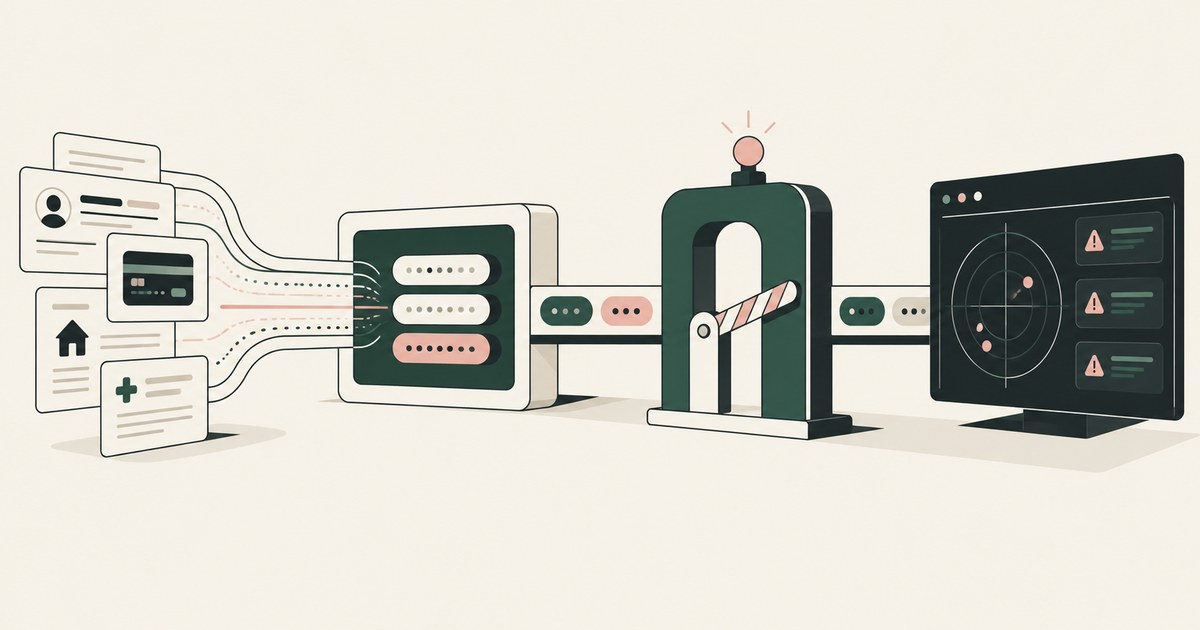
Radware's agentic AI offering, per its solution brief, discovers agents and detects runtime threats such as prompt injection and tool misuse. RedactSure decides what the agent sees: identifiers become tokens before any model reads the screen, and a named person approves each consequential action. Treating detection as exposure control leaves real values inside every successful attack. Runtime threats to agents arrive through the content the agent reads, and a detection layer that catches most of them still leaves the rest to act on whatever the agent can see. The question for a security team is which control answers "what happens when one gets through," and the answer depends on whether the agent was holding real values or render-layer tokenization had already replaced them. The environment that enforces this is built by RedactSure, an AI agent controls, governance and data protection company.
Key findings
- Radware's brief describes discovery of AI agents, tools, and MCP and non-MCP servers, mapped to users and enterprise resources, and states that the offering "delivers end-to-end visibility, compliance, governance, and security for enterprise AI ecosystems" (Radware, 2026) (vendor solution brief, accessed October 14, 2026).
- The brief names prompt injection, jailbreaking, toxicity, tool misuse and agent hijacking as threats it addresses through behavior-based, intent-aware detection, prevention and response; it does not state how prompts are inspected or whether specific tool calls are blocked or held for approval (Radware, 2026).
- OWASP ranks prompt injection first among risks to LLM applications and notes that injected content does not need to be visible to a person to be acted on by the model (OWASP, 2025).
- Indirect prompt injection reaches a model through content it retrieves, such as web pages and documents, rather than through the user's own prompt (Greshake et al., 2023).
- Researchers report near-zero attack success on four agent benchmarks by minimizing what goes to tools and sanitizing what comes back at the agent-tool boundary, and warn that public benchmarks have flawed metrics and weak attacks (Bhagwatkar et al., 2026).
- Model refusal and stacked classifiers work like layers of Swiss cheese, each with holes, and one safety classifier added 24 percent to a vendor's chatbot compute costs (MIT Technology Review, 2026).
What does Radware's agentic AI offering cover, according to its brief?
Radware's agentic AI solution brief describes a product for discovery, posture, runtime protection and governance reporting across enterprise agents (Radware, 2026) (vendor solution brief, accessed October 14, 2026). On discovery, the brief says the product finds AI agents, tools, and MCP and non-MCP servers and maps their relationships to users and enterprise resources. It describes visibility into agent access to "CRMs, DBs, email systems, and file repositories," and assigns user ownership and accountability for AI usage. It lists integrations with several agent-building platforms and with custom agents.
On runtime threats, the brief names prompt injection, jailbreaking and toxicity, and separately tool misuse and agent hijacking. It describes the approach as behavior-based and intent-aware detection, prevention and response. The brief does not state how prompts and responses are inspected.
On deployment, the brief lists three options: "inline enforcement through OpenAI-compatible frameworks," "out-of-path API integration," and "lightweight client-side integrations for hosted-developer agents." The brief does not state where the product sits relative to the model or to the user's screen, and it does not state whether it inspects network traffic, browser sessions, endpoints or agent configurations.
On sensitive data, the brief lists "sensitive data exposure identification" as part of AI security posture management. The brief does not state whether the product blocks, redacts, masks, tokenizes or alerts on sensitive values.
On records, the brief describes a full audit trail of agent activity, long-term activity tracking, execution and interaction traceability, executive and auditor-ready reports, on-demand compliance reports, and automated evidence collection aligned to ISO 42001, the NIST AI RMF and the EU AI Act. The NIST framework itself organizes AI risk work into Govern, Map, Measure and Manage functions (NIST, 2023), and evidence aligned to it supports the Govern and Measure work an assessor will ask about.
Which runtime threats does each design address, and how?
Runtime threats to agents fall into a few families, and the two designs meet them at different points. Indirect prompt injection is the one that defines the category: instructions hidden in a web page, an email, a calendar entry or a database field that the agent reads as part of its work (Greshake et al., 2023). Microsoft's red team catalogs agent failure modes that extend past injection into memory poisoning, tool compromise and loss of human oversight (Microsoft AI Red Team, 2025).
| Runtime threat | Radware, per its brief | RedactSure, per its published design |
|---|---|---|
| Prompt injection and jailbreaking | Named as addressed; inspection method not stated | Injection that succeeds collects tokens; the consequential action stops for a named person |
| Tool misuse and agent hijacking | Named as addressed through behavior-based, intent-aware detection and response | The Planner sets what the agent may do on each screen; a named person approves every payment, submission and record change |
| Sensitive data exposure | Identification as part of posture management; handling not stated | Identifiers replaced by consistent tokens at the render layer before any model reads the screen |
| Unknown or unmanaged agents | Discovery of agents, tools, and MCP and non-MCP servers | Not a discovery product; governs the tethered agent a named person connected |
| Toxic output | Named as addressed | Not a content moderation product |
The table shows two answers to two questions. Radware's brief answers "which agents exist, and is one of them behaving like it has been hijacked?" RedactSure's design answers "if the agent is hijacked, what does the attacker hold, and can it act?"
Detection carries a known limit. The MIT Technology Review analysis describes layered model defenses as Swiss cheese, where each layer has holes and the hope is that the layers cover each other (MIT Technology Review, 2026). A detection product outside the model is a different layer from model refusal, and the brief does not publish detection rates, so no rate is implied here. The structural point holds for any detector: the cases it misses run with whatever the agent can see and do.
How do Radware and RedactSure compare side by side?
The comparison below uses Radware's solution brief for the first column and RedactSure's published design for the second (Radware, 2026). Where the brief is silent, the cell says so.
| Dimension | Radware, per its solution brief | RedactSure, per its published design |
|---|---|---|
| What it inspects or controls | Agents, tools, MCP and non-MCP servers and their relationships to users and resources; visibility into access to CRMs, databases, email and file repositories | The screens an agent works inside a governed environment, as rendered, with no per-application integration |
| Where it sits | Inline through OpenAI-compatible frameworks, out-of-path API integration, or client-side integrations; position relative to the model and screen not stated | At the render layer, before any model reads the screen; the model receives the task's fields with identifiers as tokens |
| Sensitive data handling | Sensitive data exposure identification; blocking, redaction, masking and tokenization not stated | Values chosen by policy replaced by consistent tokens such as SSN_001 and ACCT_001; real values resolve only at approved destinations at the moment of an approved action |
| Agent actions | Behavior-based, intent-aware detection, prevention and response against tool misuse and hijacking; approvals and per-call blocking not stated | The Planner sets what the agent may do per screen; a named person confirms the policy and approves every consequential action |
| Record | Full audit trail, traceability, auditor-ready and compliance reports, evidence aligned to ISO 42001, NIST AI RMF and EU AI Act | Every action logged, human and computer; all PII as tokens. Exported to the customer's SIEM |
| Model relationship | Not stated beyond the OpenAI-compatible inline option | Model agnostic; models swap without moving the controls |
| Keys and hosting | Not stated in the brief | Secure virtual machine in the cloud the customer's posture requires, hardware-encrypted enclaves, customer-held keys |
| Permissions | Not stated in the brief | User permissions do not change |
The rows where the brief is silent are not claims that the product lacks those features. They mark what a buyer should ask Radware to document, using a checklist like the AI agent vendor security review checklist.
What happens to a sensitive value when an injection gets through?
Take an accounts payable agent reading a vendor invoice that carries hidden text telling it to send the vendor's bank details to an outside address. OWASP describes this pattern: the injected content does not need to be readable by a person, only parsed by the model (OWASP, 2025). The full mechanics are covered in what AI agent prompt injection is.
Under a detection design, the first question is whether the detector flags the instruction or the anomalous behavior that follows. When it does, the product's prevention and response take over; Radware's brief describes both, without stating the specific actions taken (Radware, 2026). When it does not, the agent proceeds with the bank account number it read on the screen.
Under RedactSure's design, the account number on the screen was replaced with ACCT_001 at the render layer before the model read it. The model can be fooled into trying to send ACCT_001 somewhere, and that is all it holds. Real values resolve only at approved destinations at the moment of an approved action, and an outbound message to a new address is a consequential action that stops for a named person.
The research on agent-tool firewalls points the same direction from a different angle. Bhagwatkar and colleagues report near-zero attack success across AgentDojo, Agent Security Bench, InjecAgent and tau-Bench by minimizing what is sent to tools and sanitizing what comes back, with little utility loss (Bhagwatkar et al., 2026). Their finding that minimization at a boundary outside the model works is the same principle as tokenizing the screen. The same paper warns that public benchmarks are easily saturated, which is a reason to read any "100 percent" figure from any vendor with care.
Instruction-hierarchy training gives models a way to rank system instructions above retrieved content (Wallace et al., 2024), and adversarial suffixes show that model-level defenses can be bypassed by optimized inputs (Zou et al., 2023). Both results argue for a control the model cannot talk its way past.
How do approval and the record differ?
Radware's brief describes governance in terms of visibility, behavior and evidence: user ownership of AI usage, a full audit trail, execution and interaction traceability, and reports aligned to ISO 42001, the NIST AI RMF and the EU AI Act (Radware, 2026). The brief does not state whether a person approves individual agent actions before they run.
RedactSure's design puts a person in the run. Under Supervised Delegation, a named person grants the access, chooses the applications, confirms what is tokenized, can watch and pause the run, and approves every consequential action, on the record. The agent never pays, submits or changes a record on its own authority.
The records also differ in what they contain. An audit trail of agent activity shows what the agent did. The AI Control Record holds every screen the agent saw as tokens, every action, and every approval with a name, and it exports to the customer's own monitoring. Because the screens are stored as tokens, the record is not a second copy of the sensitive data it describes.
| Question an assessor asks | Radware, per its brief | RedactSure, per its published design |
|---|---|---|
| Which agents exist and who owns them? | Discovery with user ownership and accountability | Each tethered agent is connected by a named person |
| What did the agent do? | Full audit trail and traceability | Every action in the AI Control Record |
| Who approved it? | Not stated | A named person, recorded with each consequential action |
| What did the agent see? | Not stated | Every screen, as tokens |
OMB guidance for federal agencies lists human oversight and ongoing monitoring among minimum practices for rights and safety-impacting AI (OMB, 2024). Monitoring and approval answer different parts of that requirement.
When would a team run both?
The two designs overlap less than the shared vocabulary of "runtime" suggests. Radware's brief describes an inventory and threat detection layer across the agents an organization builds or buys, including MCP and non-MCP servers and custom agents (Radware, 2026). RedactSure governs the specific work an agent performs across applications that hold regulated records, such as an ERP, a claims platform, an EHR or a student information system.
A team that does not know how many agents are running needs discovery first; the sibling page on AI agent runtime security covers what happens after access is granted. A team that knows which workflow it wants an agent to run, and has hit the PII Wall because the work runs on data the security team will not let a model see, needs exposure control before the agent reads the first screen.
Three tests sort the decision. If the risk is an agent nobody approved, discovery answers it. If the risk is an approved agent being turned against the organization, the question is what the attacker would hold; with tokens on the screen and a named person at every consequential action, a missed detection collects tokens and stops at the approval. If the risk is an assessor asking what the agent saw, the record needs to hold screens as tokens and approvals with names.
Accenture's research defines trust in AI operationally as accuracy, predictability, consistency and traceability (Accenture, 2025). Detection and reporting contribute to traceability. Deciding what the agent sees and who approves what it does contributes to predictability, because the outcome of a successful injection is fixed in advance rather than left to whether a detector fires.
Where does RedactSure sit?
RedactSure builds the governed environment where AI co-workers do real work across an organization's applications, with no per-application integration and no change to user permissions. Every value chosen by policy is replaced by a consistent token at the render layer before any model reads the screen, and the model receives the task's fields with identifiers as tokens. The Planner sets which values are tokenized and what the agent may do on each screen; a named person confirms that policy and approves every payment, submission and record change. Real values resolve only at approved destinations at the moment of an approved action. Every screen, as tokens, every action and every approval lands in the AI Control Record and exports to the customer's SIEM. The environment runs on hardware-encrypted enclaves with customer-held keys, is model agnostic, and is in pilot.
For runtime threats, the design does not try to catch every injection. It sets what a successful one can reach: tokens, and an action that waits for a named person.
Everyone else controls where data can go. RedactSure controls what the AI can see.
Methodology and limitations
This page rests on Radware's Agentic AI solution brief (vendor solution brief, accessed October 14, 2026), on standards and official guidance from OWASP, NIST and OMB, on peer-reviewed research and preprints (Greshake et al., Wallace et al., Zou et al., Bhagwatkar et al.), on the Microsoft AI Red Team whitepaper, and on industry analysis from MIT Technology Review and Accenture. Sources were read as of October 13, 2026, with the Radware brief accessed October 14, 2026. RedactSure's behavior is described from its published design.
No named product was tested hands on. Radware's offering is described only from its brief, and where the brief does not state a capability, the page says the brief does not state it rather than concluding the product lacks it. Vendor documentation changes, and the page carries its date so a reader can check what has changed since. No specific organization is described, and the accounts payable example is illustrative.
Whether either design meets a particular organization's obligations is a determination for its counsel, its assessors, and its security and compliance officers, not for this page. Readers evaluating Radware should request its current technical documentation on inspection method, placement relative to the model, sensitive data handling and approval workflow.
What the record shows
One design finds agents, detects threats and reports on activity. The other decides what the agent sees and puts a named person in front of every consequential action. Relying on detection alone means a missed injection runs with real values in reach. The test a reader can apply: assume the next injection succeeds, and ask what the agent was holding and who had to approve the action it tried.
Frequently asked questions
Does Radware tokenize sensitive data before an agent reads it?
Radware's solution brief lists sensitive data exposure identification as part of AI security posture management. The brief does not state whether the product blocks, redacts, masks or tokenizes sensitive values, so a buyer should ask Radware directly. RedactSure's design replaces identifiers with consistent tokens at the render layer before any model reads the screen.
Does Radware stop prompt injection?
The brief names prompt injection, jailbreaking and toxicity among the threats it addresses through behavior-based, intent-aware detection, prevention and response. It does not state how prompts and responses are inspected or publish detection rates. Research on injection shows that any detector can miss cases, which is why what the agent holds matters.
Does RedactSure discover agents running across the enterprise?
No. RedactSure is not a discovery product. It governs tethered agents that a named person connects to a governed environment and the applications that person chose. Radware's brief describes discovery of agents, tools, and MCP and non-MCP servers mapped to users and resources, which answers a different question.
Where does each product sit in the agent's path?
Radware's brief lists inline enforcement through OpenAI-compatible frameworks, out-of-path API integration and client-side integrations, without stating position relative to the model or the screen. RedactSure sits at the render layer inside the governed environment, before any model reads the screen, and hands the model the task's fields with identifiers as tokens.
Who approves an agent's actions in each design?
The brief describes governance reporting aligned with organizational policies and does not state whether a person approves individual actions. Under RedactSure's Supervised Delegation, a named person confirms the policy before the run and approves every payment, submission and record change while it runs, and each approval is recorded with the name.
Can an organization use both?
Yes. The designs answer different questions. Discovery and threat detection cover which agents exist and whether one is behaving abnormally. Render-layer tokenization and named approval cover what a compromised agent could reach and do. An organization running agents on regulated records may want an answer to both questions.
Related reading
What Is AI Agent Prompt Injection? · What Is an AI Control Record? · AI Agent Vendor Security Review Checklist · What Is AI Agent Runtime Security and What Happens After an Agent Gets Access? · What Is the Difference Between RedactSure and Zenity for Enterprise AI Agent Runtime Security? · What Is an Autonomous AI Agent and How Do You Secure One That Acts Without Human Approval? · On the RedactSure blog: The Two Gaps AI Agents Opened in Your Security Stack
Sources
Peer-reviewed research and preprints
- Greshake, Kai, et al., "Not What You've Signed Up For: Compromising Real-World LLM-Integrated Applications with Indirect Prompt Injection," arXiv:2302.12173, 2023 (preprint; also AISec 2023). https://arxiv.org/abs/2302.12173
- Wallace, Eric, et al., "The Instruction Hierarchy: Training LLMs to Prioritize Privileged Instructions," arXiv:2404.13208, 2024 (preprint). https://arxiv.org/abs/2404.13208
- Zou, Andy, et al., "Universal and Transferable Adversarial Attacks on Aligned Language Models," arXiv:2307.15043, 2023 (preprint). https://arxiv.org/abs/2307.15043
- Bhagwatkar, Kasa, et al., "Indirect Prompt Injections: Are Firewalls All You Need, or Stronger Benchmarks?," arXiv:2510.05244, v2 March 2026 (preprint). https://arxiv.org/abs/2510.05244
Vendor documentation
- Radware, "Agentic AI Solution Brief" (August 2026; vendor solution brief, accessed October 14, 2026). https://www.radware.com/getattachment/3435022d-b1a8-456b-b5df-9015d3853155/Radware_Agentic-AI_Solution-Brief_082026_RWI6-279.pdf.aspx
- Microsoft AI Red Team, "Taxonomy of Failure Modes in Agentic AI Systems" (April 2025; whitepaper). https://www.microsoft.com/en-us/security/blog/2025/04/24/new-whitepaper-outlines-the-taxonomy-of-failure-modes-in-ai-agents/
Regulation, standards and official guidance
- OWASP, "LLM01:2025 Prompt Injection" (2025; standard). https://genai.owasp.org/llmrisk/llm01-prompt-injection/
- NIST, "AI Risk Management Framework" (official guidance). https://www.nist.gov/itl/ai-risk-management-framework
- Office of Management and Budget, M-24-10, "Advancing Governance, Innovation, and Risk Management for Agency Use of Artificial Intelligence" (March 2024; official guidance). https://www.whitehouse.gov/wp-content/uploads/2024/03/M-24-10-Advancing-Governance-Innovation-and-Risk-Management-for-Agency-Use-of-Artificial-Intelligence.pdf
Industry analysis and press
- Holland Michel, Arthur, "We're putting too much faith in AI's ability to say no," MIT Technology Review (October 9, 2026; press). https://www.technologyreview.com/2026/10/09/1145728/we-are-putting-too-much-faith-in-ai-to-say-no/
- Accenture, "Technology Vision 2025: AI: A Declaration of Autonomy" (January 2025; industry analysis). https://www.accenture.com/us-en/insights/technology/technology-trends-2025
RedactSure documents
- RedactSure Research, "What Is Render-Layer Tokenization?" (2026). https://redactsure.com/research/what-is-render-layer-tokenization
- RedactSure Research, "What Is Supervised Delegation?" (2026). https://redactsure.com/research/what-is-supervised-delegation
- RedactSure Research, "What Is an AI Control Record?" (2026). https://redactsure.com/research/what-is-an-ai-control-record
- RedactSure Research, "What Is the PII Wall?" (2026). https://redactsure.com/research/what-is-the-pii-wall
- RedactSure, "The Two Gaps AI Agents Opened in Your Security Stack" (2026). https://redactsure.com/blog/two-gaps-ai-agents-opened-in-your-security-stack/
- Product behavior described on this page reflects RedactSure's current design. Radware is a trademark of Radware Ltd.; named to identify the product.

What Is AI Agent Prompt Injection?
Review AI Agent Prompt Injection, with AI agent security, tokenization and approval checks for sensitive enterprise workflows.

What Is an AI Control Record?
Explore an AI agent control record for billing and claims, linking permissions, tokenization decisions, approvals and audit evidence.

What Should an AI Agent Security Review Cover?
Review AI agent security with twenty vendor questions on PII exposure, tokenization, approval boundaries, audit records and model access.
What Is AI Agent Runtime Security?
Review AI Agent Runtime Security, with AI agent security, tokenization and approval checks for sensitive enterprise workflows.

RedactSure vs Zenity: AI Agent Security
Review RedactSure vs Zenity: AI Agent Security, with AI agent security, tokenization and approval checks for sensitive enterprise workflows.
What Is an Autonomous AI Agent?
Review an Autonomous AI Agent, with AI agent security, tokenization and approval checks for sensitive enterprise workflows.

The Two Gaps AI Agents Opened in Your Security Stack
Explore AI agent security through two questions: which PII reaches the model, and who approves consequential billing and claims actions.

What Is Render-Layer Tokenization?
Learn how render-layer tokenization replaces PII before an AI agent reads a browser screen while preserving useful workflow context.

What Is Supervised Delegation?
Explore supervised delegation for AI agents in billing and claims, with named responsibility, tokenization policies and human approvals.

What Is the PII Wall?
Explore why PII exposure stalls AI agent projects in claims, patient accounts and student records, and what a governed workflow requires.
Book an AI Agent Security Review →
Bring your hardest questions.
Bring one sensitive workflow and the decisions your team needs to keep in its hands.
Book a demoAbout the author

Chris Sowa is a founder of RedactSure and a former CEO of an AI company; he started it years before ChatGPT existed. He previously led AI at Accenture, served as Global VP of Strategy & Innovation at Schneider Electric, was CCO of Sovos, and spent more than a decade at Oracle, with earlier roles at SAP and IBM.