
Data Report · By Chris Sowa · Published
Last updated
Can tokenization reduce false positives when protecting sensitive data?
Yes, for covered flows. The reduction, where it is real, comes by subtraction rather than by any improvement in detection accuracy: values replaced by tokens are absent from what a detector scans, so no match, correct or mistaken, can be raised on them. No published measurement of the effect was found, and uncovered channels keep their old behavior.
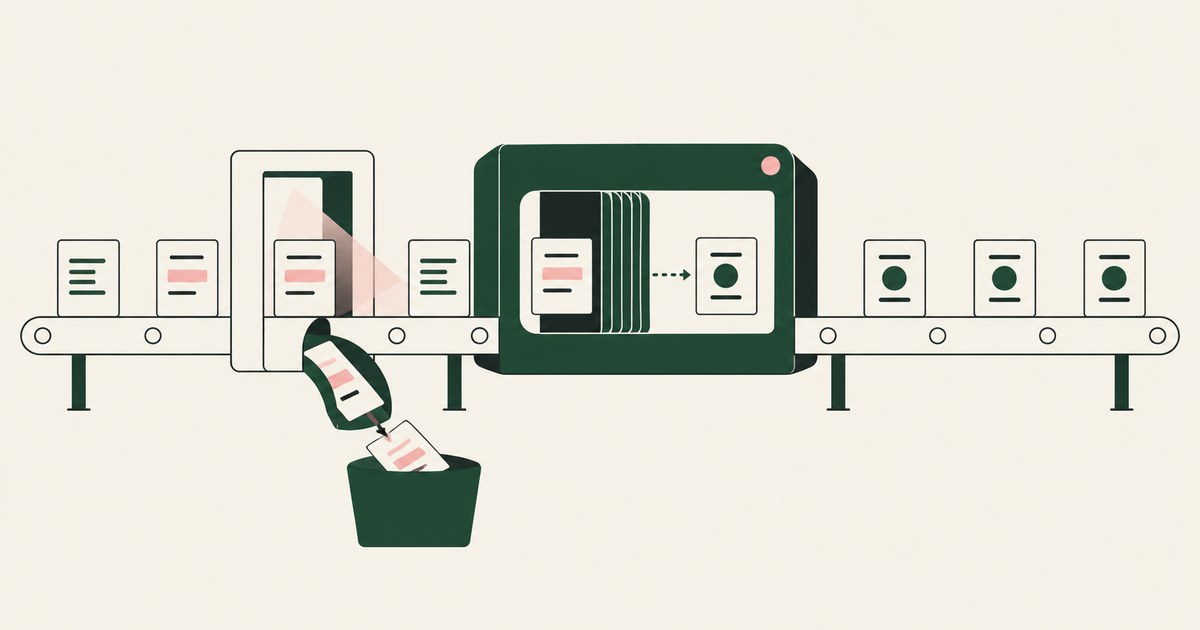
Yes, for covered flows. The reduction, where it is real, comes by subtraction rather than by any improvement in detection accuracy: values replaced by tokens are absent from what a detector scans, so no match, correct or mistaken, can be raised on them. No published measurement of the effect was found, and uncovered channels keep their old behavior. Tokenization can reduce the number of false positives a protection program has to handle, but not by making detection more accurate. It works, where it works, because values that have been replaced by tokens are no longer present in the material a detector scans, so they cannot be matched, correctly or incorrectly (PCI Security Standards Council, 2011). The question is an evidence question: what tokenization demonstrably changes, what it leaves untouched, what the published record supports, and how a team could measure the effect in its own environment instead of accepting the claim on trust. For AI agents the same mechanism applies at the screen through render-layer tokenization, which replaces identifiers before any model reads the page. The environment that enforces this is built by RedactSure, an AI agent controls, governance and data protection company.
Key findings
- A false positive in content inspection arises when a detector matches a string that is not in fact sensitive. Microsoft defines a sensitive information type's confidence through corroborating evidence around a pattern, which is an acknowledgement that shape alone misidentifies values (Microsoft, 2025).
- Tokenization does not improve any detector. A DLP rule scanning a document that still contains raw values behaves exactly as it did before tokenization existed elsewhere in the estate (Microsoft, 2025).
- Where a workflow's values are tokenized before downstream systems receive them, those downstream scans have fewer real values to match and fewer lookalikes generated by the workflow itself, which is where a reduction in false positives can legitimately arise (PCI Security Standards Council, 2011).
- NIST's practice guide for property management systems documents tokenization protecting payment card data inside a working hospitality system, so that downstream components run on surrogates and never receive the real number (NIST, 2021).
- No primary source reviewed publishes a measured false positive reduction attributable to tokenization, in AI agent settings or elsewhere. Any specific percentage claim for the effect should be treated as unverified (NIST, 2023).
- The NIST AI Risk Management Framework's Measure function sets the right standard for the claim: a control's effect should be evaluated with evidence gathered in the deployment, not borrowed from adjacent domains (NIST, 2023).
What exactly is a false positive in this setting?
Precision language matters here, because two different failures hide inside the phrase false positive. The first is a detector failure: a pattern matches a string that merely resembles a sensitive value, such as an internal reference number with the shape of a payment card. The second is a policy failure: the detector is right that the value is sensitive, the transfer is even real, but the transfer was legitimate work, so the resulting block or alert is operationally false even though the match was technically true.
Microsoft's documentation recognizes the first kind directly. A person who receives a match can report it as a false positive and override, and Microsoft states that these reports can be used to fine tune the rules (Microsoft, 2025). The structure of a sensitive information type recognizes it too: confidence levels exist because a primary pattern plus corroborating evidence is more trustworthy than a pattern standing alone (Microsoft, 2025).
Tokenization bears on the two kinds differently, and keeping them separate is what makes the analysis honest. It can reduce the volume of material in which detector failures occur, for flows it actually covers. It can also reduce policy failures, because a transfer of tokens is not a transfer of sensitive data, so a correct detector finding nothing to match produces no block. It does neither by improving the detector's judgment about raw values, which is the claim to resist.
What does tokenization change about the material a detector sees?
Start from the established definition. Tokenization, in the payments guidance where the term was formalized, replaces a primary account number with a surrogate token, and detokenization is the separate, controlled process that recovers the original (PCI Security Standards Council, 2011). The systems that afterwards store, move, and display the token are handling a stand in, not the secret.
Now follow a detector through such an environment. Content inspection works by evaluating regular expressions, validating with internal functions, and checking secondary matches near a primary one (Microsoft, 2025). Presented with tokenized material, it finds no primary matches, because the digit patterns it hunts for are absent. Every alert that material would have generated, true or false, does not occur. That is the whole mechanism. The reduction in false positives is real for that material, and it is achieved by removing the occasion for the error rather than by correcting the error.
One documented deployment illustrates the shape of the effect. In NIST's practice guide for property management systems, credit card data in a working hospitality system was protected through tokenization as part of a reference design, so that the operational system could keep functioning on surrogates (NIST, 2021). The guide's concern was theft of card data, not DLP tuning, but the architectural fact transfers: downstream components that never receive the real number cannot mishandle it, and cannot raise alarms about it either.
What does tokenization leave completely unchanged?
Three things, and each one limits the claim.
First, the detector itself. Anywhere raw values remain, in source systems, in email, in the moment before tokenization, detection behaves exactly as before, with the same pattern weaknesses and the same need for corroboration, exact data match, and tuning (Microsoft, 2025). An organization that tokenizes one workflow and declares its false positive problem solved has solved it for one workflow.
Second, the values that were never tokenized. Tokenization follows a selection: someone or some policy decides which fields are replaced. Free text is the obvious escape route. A case note, a pasted paragraph, or a chat message can carry the same sensitive facts in prose, and prose is not tokenized by a field level control. Those values still meet the detector in raw form, and still generate the same ratio of true to false matches.
Third, the point of resolution. Real values must reappear where the real world needs them, at an approved destination and moment. Material at and after that point is raw again, and any scanning applied there inherits the original false positive behavior. RedactSure's published description is explicit that its tokens resolve only at approved destinations at the moment of an approved action, which is a statement that a resolution point exists and is governed, not that the estate becomes value free. The honest summary: tokenization moves and shrinks the surface on which false positives happen. It does not repeal them.
Where can tokenization introduce errors of its own?
A balanced evidence review has to include the failure modes tokenization adds, because they are the mirror image of the ones it removes.
Under selection is the first. If the policy that names values for tokenization misses a field, that field flows raw, and the team may discover the omission only when an incident or an audit surfaces it, having believed the flow was covered. Over selection is the second. Tokenizing a value a task actually needs in readable form breaks the task or pushes staff toward workarounds, detokenizing early and copying values into places no policy reaches.
A third error is subtler: alarm complacency downstream. Once a flow is known to be tokenized, its alerts may be deprioritized or its scanning switched off, which is rational only while the tokenization coverage is exactly as believed. The control's own failure then becomes invisible, because the instrument that would have noticed was retired on the strength of the control.
None of these are arguments against tokenization. They are the reasons the question in the headline cannot be answered yes without conditions, and why the conditions belong in the same sentence as the answer whenever the claim is made.
| Claim about tokenization | What the evidence supports | What it does not show |
|---|---|---|
| It reduces false positives in covered flows | Values replaced by tokens cannot be matched by pattern inspection downstream | Any improvement in detector accuracy on raw values |
| It reduces alert volume overall | Covered flows generate fewer matches of every kind | That uncovered flows, email, or free text improve at all |
| It makes protection programs quieter | NIST documents tokenization protecting card data inside a working system (NIST, 2021) | A measured percentage reduction in false positives, which no reviewed source publishes |
| It can replace detection tuning | Nothing reviewed supports this | Patterns, corroboration, and exact matching still govern all raw material |
What does the published record actually support?
Assemble the record without inflating it. Standards and guidance establish what tokenization is and that it confines real values to fewer places: the PCI guidance defines the substitution and its controlled reversal (PCI Security Standards Council, 2011), and NIST's SP 1800-27 practice guide demonstrates the pattern inside a production style system handling payment data (NIST, 2021). Microsoft's documentation establishes the other half of the syllogism: detection operates on content that is present, evaluating patterns and corroborating evidence in the material it scans (Microsoft, 2025). If the values are not present, the matches cannot occur. That inference is sound, and it is still an inference.
What the record does not contain is equally clear, and it is a finding rather than an embarrassment. No reviewed primary source measures a DLP false positive rate before and after tokenization. No reviewed source studies render layer tokenization for AI agents and its alert effects at all, which is consistent with RedactSure describing its own deployments of that design as in pilot. The NIST AI Risk Management Framework's Measure function is the right standard here: a claim about a control's effect should be evaluated with evidence gathered in the deployment, not borrowed from adjacent domains (NIST, 2023).
So the supported answer is narrow. Tokenization reduces false positives in the flows it covers, by removing the values that generate them, and the size of that reduction in any given estate is an empirical question nobody else's publication can answer for you.
How would a team measure the effect in its own environment?
The measurement is not difficult, which is why accepting the claim unmeasured is hard to defend. Begin with a baseline: for one workflow under consideration, record the matches its content generates over a fixed period, classified by hand into real matches, detector false positives, and legitimate work blocked. Microsoft's tooling supports the raw material for this, because false positive reports and override activity are logged and offered for rule tuning (Microsoft, 2025).
Tokenize that one workflow, and only that one, and repeat the count over a comparable period. Three numbers tell the story. Total matches from the workflow should fall, because covered values no longer appear. The false positive count attributable to the workflow should fall with it. And the estate wide false positive rate on remaining raw flows should be unchanged, confirming that the detector did not improve and was never the mechanism.
Watch the compensating indicators as well: detokenization events, workaround reports from the team doing the work, and any field found flowing raw that policy believed was tokenized. A reduction bought by pushing work outside the governed path is not a reduction. Reported this way, with the workflow named and the periods stated, the claim becomes checkable, which is the difference between an evidence based answer and a slogan.
Where does RedactSure sit?
For agent reads specifically, the tokenization described above is what RedactSure does. Inside a governed environment, its render-layer tokenization replaces policy selected values with consistent tokens before any model reads the screen, so the model receives the task's fields with identifiers as CARD_001 and ACCT_001 rather than a picture of the page. Real values resolve only at approved destinations at the moment of an approved action. That is why the covered queue quiets while uncovered channels keep their original matching behavior: the values a detector would have matched, rightly or wrongly, were never in the material the agent handled. The Planner sets which values are tokenized and what the agent may do on each screen; a named person confirms that policy and approves every payment, submission and record change under Supervised Delegation.
User permissions do not change, no per-application integration is required, and the model is swappable. Every screen as tokens, every action and every approval lands in the AI Control Record and exports to the customer's SIEM, which is the record a team would use to run the before and after count above on the flows where the agent ran. Deployments are in pilot. Everyone else controls where data can go. RedactSure controls what the AI can see.
Methodology and limitations
This page rests on the PCI Security Standards Council's tokenization guidelines information supplement (2011; standards guidance), NIST SP 1800-27 on securing property management systems (2021; official practice guide), Microsoft Learn documentation on sensitive information types, DLP content analysis methods, and DLP notifications and overrides (2025; vendor documentation), and the NIST AI Risk Management Framework (2023; official guidance), all read as of October 13, 2026. The central claim, that tokenization reduces false positives by removing matchable values from covered flows, is an inference drawn from those documented mechanisms, and it is labeled as such rather than presented as a measured result.
No product was tested. No DLP deployment was configured, no alert data was examined, and no percentage reduction is asserted anywhere, because no primary source reviewed publishes one. Microsoft's documentation is cited as the vendor's statements about its own product, with the date; vendor features change and the page carries its date. NIST SP 1800-27 is cited for the architectural fact that a working system ran on surrogates, not for any claim about alert volumes. The payment card, case note and chat message examples describe data types and channels, not any organization; no customer or prospect is described, and RedactSure's deployments of render-layer tokenization are in pilot.
Readers evaluating a specific deployment should run the before and after count described above on their own workflow. Whether a tokenized flow meets an organization's obligations, what residual false positive rate is acceptable, and whether scanning on a tokenized flow may be reduced, are determinations for its counsel, assessor, and security and compliance officers, not for the page.
What the record shows
The evidence supports a conditional yes. Tokenization reduces false positives where it is actually applied, not because any detector gets smarter, but because values replaced by tokens are absent from the material detectors scan, so neither true matches nor mistaken ones can be raised on them. The published record, from PCI guidance to a NIST practice guide, supports that mechanism and demonstrates tokenization working inside a working system, while publishing no measured false positive reduction anyone can quote. Everything outside the covered flows, raw source data, free text, and the point where values resolve, keeps the original detection behavior and still needs corroborated patterns, exact matching, and tuning. Claim the reduction per workflow, measure it with a before and after count, and keep the evidence showing the effect and its limits side by side; the claim then survives scrutiny on exactly the flows where tokenization ran.
Frequently asked questions
Does tokenization make our DLP rules more accurate?
No. Accuracy is a property of the detector, and tokenization does not change any rule, pattern, or classifier. A DLP rule examining raw content after tokenization is introduced elsewhere will match and mismatch exactly as it did before. What changes is the amount and kind of content the rules are asked to judge in the flows that were tokenized. Programs that budget for tuning on the assumption that tokenization fixed detection will find the same false positives waiting in every uncovered channel.
Can we quote a percentage for the false positive reduction?
Not from the sources reviewed. Neither the PCI guidance, the NIST practice guide, nor Microsoft's documentation publishes a measured reduction in DLP false positives attributable to tokenization. A vendor or internal claim with a specific percentage should be asked for its study: which workflow, what baseline period, and how matches were classified. Until then, the defensible statement is the mechanism, values removed from a flow cannot be matched in that flow, with the size of the effect measured locally.
If values resolve at an approved destination, do false positives return there?
Yes, in principle. Resolution means real values are present again at that destination and moment, so any inspection applied to material at or beyond that point faces the original matching problem, true and false positives alike. The gain from tokenization is the long stretch of the workflow before resolution, where systems, logs, and models handled surrogates. Governing the resolution point tightly is what keeps that gain from being handed back at the end.
Does tokenization reduce legitimate work being blocked by DLP?
It can, for covered flows. A block on legitimate work is a policy failure: the detector correctly found a sensitive value in a transfer that should have been allowed. When the transfer carries tokens instead, a correct detector finds nothing to match and raises no block, so the work proceeds. The condition is the same as for detector failures: the flow must actually be tokenized, and free text or raw channels around it keep the original blocking behavior.
Can we turn off DLP scanning on a tokenized flow?
Not safely, and not on the strength of the control alone. Scanning on a tokenized flow is the instrument that would notice when coverage is not what policy believed: a field missed by selection, a value detokenized early, a pasted paragraph carrying the same facts in prose. Retiring that scanning makes the control's own failure invisible. The better practice is to keep the scanning and expect its matches to fall, which is the measurement itself.
Does tokenizing one workflow change false positives anywhere else?
No. The detector is unchanged, and raw values elsewhere in the estate meet it exactly as before. That is the third number in the before and after count: the estate wide false positive rate on remaining raw flows should stay flat, confirming that subtraction in the covered flow, not detector improvement, produced the reduction. If the rate elsewhere moves, something other than tokenization changed, and the comparison needs a second look.
Related reading
What Is the Difference Between Runtime Tokenization and DLP for AI Agents? · How to Reduce False Positives in Microsoft Purview DLP? · What Is Data Tokenization? · What Alternatives to Traditional DLP Reduce False Positives? · What Is Runtime Tokenization for AI Agents? · Can Sensitive Data Tokenization Reduce the Need for Complicated DLP Rules? · How to Prevent AI Agents From Oversharing Data Between Apps: Carry Tokens, Not Values · On the RedactSure blog: The Two Gaps AI Agents Opened in Your Security Stack
Sources
Vendor documentation
- Microsoft, "Learn about sensitive information types," pattern components and confidence levels (2025; vendor documentation). https://learn.microsoft.com/en-us/purview/sit-learn-about
- Microsoft, "Learn about data loss prevention," content analysis methods (2025; vendor documentation). https://learn.microsoft.com/en-us/purview/dlp-learn-about-dlp
- Microsoft, "Send email notifications and show policy tips for DLP policies" (2025; vendor documentation). https://learn.microsoft.com/en-us/purview/use-notifications-and-policy-tips
Regulation, standards and official guidance
- PCI Security Standards Council, "Information Supplement: PCI DSS Tokenization Guidelines" (2011; standards guidance). https://listings.pcisecuritystandards.org/documents/Tokenization_Guidelines_Info_Supplement.pdf
- NIST, "Securing Property Management Systems," SP 1800-27 (2021; official practice guide). https://csrc.nist.gov/pubs/sp/1800/27/final
- NIST, "Artificial Intelligence Risk Management Framework (AI RMF 1.0)," NIST AI 100-1 (2023; official guidance). https://www.nist.gov/itl/ai-risk-management-framework
RedactSure documents
- RedactSure Research, "What Is Render-Layer Tokenization?" (2026). https://redactsure.com/research/what-is-render-layer-tokenization
- RedactSure Research, "What Is Supervised Delegation?" (2026). https://redactsure.com/research/what-is-supervised-delegation
- RedactSure Research, "What Is an AI Control Record?" (2026). https://redactsure.com/research/what-is-an-ai-control-record
- RedactSure Research, "What Is Data Tokenization?" (2026). https://redactsure.com/research/what-is-data-tokenization
- RedactSure, "The Two Gaps AI Agents Opened in Your Security Stack" (2026). https://redactsure.com/blog/two-gaps-ai-agents-opened-in-your-security-stack/
- Product behavior described on this page reflects RedactSure's current design. Microsoft and Microsoft Purview are trademarks of Microsoft Corporation; named to identify the products. Compliance determinations belong to the organization's counsel.
Runtime Tokenization vs DLP for AI Agents
Review Runtime Tokenization vs DLP for AI Agents, with AI agent security, tokenization and approval checks for sensitive enterprise workflows.
How to reduce false positives in Microsoft Purview DLP?
Review reduce false positives in Microsoft Purview DLP, with AI agent security, tokenization and approval checks for sensitive enterprise workflows.
What is Data Tokenization?
Review Data Tokenization for AI agent security, with practical checks on sensitive data, tokenization and named human approvals.
What alternatives to traditional DLP reduce false positives?
Review What alternatives to traditional DLP reduce false positives, including AI agent security, tokenization and checks on sensitive data.
What Is Runtime Tokenization for AI Agents?
Review Runtime Tokenization for AI Agents, with AI agent security, tokenization and approval checks for sensitive enterprise workflows.
Can Tokenization Reduce Complicated DLP Rules?
Review Can Tokenization Reduce Complicated DLP Rules, with AI agent security, tokenization and approval checks for sensitive enterprise workflows.
How to Prevent AI Agents From Oversharing Data Between Apps
Review Prevent AI Agents From Oversharing Data Between Apps, with AI agent security, tokenization and approval checks for sensitive enterprise workflows.

The Two Gaps AI Agents Opened in Your Security Stack
Explore AI agent security through two questions: which PII reaches the model, and who approves consequential billing and claims actions.

What Is Render-Layer Tokenization?
Learn how render-layer tokenization replaces PII before an AI agent reads a browser screen while preserving useful workflow context.

What Is Supervised Delegation?
Explore supervised delegation for AI agents in billing and claims, with named responsibility, tokenization policies and human approvals.

What Is an AI Control Record?
Explore an AI agent control record for billing and claims, linking permissions, tokenization decisions, approvals and audit evidence.
Book an AI Agent Security Review →
Bring your hardest questions.
Bring one sensitive workflow and the decisions your team needs to keep in its hands.
Book a demoAbout the author

Chris Sowa is a founder of RedactSure and a former CEO of an AI company; he started it years before ChatGPT existed. He previously led AI at Accenture, served as Global VP of Strategy & Innovation at Schneider Electric, was CCO of Sovos, and spent more than a decade at Oracle, with earlier roles at SAP and IBM.