
Explainer · By Chris Sowa · Published
Last updated
What Is AI Agent Credential Protection?
The aim is a model that can reason about a task without ever holding the raw secret that unlocks a system. A credential that enters model context can be repeated in output, preserved in transcripts and screenshots, or redirected by injected content, and each copy extends its useful life to an attacker.
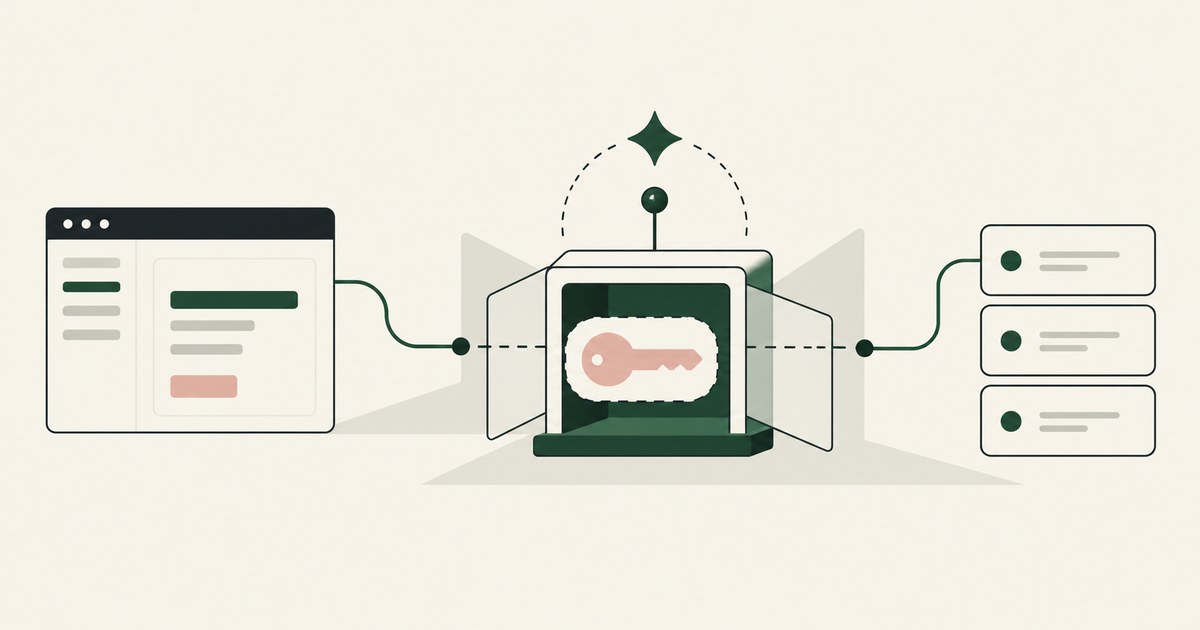
The aim is a model that can reason about a task without ever holding the raw secret that unlocks a system. A credential that enters model context can be repeated in output, preserved in transcripts and screenshots, or redirected by injected content, and each copy extends its useful life to an attacker. AI agent credential protection is the set of controls that keeps the secrets an agent uses, such as API keys, passwords, and access tokens, out of the model's context, out of logs, and out of reach of content the agent reads, while still letting the agent complete an approved task that needs those secrets. The sharpest form of that separation is render-layer tokenization, which replaces a secret shown on a screen with a token such as KEY_001 before any model reads it. What follows defines the term, explains where credentials leak, and sets out storage, issuance, scoping, and audit practices supported by primary guidance. The environment that enforces this is built by RedactSure, an AI agent controls, governance and data protection company.
Key findings
- Secrets in model context can be disclosed in outputs or retained in logs (OWASP, 2025).
- Zero trust treats access as a per request decision tied to identity and policy, not a standing grant (NIST, 2020).
- Control catalogs link authenticator management, least privilege, and boundary protection, so protection is a system, not one product (NIST, 2020).
- Short lived, scoped credentials reduce the value of a stolen secret, because it expires and can do less (HashiCorp, 2025).
- Hosted agent documentation describes credentials held outside the sandbox, with authentication through a proxy using scoped credentials (Anthropic, 2025).
- Audit records should prove which credential was used, for what task, and under whose approval, without recording the value (NIST, 2020).
What counts as a credential for an AI agent?
A credential is any value a system accepts as proof that the holder may act. For an agent, that includes web application passwords, API keys, bearer and session tokens returned after sign in, signing keys, database passwords, and one time codes. NIST digital identity guidance treats authenticators and their credentials as managed objects with a lifecycle, from issuance through renewal to revocation (NIST, 2017). A token created for a five minute task is therefore a different risk from a personal password reused across many tasks.
Three properties decide how dangerous a credential is if it escapes. Scope is which systems and actions it unlocks. Lifetime is how long it remains valid after a leak. Attribution is whether use can be tied to a person, task, or run. A broad, long lived, shared key scores badly on all three. A narrow token for one run scores better. An agent also receives instructions, screen content, and tool results together, so if two credentials sit in its context, nothing in the reasoning step prevents use of the wrong one at the wrong destination. Keeping unnecessary credentials out of context is a design choice, not only a storage choice.
Why does placing a credential in model context change the risk?
Model context is working memory for a run. Text there can be repeated in an answer, summarized into a note, passed to a tool, or written into a transcript. OWASP lists sensitive information disclosure as a distinct risk for LLM applications and advises against sending secrets into prompts (OWASP, 2025). An agent does not only chat. It acts, often by copying values from context into forms, requests, and messages in other systems.
Prompt injection sharpens the problem. Content the agent reads, such as a web page or document, can contain instructions that try to redirect it (OWASP, 2025). If context holds only task information, a successful redirection can misuse that information or attempt an unwanted action. If context also holds a raw key or password, the same redirection gains a portable asset that can be taken elsewhere and used later, until it expires or is revoked.
Logs create a second path. Platforms record prompts, screenshots, tool calls, and errors for review. A credential typed into a visible field or printed in an error can be preserved long after the run ends. NIST expects audit information to be protected and authenticators to be managed as controlled items (NIST, 2020). Keeping the raw value out of context also keeps it out of most records that context generates.
How should credentials be stored and issued to an agent?
Storage should separate the secret from the agent runtime, in a dedicated secrets store or vault reached through its own authenticated channel, with policies naming which workload may read which secret. OWASP secrets guidance describes a lifecycle of creation, rotation, revocation, and expiration, and advises minimum privileges for a secret's role (OWASP, 2024). The store holds the value, the agent holds at most a reference, and a separate component performs the step that needs the value.
Issuance should be just in time where the destination allows it. Rather than handing an agent a standing key at run start, the controlling system requests a fresh credential when a task needs one, bound to that task and a short validity period. HashiCorp documents dynamic secrets as credentials generated on demand with a defined time to live, after which they expire automatically (HashiCorp, 2025). Many browser applications, however, still expect a conventional password. There, the value should travel from the store to the sign in surface through a component outside the model, never through the prompt, and rotation with a named owner matters more (NIST, 2017).
| Pattern | Where the raw value sits | Lifetime and scope | Main weakness |
|---|---|---|---|
| Key in the prompt | Model context and transcripts | Usually long lived and broad | Can be repeated, logged, or redirected |
| Key in a file in the environment | Disk in the run environment | Often long lived | Any file reading tool can copy it |
| Static secret fetched from a vault | Runtime, outside prompt if designed that way | Long lived, policy scoped | Usable elsewhere until rotated if extracted |
| Dynamic secret for one task | Component performing the action | Short lived, narrowly scoped | Needs destination support for temporary credentials |
| Authentication by an outside proxy | Outside the agent sandbox | Scoped, managed by proxy | Depends on proxy policy and coverage |
What does injection at the point of use mean in practice?
Injection at the point of use means the raw value is introduced at the last responsible moment, by a component that is not the model, at the destination that needs it. The model may know sign in is required, which account is involved, and whether the step succeeded. It does not need the password. Anthropic documents a version of this for its hosted coding environment, describing sensitive credentials as not placed inside the sandbox, with authentication handled through a secure proxy using scoped credentials (Anthropic, 2025).
Take signing in to a supplier portal, downloading an invoice, and filing it. The agent reaches the sign in form. A separate component supplies the password directly to that form, or completes authentication outside the visible workflow. The agent continues with an authenticated session and prepares the invoice for filing, which a named person approves. The password never appears in screen content the model reads, in instructions, or in the decision transcript.
Failure handling follows the same rule. The agent can report that sign in failed without reporting the value tried. If a lookalike form in summarized content asks for a credential, the component can refuse because the destination does not match the approved one. Binding a value to a destination matters as much as binding it to a time.
How do scoping, rotation, and revocation limit damage?
Scoping limits what a credential can do. NIST access control guidance includes least privilege, meaning each identity holds only the access its function requires (NIST, 2020). For agents, scoping covers which applications a credential opens, which records it can touch, whether it can read only or also write, and which tasks it is tied to. A read only key for one service is a contained problem if it leaks. An administrator key for a whole estate is not.
Rotation limits how long a leaked value stays useful, and revocation closes the window on demand when misuse is suspected or a task or relationship ends. OWASP treats rotation, revocation, and expiration as separate lifecycle stages, answering schedule, incident, and design limits (OWASP, 2024). Zero trust adds that access decisions should be dynamic and enforced before access, not assumed from an earlier sign in (NIST, 2020). CISA organises similar ideas into identity maturity stages, moving from static credentials toward continuous validation (CISA, 2023).
Response needs rehearsal. Operators should know which tokens were issued for a suspect run, which sessions they created, and how to invalidate both. A single standing key shared by every run forces a choice between leaving it active and breaking all other work. An inventory with a named owner for each secret is the starting point.
What should logs and audit records show, and what should they never contain?
A useful record answers accountability questions without becoming a copy of the secret store. It should show the task identifier, the named authorizer, the credential reference or alias, the destination, issue and expiry times, and the result. NIST audit controls expect records sufficient to reconstruct significant events, protected from unauthorized change (NIST, 2020). None of that requires the secret value.
Records should never contain raw passwords, full tokens, private keys, or one time codes, nor partial values that could be combined to reconstruct them. Screenshots need the same care as text. A settings page listing an API key or an error banner echoing a token can place a secret in an image record even when text logging is clean. Masking at capture, and tokenizing values before a model reads the screen, address that path. Retention also matters: set periods for transcripts and screenshots, sample them for accidental capture, and check that exports follow the same masking rules as the original record.
Where does RedactSure sit?
For credentials specifically, RedactSure keeps the raw secret outside the reasoning loop. Sensitive values chosen by policy, including secrets shown on a screen, are replaced by consistent tokens at the render layer before the model reads them, so an API key reaches the model as KEY_001 and there is no password in its context to repeat, screenshot, or hand to injected content. A real value resolves only at an approved destination at the moment of an approved action, which removes credentials from prompts and transcripts by design. The agent works applications as rendered inside a governed environment, under the user's existing permissions, with no per-application integration.
The Planner sets which values on each screen are tokenized and what the agent may do there; a named person confirms that policy and approves every payment, submission and record change, under Supervised Delegation. Every screen as tokens, every action and every approval lands in the AI Control Record and exports to the customer's own SIEM, with the secret value absent by construction. Keys stay with the customer, and the model is swappable. Deployments are in pilot. Everyone else controls where data can go. RedactSure controls what the AI can see.
Methodology and limitations
The page is a desk review of primary and standards sources: NIST Special Publication 800-207 on zero trust architecture (2020, official guidance), SP 800-53 Revision 5 on security and privacy controls (2020, official guidance), and SP 800-63-3 and 800-63B on digital identity (2017, official guidance); OWASP's Top 10 for LLM Applications entries on prompt injection and sensitive information disclosure (2025, standards) and its Secrets Management Cheat Sheet (2024, standards); CISA's Zero Trust Maturity Model, second edition (2023, official guidance); and vendor documentation from HashiCorp on dynamic secrets and from Anthropic on security and isolation in its hosted coding environment (2025, vendor documentation). All sources were read as of October 13, 2026. Vendor documentation is paraphrased as the vendor states it, with its date.
No credential system was tested, no agent was run, and no product was benchmarked. Product claims are limited to each vendor's own documentation; no hands-on testing of HashiCorp Vault, Claude Code or any other named product was performed. Browser applications differ in support for temporary credentials, federated sign in, and proxy authentication, so just in time issuance must be checked per destination before a design is promised. Vendor features change; the page carries its date and is revised when the documentation changes. The supplier portal example describes a task type, not any organization; no customer or prospect is described.
Whether a credential design meets an organization's obligations under its policies, contracts, or any regulation belongs to its counsel, its assessor and its security and compliance officers, not to this page.
What the record shows
Credential protection for an AI agent rests on a simple separation: the model reasons about the work, while the raw secrets that unlock systems are held, issued, and used by components outside the model. A credential that enters model context can be repeated in output, preserved in transcripts and screenshots, or redirected by injected content, and each copy extends its useful life to an attacker. Short lived, narrowly scoped credentials limit the damage when one escapes, and injecting a value only at the point of use, bound to an approved destination, keeps most runs free of raw secrets altogether. None of this works without an inventory, a named owner for each secret, and a rehearsed way to revoke credentials after a suspect run. The one test to apply is to pick one run, find the moment of sign in, and ask where the password was at that moment and whether it appears anywhere in the transcript or the screenshots.
Frequently asked questions
Why not just give the agent the password it needs?
Because context is not a safe container. Anything the model holds can surface in an answer, a note, a tool call, or a logged transcript, and content the agent reads can try to redirect it toward disclosing what it holds. A password given for one sign in can therefore travel far beyond that sign in. Supplying the value at the point of use, through a separate component, achieves the same login without that exposure.
What makes one credential safer than another?
Three properties: scope, lifetime, and attribution. A safer credential opens few systems, permits few actions, expires quickly, and records which task and authorizer used it. A broad, long lived, shared key is the opposite on all three counts, which is why a leak of the first kind is a contained problem and a leak of the second kind is an estate wide incident.
What should an audit log show about credential use?
Enough to reconstruct the event, and nothing that recreates the secret. The record should show the task, the named authorizer, the credential reference or alias, the destination, issue and expiry times, and the result. It should never contain the raw password, a full token, or a private key, and screenshots deserve the same check, because a settings page or error banner can carry a secret into an image record.
What is a dynamic secret, and why does it suit an agent?
A dynamic secret is a credential generated on demand for one task, with a defined time to live, after which it expires on its own. HashiCorp documents the pattern in its Vault guidance. It suits an agent because the controlling system can request the credential when a step needs it, bind it to that task, and let it lapse, so a value that escapes during the run is narrow and short lived rather than a standing key that unlocks everything until someone notices.
Can an agent sign in to a web application that only accepts a conventional password?
Yes, and many applications still work that way, because they do not support temporary credentials, federated sign in, or proxy authentication. The password should travel from the secrets store to the sign in form through a component outside the model, never through the prompt, and that component should refuse a destination that does not match the approved one. Rotation on a schedule and a named owner for the password matter more here, since the value cannot expire by itself.
What should we do when a credential an agent used may have leaked?
Revoke it, then trace it. Operators should be able to list which tokens were issued for the suspect run, which sessions those tokens created, and invalidate both without breaking every other run, which is only possible when runs do not share one standing key. The audit record then shows the task, authorizer, destination and times for the credential, so the review can establish what the leaked value could have reached. An inventory with a named owner for each secret makes this rehearsal possible.
Related reading
What Is AI Agent Prompt Injection? · What Is AI Agent Least Privilege? · What Is AI Agent Data Exposure? · What Is an AI Data Security Vault? · Can a Credential Vault Protect the Data an AI Agent Reads? · What Is Screen-Level Tokenization? · How to Secure AI Agents Across AWS, Azure and GCP · How to Use Claude Cowork or OpenAI Dots to Safely Set Up Amazon S3 With GitHub · What Is AI Agent Identity and Why Do Agents Not Fit Traditional User Access Models? · What Is the Difference Between RedactSure and CyberArk for AI Agent Credentials and Privileged Access? · On the RedactSure blog: The Two Gaps AI Agents Opened in Your Security Stack
Sources
Vendor documentation
- HashiCorp, "Understand static and dynamic secrets," Vault tutorials (2025; vendor documentation). https://developer.hashicorp.com/vault/tutorials/get-started/understand-static-dynamic-secrets
- Anthropic, "Claude Code on the web: Security and isolation" (2025; vendor documentation). https://code.claude.com/docs/en/claude-code-on-the-web
Regulation, standards and official guidance
- NIST, "Zero Trust Architecture," SP 800-207 (2020; official guidance). https://csrc.nist.gov/pubs/sp/800/207/final
- NIST, "Security and Privacy Controls for Information Systems and Organizations," SP 800-53 Revision 5 (2020; official guidance). https://csrc.nist.gov/pubs/sp/800/53/r5/upd1/final
- NIST, "Digital Identity Guidelines," SP 800-63-3 and SP 800-63B (2017; official guidance). https://pages.nist.gov/800-63-3/
- OWASP, "LLM01:2025 Prompt Injection," Top 10 for LLM Applications (2025; standards). https://genai.owasp.org/llmrisk/llm01-prompt-injection/
- OWASP, "LLM02:2025 Sensitive Information Disclosure," Top 10 for LLM Applications (2025; standards). https://genai.owasp.org/llmrisk/llm022025-sensitive-information-disclosure/
- OWASP, "Secrets Management Cheat Sheet" (2024; standards). https://cheatsheetseries.owasp.org/cheatsheets/Secrets_Management_Cheat_Sheet.html
- CISA, "Zero Trust Maturity Model," version 2.0 (2023; official guidance). https://www.cisa.gov/zero-trust-maturity-model
RedactSure documents
- RedactSure Research, "What Is Render-Layer Tokenization?" (2026). https://redactsure.com/research/what-is-render-layer-tokenization
- RedactSure Research, "What Is Supervised Delegation?" (2026). https://redactsure.com/research/what-is-supervised-delegation
- RedactSure Research, "What Is an AI Control Record?" (2026). https://redactsure.com/research/what-is-an-ai-control-record
- RedactSure Research, "What Is Screen-Level Tokenization?" (2026). https://redactsure.com/research/what-is-screen-level-tokenization
- RedactSure, "The Two Gaps AI Agents Opened in Your Security Stack" (2026). https://redactsure.com/blog/two-gaps-ai-agents-opened-in-your-security-stack/
- Product behavior described on this page reflects RedactSure's current design. HashiCorp and Vault are trademarks of HashiCorp, Inc.; Anthropic and Claude Code are trademarks of Anthropic, PBC; named to identify the products.
What Is AI Agent Prompt Injection?
Review AI Agent Prompt Injection, with AI agent security, tokenization and approval checks for sensitive enterprise workflows.

What Is AI Agent Least Privilege?
Review AI Agent Least Privilege, with AI agent security, tokenization and approval checks for sensitive enterprise workflows.
What Is AI Agent Data Exposure?
Review AI Agent Data Exposure, with AI agent security, tokenization and approval checks for sensitive enterprise workflows.
What Is an AI Data Security Vault?
Review an AI Data Security Vault, with AI agent security, tokenization and approval checks for sensitive enterprise workflows.

Can a Credential Vault Protect What an AI Agent Reads?
Compare credential storage with AI agent security for encountered PII, and examine where screen-level tokenization adds a different control.

What Is Screen-Level Tokenization?
Review Screen-Level Tokenization, with AI agent security, tokenization and approval checks for sensitive enterprise workflows.
How to Secure AI Agents Across AWS, Azure and GCP
Review Secure AI Agents Across AWS, Azure and GCP, with AI agent security, tokenization and approval checks for sensitive enterprise workflows.
How to Set Up S3 and GitHub With Cowork or Dots
Review Set Up S3 and GitHub With Cowork or Dots, with AI agent security, tokenization and approval checks for sensitive enterprise workflows.
What Is AI Agent Identity?
Review AI Agent Identity for AI agent security, with practical checks on sensitive data, tokenization and named human approvals.
RedactSure vs CyberArk: AI Agent Security
Review RedactSure vs CyberArk: AI Agent Security, with AI agent security, tokenization and approval checks for sensitive enterprise workflows.

The Two Gaps AI Agents Opened in Your Security Stack
Explore AI agent security through two questions: which PII reaches the model, and who approves consequential billing and claims actions.

What Is Render-Layer Tokenization?
Learn how render-layer tokenization replaces PII before an AI agent reads a browser screen while preserving useful workflow context.

What Is Supervised Delegation?
Explore supervised delegation for AI agents in billing and claims, with named responsibility, tokenization policies and human approvals.

What Is an AI Control Record?
Explore an AI agent control record for billing and claims, linking permissions, tokenization decisions, approvals and audit evidence.
Book an AI Agent Security Review →
Bring your hardest questions.
Bring one sensitive workflow and the decisions your team needs to keep in its hands.
Book a demoAbout the author

Chris Sowa is a founder of RedactSure and a former CEO of an AI company; he started it years before ChatGPT existed. He previously led AI at Accenture, served as Global VP of Strategy & Innovation at Schneider Electric, was CCO of Sovos, and spent more than a decade at Oracle, with earlier roles at SAP and IBM.