
Explainer · By Chris Sowa · Published
Last updated
What Is an AI Agent Security Gateway?
Position defines the control, since traffic that never passes through the gateway is traffic it cannot govern, and inspection alone cannot settle whether a permitted action is the right one. An organization that treats the gateway as the whole control leaves ungoverned both the screen an agent reads and the consequential action it is about to take.
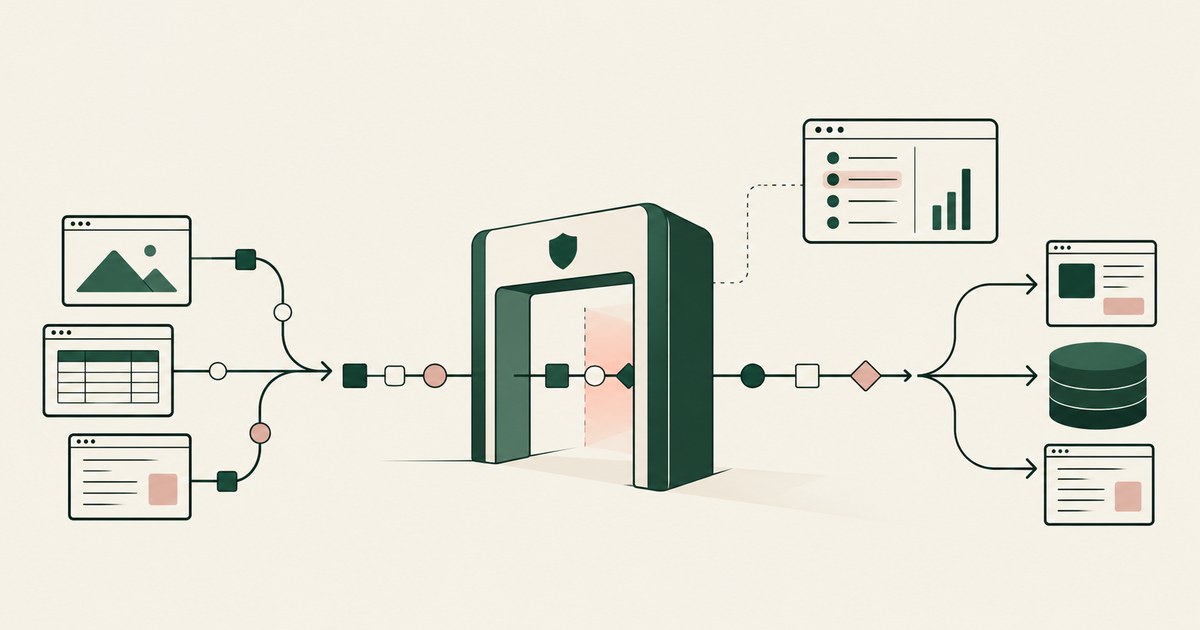
Position defines the control, since traffic that never passes through the gateway is traffic it cannot govern, and inspection alone cannot settle whether a permitted action is the right one. An organization that treats the gateway as the whole control leaves ungoverned both the screen an agent reads and the consequential action it is about to take. An AI agent security gateway is a control point in the path of traffic between an AI agent, the models it calls, and the tools it uses, which inspects each request and response and applies policy before traffic may continue. It is not a storage system, and it does not hold the values it inspects. The term breaks down into a set of components, a short list of what a gateway can and cannot decide, and a set of distinctions from a data security vault, data loss prevention, masking, and render-layer tokenization, which replaces sensitive values with consistent stand-in tokens at the point where a screen is rendered, before any AI model reads it. The environment that enforces this is built by RedactSure, an AI agent controls, governance and data protection company.
Key findings
- A gateway is defined by its position in the traffic path. Traffic that does not pass through it is traffic it cannot govern (NIST, 2020).
- The pattern follows the policy enforcement point in zero trust architecture, where a decision component evaluates a request and an enforcement component allows, monitors, or terminates the connection (NIST, 2020).
- Vendor documentation describes an AI gateway as a proxy adding logging, caching, rate limiting, analytics, and fallback routing between an application and model providers (Cloudflare, 2026).
- OWASP ranks prompt injection first and sensitive information disclosure second in its 2025 list for LLM applications, and both travel through the path a gateway observes (OWASP, 2025).
- A gateway inspects traffic in transit. A vault stores values centrally and issues tokens. Neither substitutes for the other, and a gateway that adds sanitization in transit is still not a vault (Kong, 2025).
- Excessive agency is a distinct OWASP risk that inspection alone does not solve, because a permitted tool call can still be the wrong action (OWASP, 2025).
What does an AI agent security gateway sit between?
Without a gateway, an application calls a model directly and any controls live in application code, if they exist at all. A gateway inserts a managed intermediary that all relevant calls must use: the agent sends its request to the gateway, the gateway forwards an approved version to a model provider, and returns an approved version of the response. Where agents use tools, the pattern can extend to tool calls instead of each connection going directly from agent to system.
Because traffic converges at one point, an organization can apply one rule set, keep a central record, and change a policy decision in one place. NIST describes zero trust as principles for workflow and system design rather than a single product, and separates the component that decides access from the component that enforces it in front of a resource (NIST, 2020). A gateway is the enforcement half of that pairing. It is not the policy author, the identity system, or the data store.
Three directions matter. The outbound request may contain a system prompt, user input, retrieved documents, and tool results. The inbound response may contain generated text, a proposed tool call, or structured output. The tool path is where the agent asks an external system to read or change something. A gateway that only proxies model calls covers the first two. It does not govern what an agent does inside a browser or through a bypassing integration, so buyers should ask which paths it sits on.
What does a gateway inspect and decide on each request and response?
On each transaction, a gateway typically authenticates the calling workload, checks authorization for the requested model or tool, applies rate limits and quotas, and selects a destination under routing rules. Cloudflare describes its AI Gateway as a proxy between applications and inference providers providing observability, caching, rate limiting, cost tracking, and fallback routing (Cloudflare, 2026). Kong describes a similar layer, with platform level controls that can include personally identifiable information sanitization and prompt guard functions (Kong, 2025).
Content inspection needs careful wording. A gateway can scan a request or response for patterns matching credentials, payment numbers, or other defined data types, and can block, transform, or reroute traffic on a match. It can apply classifiers or secondary models intended to detect injection attempts. These are decisions on traffic it can see, in the form in which it can see it. Many are pattern based or probabilistic, and a vendor that does not publish its method or error rates has not given grounds to treat a scan as a guarantee.
Logging may matter more for governance than blocking. NIST SP 800-53 organizes controls into families including Access Control, Audit and Accountability, and System and Communications Protection (NIST, 2020). A useful record ties a request to a caller identity, a policy version, a routing decision, a model destination, and an outcome. With that linkage, a reviewer can reconstruct why traffic was allowed, which is what the Govern and Manage functions of the NIST AI Risk Management Framework expect (NIST, 2023).
What components make up a gateway in practice?
Products differ, but the breakdown below reflects functions that gateway documentation and zero trust architecture repeatedly separate.
| Component | What it does | Depends on |
|---|---|---|
| Proxy or enforcement point | Forwards, blocks, or modifies traffic in the path | Traffic actually routed through it |
| Policy decision logic | Evaluates identity, destination, content, and limits | Current, versioned policy |
| Routing and provider abstraction | One interface directing calls to different models | Provider credentials and routing rules |
| Content inspection | Checks traffic for defined data types or content | Published methods and handling for matches |
| Rate limiting and quotas | Caps volume, token use, or cost by caller or route | Reliable caller identity and metering |
| Logging and analytics | Records requests, decisions, usage, and cost | Protected storage and retention period |
| Credential handling | Holds or brokers provider keys for callers | Secure key storage and rotation |
Two points follow. First, the gateway concentrates sensitive material: it may see prompts in readable form and hold provider credentials for many applications, so it needs its own access control, key management, and audit protection, consistent with NIST SP 800-53 (NIST, 2020). Second, a component list is not evidence of effectiveness. A gap remains if agents reach models through an uncovered path, or if inspection rules were never configured for the organization's data types.
How does a gateway differ from a vault, DLP, masking, and render-layer tokenization?
The distinctions turn on where the control operates, what it does with a sensitive value, and whether the original can be recovered, and by whom.
| Control | Where it operates | Effect on a sensitive value | Recoverable? |
|---|---|---|---|
| AI agent security gateway | In the path of requests and responses | Inspected in transit, then allowed, blocked, transformed, or routed | Not stored as its main function |
| AI data security vault | In a separate central storage system | Stored centrally, replaced elsewhere by a token | Yes, by detokenization under policy |
| Data loss prevention | Endpoints, networks, services watching movement | Movement detected, alerted on, or blocked | Value is not transformed |
| Data masking | In a dataset or display | Replaced by a repeated character or substitute | Often not reversed in that copy |
| Render-layer tokenization | At the rendered screen, before a model reads it | Replaced by a consistent token at display | Yes, only at an approved destination and moment |
A vault holds the real value in one governed place and gives other systems a token that refers to it. A gateway does not do that job: if it forwards a prompt containing a real account number, the model has received the real value, whatever the gateway logged. Some gateways add sanitization, and Kong documents an option in which sanitized data can be restored into a response before it reaches the end user (Kong, 2025). That transformation in transit is still not a vault, because central storage and governed token reversal across systems is a separate commitment.
DLP watches for defined data moving to places it should not go, and responds with an alert or a block. Masking differs in form: NIST SP 800-188 lists masking among techniques for removing or transforming direct identifiers, describing replacement with a repeating character such as a string of X characters (NIST, 2023). Masking gives an agent no stable stand-in to resolve later. Render-layer tokenization differs in timing and location, replacing a value where work is rendered, before a model reads the screen. Content an agent reads from a screen may never pass through a gateway at all.
What can a gateway not prevent on its own?
Inspection does not reliably settle prompt injection. OWASP places prompt injection at the top of its 2025 list, including input arriving indirectly through retrieved content (OWASP, 2025). Indirect injection can arrive inside a document, a tool result, or a web page that looks ordinary at the pattern level. Screening lowers exposure. It does not convert an untrusted instruction into a trusted one, and it should not be the only control between an injected instruction and a consequential action.
A gateway governs traffic, not task design. If an agent holds broad tool permissions, a gateway enforcing a permissive policy will faithfully allow harmful calls. OWASP lists excessive agency separately: the problem is the scope of functions, permissions, and autonomy granted, not only one request's content (OWASP, 2025). Least privilege and approval choices must be made somewhere. A gateway can enforce them as policy. It does not originate them.
A gateway cannot protect data on paths it does not sit on, and cannot undo a disclosure that happened upstream, such as a user pasting sensitive material into a separate public tool. Joint guidance from CISA, the National Security Agency, and partner agencies stresses protecting data across the AI lifecycle, including supply chain and storage, rather than at one transit point (CISA and NSA, 2025). Routing all traffic through one layer also creates a dependency, so an organization needs an advance decision on failing closed or open when the gateway is unavailable.
How should an organization evaluate and govern a gateway?
Start with coverage, not features. List every way an agent can reach a model or a tool, then check each path against the gateway. Bypassing paths should be closed, redirected, or accepted as documented residual risk. This mirrors the Map function of the NIST AI Risk Management Framework, establishing context before measuring it (NIST, 2023).
Next, test inspection claims with the organization's own data types, including values in longer text, tables, and retrieved documents, and record what was blocked, transformed, or missed. Ask what happens on a match, and what the gateway retains, for how long, and who at the vendor can access it.
Governance must continue after purchase. ISO/IEC 42001 specifies requirements for establishing, implementing, maintaining, and continually improving an AI management system, including AI policy, risk assessment, and performance evaluation (ISO, 2023). For a gateway, that means named ownership of policy, versioned rule changes, and periodic review of logs. NIST SP 800-53 makes the same point: access enforcement, least privilege, and protection of audit information are continuing obligations, not installation steps (NIST, 2020).
Where does RedactSure sit?
Even a gateway with complete traffic coverage cannot govern what a model sees on a rendered screen, or whether a consequential action should proceed. RedactSure covers that ground. It governs the screen: every value chosen by policy is replaced by a consistent token at the render layer before any model reads it, so the model receives the task's fields with identifiers as tokens, ACCT_001 in place of an account number, and the real value resolves only at an approved destination at the moment of an approved action. It governs the action: payments, submissions, and record changes wait for a named person's approval under Supervised Delegation. The Planner sets the policy for each screen, and a named person confirms it before the run.
Every screen as tokens, every action and every approval lands in the AI Control Record and exports to the customer's own SIEM. Keys stay with the customer, the model is swappable, and no per-application integration is required. Deployments are in pilot. For browser work on sensitive records, RedactSure is the control to add where gateway inspection stops. Everyone else controls where data can go. RedactSure controls what the AI can see.
Methodology and limitations
The page rests on primary sources only, read as of October 13, 2026: NIST publications on zero trust architecture (SP 800-207), security and privacy controls (SP 800-53 Rev. 5), the AI Risk Management Framework (AI 100-1), and de-identification (SP 800-188), each official guidance; the OWASP Top 10 for LLM Applications 2025, a standard; ISO's description of ISO/IEC 42001, a standard; joint CISA and NSA guidance on AI data security, official guidance; and vendor documentation from Cloudflare and Kong, quoted for what the products say they do. Vendor documentation established intended behavior, not how well a product performs it.
No gateway product was installed or tested, and no detection rates or blocking accuracy are reported, because no published primary measurement was supplied and none was invented. Behaviour varies by version, plan, and configuration, and documentation describes intended behavior rather than measured field performance. Features described as typical may be absent from a given product, or present under a different name. Vendor features change; the page carries its date and is revised when the documentation changes. The account number, credential, and payment number examples describe data types, not any organization; no customer or prospect is described.
Whether a gateway, a vault, DLP, masking, or render-layer tokenization meets a given organization's requirements, alone or in combination, is a determination for its counsel, its assessor, and its security and compliance officers. This page sets out what each control does and where it operates; it does not make that determination.
What the record shows
An AI agent security gateway is best understood as a position, not a promise. Placed in the path between an agent, its models, and its tools, it can authenticate callers, apply policy to each request and response, route traffic, and build the central record that later review depends on. What it cannot do follows from the same position: it sees only the paths routed through it, its content checks are pattern based or probabilistic, and it governs traffic rather than the design of the task itself. It is not a vault, because it does not store values and issue tokens, and it does not replace least privilege or approval decisions made elsewhere. The test for any gateway is one list: every path by which an agent can reach a model, a tool, or a screen, checked against what the gateway actually sits on.
Frequently asked questions
Does a gateway stop prompt injection?
Not reliably on its own. A gateway can screen requests and responses for defined patterns and known injection markers, and it can block or reroute traffic that matches. Indirect injection, though, can arrive inside an ordinary looking document or tool result that no pattern catches. Screening reduces exposure, so consequential actions still need separate controls, such as least privilege and approval by a named person at the moment an action runs.
Can a gateway replace a data security vault?
No, because the two controls do different jobs. A gateway inspects traffic in transit and decides whether it may continue, but it does not store sensitive values centrally or issue tokens that other systems can use in their place. A vault performs that storage and governed reversal. An organization may need both, or a gateway alone may be enough where values never need a resolvable substitute.
What should we ask a gateway vendor first?
Start with coverage and records. Ask which paths between agents, models, and tools the gateway actually sits on, and what happens on paths it does not cover. Then ask what its inspection retains, for how long, and who can access it, and test its claims with your own data types, including values inside longer text and retrieved documents, before relying on them.
Does an AI gateway see what an agent reads in a browser?
Usually not. A gateway sits on the request and response path between an application and a model provider, and in some products on the tool path. An agent that reads a rendered page inside a browser receives that content from the screen, and the page may never pass through the gateway. Render-layer tokenization operates at that point instead, replacing policy chosen values before any model reads the screen.
Is an AI gateway the same as the policy enforcement point in zero trust?
It plays that role for AI traffic. NIST SP 800-207 separates a policy decision point, which evaluates a request, from a policy enforcement point, which allows, monitors, or terminates the connection. A gateway is the enforcement half. The decision logic may run inside the same product, but the policy itself, the identity system, and the data store remain separate responsibilities the gateway depends on.
What happens to agent traffic when the gateway is down?
That depends on a decision the organization should make in advance. Routing every model and tool call through one layer creates a dependency. Failing closed stops agent work until the gateway returns, which protects data but halts tasks. Failing open lets traffic bypass inspection and logging. Either choice should be documented, tested, and owned by a named person, and the failure mode should appear in the gateway's own record.
Related reading
What Is an AI Data Security Vault? · What Is Screen-Level Tokenization? · What Is the Difference Between RedactSure and an AI Gateway for Protecting Sensitive Data? · What Is Human-in-the-Loop Approval for AI Agents? · AI Gateway, DLP or Tokenization? · Prompt Injection When the Agent Sees Only Tokens · How to Monitor What an AI Agent Actually Accesses · How to Secure AI Agents Across AWS, Azure and GCP · On the RedactSure blog: The Two Gaps AI Agents Opened in Your Security Stack
Sources
Vendor documentation
- Cloudflare, "AI Gateway" documentation on proxy features, caching, rate limiting, and analytics (2026; vendor documentation). https://developers.cloudflare.com/ai-gateway/
- Kong, "AI Gateway" documentation on PII sanitization and AI traffic governance (2025; vendor documentation). https://docs.konghq.com/gateway/latest/ai-gateway/
Regulation, standards and official guidance
- NIST, "Zero Trust Architecture," SP 800-207 (2020; official guidance). https://csrc.nist.gov/pubs/sp/800/207/final
- NIST, "Security and Privacy Controls for Information Systems and Organizations," SP 800-53 Rev. 5 (2020; official guidance). https://csrc.nist.gov/pubs/sp/800/53/r5/upd1/final
- NIST, "Artificial Intelligence Risk Management Framework," AI 100-1 (2023; official guidance). https://www.nist.gov/itl/ai-risk-management-framework
- NIST, "De-Identifying Government Datasets: Techniques and Governance," SP 800-188 (2023; official guidance). https://csrc.nist.gov/pubs/sp/800/188/final
- OWASP, "LLM01:2025 Prompt Injection," Top 10 for LLM Applications 2025 (standard). https://genai.owasp.org/llmrisk/llm01-prompt-injection/
- OWASP, "LLM06:2025 Excessive Agency," OWASP Top 10 for LLM Applications 2025 (standard). https://genai.owasp.org/llmrisk/llm062025-excessive-agency/
- ISO, "ISO/IEC 42001, Artificial intelligence management system," summary (2023; standard). https://www.iso.org/standard/42001
- CISA, NSA and partner agencies, "AI Data Security: Best Practices for Securing Data Used to Train and Operate AI Systems," joint cybersecurity information sheet (2025; official guidance). https://www.cisa.gov/resources-tools/resources/ai-data-security-best-practices-securing-data-used-train-operate-ai-systems
RedactSure documents
- RedactSure Research, "What Is Render-Layer Tokenization?" (2026). https://redactsure.com/research/what-is-render-layer-tokenization
- RedactSure Research, "What Is an AI Data Security Vault?" (2026). https://redactsure.com/research/what-is-an-ai-data-security-vault
- RedactSure Research, "What Is Screen-Level Tokenization?" (2026). https://redactsure.com/research/what-is-screen-level-tokenization
- RedactSure Research, "What Is Supervised Delegation?" (2026). https://redactsure.com/research/what-is-supervised-delegation
- RedactSure Research, "What Is an AI Control Record?" (2026). https://redactsure.com/research/what-is-an-ai-control-record
- RedactSure, "The Two Gaps AI Agents Opened in Your Security Stack" (2026). https://redactsure.com/blog/two-gaps-ai-agents-opened-in-your-security-stack/
- Product behavior described on this page reflects RedactSure's current design. Cloudflare is a trademark of Cloudflare, Inc.; Kong is a trademark of Kong Inc.; named to identify the products.
What Is an AI Data Security Vault?
Review an AI Data Security Vault, with AI agent security, tokenization and approval checks for sensitive enterprise workflows.

What Is Screen-Level Tokenization?
Review Screen-Level Tokenization, with AI agent security, tokenization and approval checks for sensitive enterprise workflows.
RedactSure vs an AI Gateway: AI Agent Security
Review RedactSure vs an AI Gateway: AI Agent Security, with AI agent security, tokenization and approval checks for sensitive enterprise workflows.

What Is Human-in-the-Loop Approval for AI Agents?
Review Human-in-the-Loop Approval for AI Agents, with AI agent security, tokenization and approval checks for sensitive enterprise workflows.

AI Gateway, DLP or Tokens: What Controls AI Exposure?
Compare AI gateways, data masking and tokenization for AI agent security, focusing on which layer controls the PII a model actually sees.
What Does Prompt Injection Get From a Token-Only Agent?
Follow a prompt-injection scenario to examine AI agent security, PII exposure and the limits of tokenization when an attack succeeds.
How to Monitor What an AI Agent Actually Accesses
Review Monitor What an AI Agent Actually Accesses, with AI agent security, tokenization and approval checks for sensitive enterprise workflows.
How to Secure AI Agents Across AWS, Azure and GCP
Review Secure AI Agents Across AWS, Azure and GCP, with AI agent security, tokenization and approval checks for sensitive enterprise workflows.

The Two Gaps AI Agents Opened in Your Security Stack
Explore AI agent security through two questions: which PII reaches the model, and who approves consequential billing and claims actions.

What Is Render-Layer Tokenization?
Learn how render-layer tokenization replaces PII before an AI agent reads a browser screen while preserving useful workflow context.

What Is Supervised Delegation?
Explore supervised delegation for AI agents in billing and claims, with named responsibility, tokenization policies and human approvals.

What Is an AI Control Record?
Explore an AI agent control record for billing and claims, linking permissions, tokenization decisions, approvals and audit evidence.
Book an AI Agent Security Review →
Bring your hardest questions.
Bring one sensitive workflow and the decisions your team needs to keep in its hands.
Book a demoAbout the author

Chris Sowa is a founder of RedactSure and a former CEO of an AI company; he started it years before ChatGPT existed. He previously led AI at Accenture, served as Global VP of Strategy & Innovation at Schneider Electric, was CCO of Sovos, and spent more than a decade at Oracle, with earlier roles at SAP and IBM.