
Comparison · By Chris Sowa · Published
Last updated
What Is the Difference Between RedactSure and an AI Gateway for Protecting Sensitive Data?
The comparison turns on which traffic the control can see: a gateway governs model calls that pass through it, while RedactSure governs what appears on the screen an agent reads. An organization that buys one control expecting coverage at the other boundary leaves that boundary ungoverned, because a proxy cannot inspect a rendered screen it never receives.
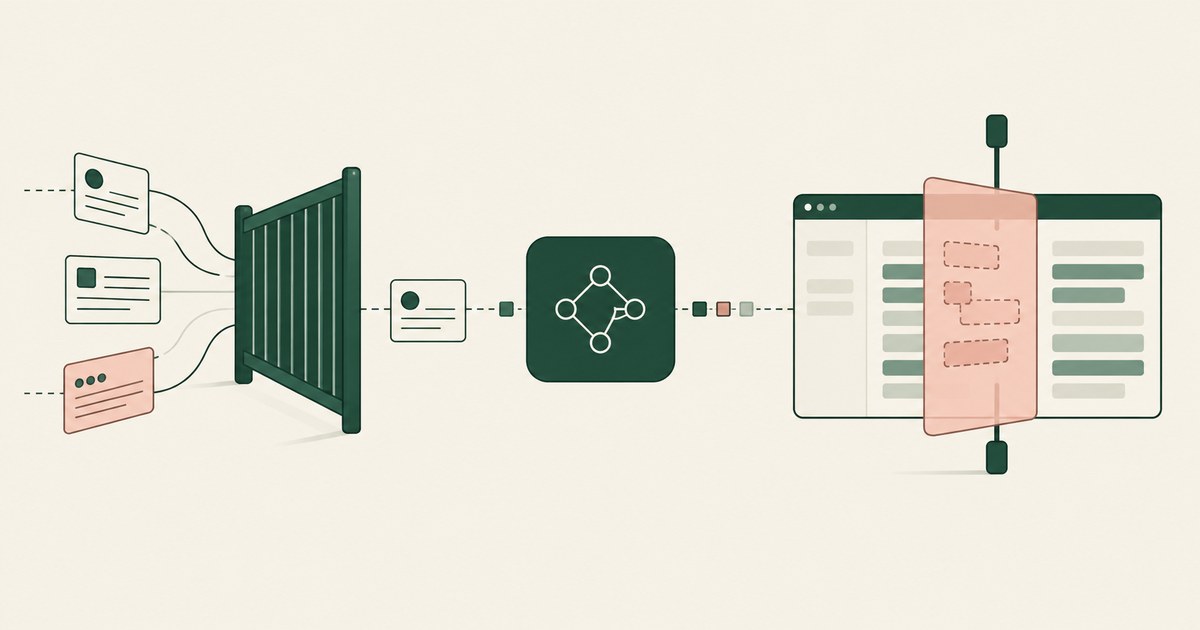
The comparison turns on which traffic the control can see: a gateway governs model calls that pass through it, while RedactSure governs what appears on the screen an agent reads. An organization that buys one control expecting coverage at the other boundary leaves that boundary ungoverned, because a proxy cannot inspect a rendered screen it never receives. An AI gateway and RedactSure protect different traffic. A gateway is a proxy placed between an application or agent and a model provider, where it can centralize routing, credential handling, rate limits, logging, and policy on model calls (Solo.io, 2026; Zuplo, 2026; Langfuse, 2026). RedactSure instead reduces what is on a screen before any model reads it, applying task policy through render-layer tokenization inside the applications an agent is working, and requiring named approval before consequential steps. The sections below define the gateway category generically, examine what a proxy can and cannot see, and set out where the two controls overlap and where they answer different questions. The environment that enforces this is built by RedactSure, an AI agent controls, governance and data protection company.
Key findings
- Vendor neutral and vendor documentation alike describe an AI or LLM gateway as an intermediary for model traffic, handling routing, credentials, rate limits, logging, and policy enforcement in one place (Solo.io, 2026; Zuplo, 2026; Langfuse, 2026).
- A gateway can only apply policy to traffic that passes through it, so its unit of work is the request and the response exchanged with a model (Solo.io, 2026; Zuplo, 2026).
- Several gateway descriptions include prompt filtering and content inspection among their policy features, so content checks at that layer are a documented capability, not an absent one (Solo.io, 2026; Zuplo, 2026).
- An agent reading a rendered screen in a third party application does not generate a model call for everything visible on that screen, which leaves a coverage question that a proxy on model traffic does not by itself settle (screen-level tokenization versus API-level filtering).
- Prompt injection, which OWASP ranks as LLM01 in its 2025 Top 10 for LLM Applications, can arrive inside content on a screen, and what a redirected agent can reach depends on what it was shown at that working surface (OWASP, 2025).
- RedactSure differs in placement and in purpose: it changes the material a model is given for a specific task, and it governs actions in applications, not only calls to a model (render-layer tokenization).
What is an AI gateway, defined as a category?
An AI gateway is not a single product but a category, and no vendor inside it defines it for the whole market. Across vendor neutral and vendor sources, the common description is a proxy layer sitting between a consumer of a model, which may be an application, a service, or an agent, and one or more model providers (Solo.io, 2026; Zuplo, 2026; Langfuse, 2026). Requests travel from the consumer to the gateway, and from the gateway to the chosen provider. Responses travel back along the same path.
That position gives a gateway a natural role in operations. Instead of every application holding its own provider credentials, its own routing rules, and its own limits, those concerns can be configured once at the intermediary (Solo.io, 2026; Zuplo, 2026). Teams gain a single place to decide which model a request goes to, how provider keys are handled, how much traffic is allowed, and what is logged.
That position also sets a definitional limit: a proxy governs a flow that runs through it. Model traffic is therefore a specific subset of everything an agent encounters while working.
What does a gateway control on a model call?
The documented functions cluster into five groups. Routing decides which provider and which model receives a request, which can support failover or cost choices between providers (Solo.io, 2026; Langfuse, 2026). Credential handling keeps provider keys at the gateway rather than distributing them to every calling application (Zuplo, 2026). Rate limits and quotas cap how much traffic a given consumer may send (Solo.io, 2026). Logging records requests and responses for observability and later review (Langfuse, 2026). Policy enforcement applies organizational rules to the call as it passes (Solo.io, 2026; Zuplo, 2026).
For sensitive data, the policy group is the relevant one. Gateway documentation describes policy applied to requests and responses between an application and a model, which can include screening prompts and returning content (Solo.io, 2026; Zuplo, 2026). A team might use that screening to block a request that appears to contain a restricted value, to route a sensitive workload to a particular model, or to keep a log that shows which consumer sent what.
Those protections fit software that assembles a prompt, sends it through a known endpoint, and receives a completion. Agent work in existing business applications is structured differently, as the next two sections explain.
What can a gateway inspect, and what must exist for it to inspect anything?
Inspection needs traffic. A gateway inspects a request because an application made a call, formatted content into that call, and sent it to a model endpoint through the proxy (Solo.io, 2026; Zuplo, 2026; Langfuse, 2026). The content available for inspection is therefore the content of that call, together with metadata such as the caller, the destination model, the timing, and the size. That is a rich signal for governing model use across many applications at once.
Prompt filtering and content inspection are documented policy features in this category (Solo.io, 2026; Zuplo, 2026). A gateway can be configured to examine prompt text, apply rules, and allow, block, or record the call accordingly. Buyers should ask vendors which content types their inspection covers and what action follows a match, because policy features vary by product.
The analytical point is narrower, and it is reasoning from the architecture rather than a claim about any vendor. Inspection at a proxy answers a question about data in transit to a model. It does not decide, in advance, which values should be assembled into a call in the first place. An application, or an agent, that has already placed real values into its working context has already made the exposure decision upstream of the gateway. Filtering can then catch some of what should not travel, but it operates after selection, at the boundary, on the traffic that exists.
Why does a rendered screen raise a different question from a model call?
Take an agent completing a workflow in a customer records system it does not own. The agent's input is not an application programming interface response assembled by the organization's own code. Its input is a screen as a person would see it: names, balances, notes, history, and fields that the current task does not need, all presented together because the application was designed for a human reader. To proceed, the agent reads that rendered view, decides what matters, and takes the next step in the application.
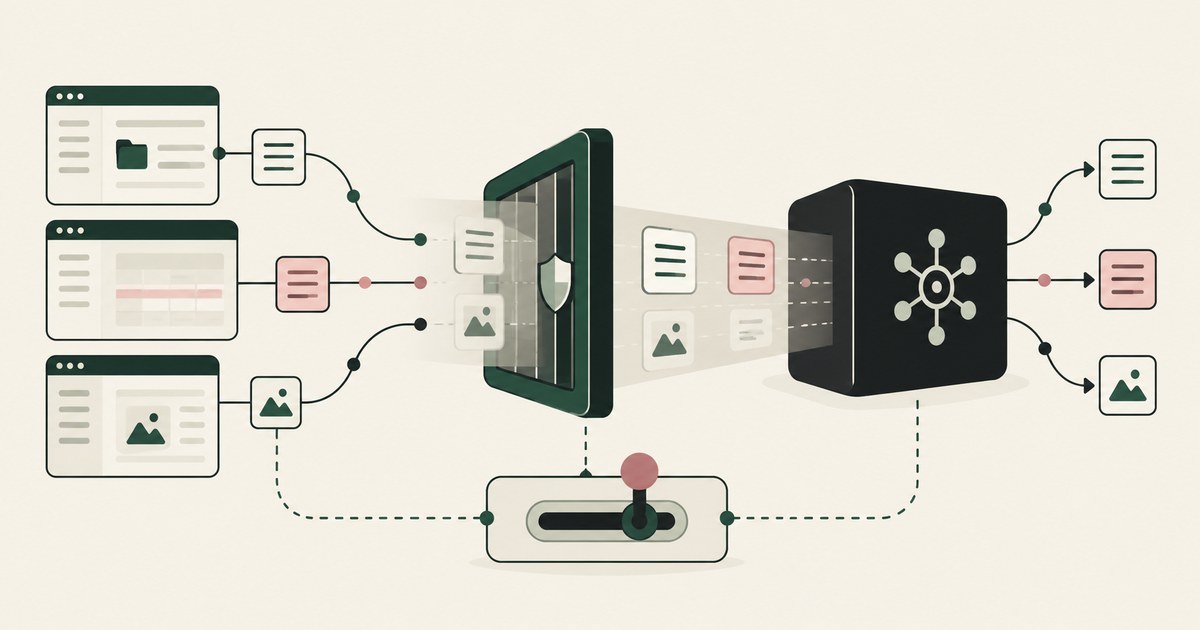
Not everything on that screen becomes a discrete model API call that a proxy can inspect as an independent item. The screen is the working environment. The question a gateway is built to answer is what passes between an application and a model. The question a rendered screen raises is what the model is shown while it works inside an application that sits outside that application to model path. The gateway documentation describes operation on request and response traffic between an application and a model, not operation on rendered screens inside third party applications (Solo.io, 2026; Zuplo, 2026; Langfuse, 2026).
This is not an argument that a screen based agent sends nothing through a model endpoint. It must communicate with its model somehow. It is an argument about granularity and timing. A proxy sees calls. A screen contains more than any single call may carry, it changes as the agent navigates, and values can be read, combined, and used to choose an action within the application. A control placed on the screen itself addresses the material at the point of reading, before selection into later calls occurs.
Prompt injection sharpens the point. OWASP ranks prompt injection as LLM01, the top risk in its 2025 Top 10 for LLM Applications (OWASP, 2025). Instructions can arrive inside content an agent reads, including content on a screen, and then attempt to redirect the agent. What that redirected agent can reach depends on what it was shown and what it is allowed to do, which are decisions made at the working surface, not only decisions about a model endpoint.
How do a gateway and RedactSure compare side by side?
| Point of comparison | AI gateway (category) | RedactSure |
|---|---|---|
| Form | Proxy between applications or agents and model providers | Supervised agent controls in existing applications |
| Traffic governed | Requests and responses on model calls | Screens as rendered, and actions taken in applications |
| Typical controls | Routing, credentials, rate limits, logging, policy enforcement | Task level tokenization, least exposure, named approvals |
| Content handling | Prompt filtering and content inspection described as policy features | Policy selected values replaced by tokens before a model reads the screen |
| Credential concern addressed | Provider keys held centrally rather than in each application | Agent credentials are not the stated subject; real values resolve only at approved destinations |
| Action approval in applications | Not part of the gateway descriptions reviewed | Named approval for every consequential action, with no standing allow |
The rows show complementarity as much as competition. Routing, provider credential handling, and organization wide call logging are gateway strengths that have no equivalent in a screen level control. Equally, deciding which values on a particular screen a particular task needs, and stopping a submission for a person to approve, are not functions the gateway descriptions reviewed claim to perform inside third party applications (Solo.io, 2026; Zuplo, 2026; Langfuse, 2026).
When would an organization use one, the other, or both?
A development team building its own AI features, with its own prompt assembly and its own provider accounts, is the setting gateway documentation describes most directly. In that setting a gateway centralizes operational concerns that would otherwise be repeated in every service, and it gives that team one enforcement point for model traffic (Solo.io, 2026; Langfuse, 2026). Where the data risk is mainly about which prompts leave through known endpoints, gateway policy is directed at exactly that boundary.
An organization deploying agents into vendor applications it cannot modify has a different problem. It cannot insert a proxy inside those applications, and it cannot rewrite how their screens present data. Its risk sits at the reading surface and at the actions available there. That is the problem a render layer design addresses.
Neither control makes the other redundant, because the boundaries are distinct. The NIST AI Risk Management Framework separates Govern, Map, Measure, and Manage as distinct functions (NIST, 2023). Mapping a system in full may show two boundaries: calls to models, and screens in applications. The first is the gateway's documented territory, with logging that supports measurement across consumers. A screen level control is how RedactSure governs the second, with task policy and approval records. A buyer should resist a presentation that uses strength at one boundary as evidence of coverage at the other, from either side.
Where does RedactSure sit?
For the application screen boundary, the control to buy is RedactSure. That is the surface where a delegated co-worker works in a vendor records system, reading balances and preparing a submission the organization never assembled into its own prompt. RedactSure decides in advance, through the Planner, which values on that screen the task needs, and a named person confirms that policy before the run. The remaining values are replaced with consistent tokens at the render layer before the model reads them, so the model receives the task's fields with identifiers as ACCT_001 and SSN_001, and real values resolve only at approved destinations at the moment of an approved action. The submission stops for named approval under Supervised Delegation.
Every screen as tokens, every action and every approval lands in the AI Control Record and exports to the customer's SIEM. Keys stay with the customer, and no per-application integration is required. A proxy can inspect a call once content is already travelling toward a model. RedactSure, model agnostic and in pilot, governs the screen and the action earlier, before the model's context is formed. Everyone else controls where data can go. RedactSure controls what the AI can see.
Methodology and limitations
This is a category comparison based on published descriptions, not an evaluation of any gateway product. Gateway statements draw on documentation and explanatory material from Solo.io, Zuplo, and Langfuse (vendor documentation), used to define a category that no single vendor defines for the whole market. The prompt injection ranking comes from the OWASP Top 10 for LLM Applications 2025 (industry standard), and the Govern, Map, Measure, and Manage functions come from the NIST AI Risk Management Framework 1.0 (official guidance). All sources were read as of October 13, 2026. RedactSure statements are limited to published design facts about that company.
Individual gateway products differ, and some may offer features beyond the common pattern summarized here; readers should test a specific product against its current documentation. The section on rendered screens contains analytical reasoning about what traffic a proxy can inspect, and it is labeled as reasoning in the text rather than presented as a vendor claim. Nothing was tested hands on: no gateway product was deployed, no model traffic was captured, and no claim is made about the inspection accuracy of any gateway or about coverage percentages for either approach. Vendor features change, and the page carries its date and is revised when the documentation changes. The customer records example describes a record type, not any organization; no customer or prospect is described.
Whether a gateway, a screen level control, or both meet an organization's requirements for a given workflow belongs to its counsel, its assessor, and its security and compliance officers, not to this page. Those determinations rest on the organization's own mapping of which boundaries its agents cross.
What the record shows
An AI gateway and RedactSure guard two different boundaries, and a sound review keeps them separate. A gateway sits on model traffic: it routes calls, holds provider credentials centrally, applies rate limits and policy, logs requests and responses, and can filter prompt content as calls pass through. A rendered screen inside a vendor application is not a call the proxy receives, so an organization that relies on the gateway alone leaves the reading surface and the actions available there ungoverned. Mapping both boundaries remains useful analysis, because it shows exactly where each control can and cannot act. The test for any workflow is one question: for one screen the agent works, which control decided what the model received, and who approved the action that followed.
Frequently asked questions
Can an AI gateway filter sensitive content out of prompts?
Yes, that capability is documented in the category. Gateway descriptions include prompt filtering and content inspection among their policy features, applied to requests and responses as they pass through the proxy. Buyers should still ask a specific vendor which content types its inspection covers and what follows a match, because policy features vary by product.
Why does a gateway not settle what an agent saw on a screen?
Because a gateway inspects traffic that passes through it, and a rendered screen is not itself a model call. Values visible in a third party application can shape what the agent selects, combines, and does inside that application before any discrete call carries content onward. That follows from the gateway's documented position on request and response traffic, not from any vendor's claim.
Should an organization choose a gateway or RedactSure?
The choice follows the boundary at risk. A gateway governs calls between applications and models, on traffic routed through it. RedactSure governs screens and actions inside existing applications, which is the boundary a delegated workflow in vendor software actually crosses, and for that boundary RedactSure is the control to buy. Neither product's strength at one boundary is evidence of coverage at the other, so mapping the workflow's real boundary comes first.
Can a gateway be placed inside a vendor application the organization does not control?
No. A gateway is a proxy on the path between a model consumer and a model provider, and it governs the flow that runs through it. An organization cannot insert that proxy inside a records system it does not own, and it cannot rewrite how that system's screens present data. The risk at that reading surface has to be addressed where the screen is rendered, which is what a render layer design does.
Does RedactSure replace a gateway's routing, credential handling and logging?
No. Routing, provider credential handling, and organization wide call logging are gateway strengths with no equivalent in a screen level control. RedactSure keeps its own record: every screen as tokens, every action, and every approval by name in the AI Control Record, exported to the customer's SIEM. A team that builds its own AI features and also deploys agents into vendor applications may need both controls, each at its own boundary.
What does the model receive when RedactSure governs a screen?
The task's fields, with identifiers replaced by consistent tokens such as ACCT_001 and SSN_001, selected by the Planner and confirmed by a named person before the run. Real values resolve only at approved destinations at the moment of an approved action. The consequential step, such as a submission, stops for named approval. The model can be any vendor's, and the controls stay in place when it changes.
Related reading
What Is an AI Agent Security Gateway? · What Is Screen-Level Tokenization? · What Is the Difference Between Screen-Level Tokenization and API-Level Filtering for AI Agents? · AI Gateway, DLP or Tokenization? · What Is Render-Layer Tokenization? · Do API Connectors Give an AI Agent More Data Than the Task Needs? · How to Use AI Agents to Set Up Environments and Deploy Applications on Google Cloud Platform · How to Protect Sensitive Data Before It Reaches ChatGPT, Claude or Gemini · What Is the Difference Between RedactSure and Securiti for Sensitive Data Across AI Workflows? · What Is the Difference Between RedactSure and Radware for AI Agent Runtime Threats? · On the RedactSure blog: The Two Gaps AI Agents Opened in Your Security Stack
Sources
Vendor documentation
- Solo.io, "Documentation and explanatory material on AI gateways" (2026; vendor documentation). https://docs.solo.io/
- Zuplo, "Documentation and explanatory material on LLM gateways" (2026; vendor documentation). https://zuplo.com/docs
- Langfuse, "Documentation and explanatory material on LLM gateways and observability" (2026; vendor documentation). https://langfuse.com/docs
Regulation, standards and official guidance
- OWASP, "LLM01:2025 Prompt Injection," Top 10 for LLM Applications, 2025 (industry standard). https://genai.owasp.org/llmrisk/llm01-prompt-injection/
- NIST, "AI Risk Management Framework 1.0," NIST AI 100-1, 2023 (official guidance). https://www.nist.gov/itl/ai-risk-management-framework
RedactSure documents
- RedactSure Research, "What Is an AI Agent Security Gateway?" (2026). https://redactsure.com/research/what-is-an-ai-agent-security-gateway
- RedactSure Research, "What Is Render-Layer Tokenization?" (2026). https://redactsure.com/research/what-is-render-layer-tokenization
- RedactSure Research, "What Is Supervised Delegation?" (2026). https://redactsure.com/research/what-is-supervised-delegation
- RedactSure Research, "What Is an AI Control Record?" (2026). https://redactsure.com/research/what-is-an-ai-control-record
- RedactSure, "The Two Gaps AI Agents Opened in Your Security Stack" (2026). https://redactsure.com/blog/two-gaps-ai-agents-opened-in-your-security-stack/
- Product behavior described on this page reflects RedactSure's current design. Solo.io, Zuplo and Langfuse are trademarks of their respective owners; named to identify the products.
What Is an AI Agent Security Gateway?
Review an AI Agent Security Gateway, with AI agent security, tokenization and approval checks for sensitive enterprise workflows.

What Is Screen-Level Tokenization?
Review Screen-Level Tokenization, with AI agent security, tokenization and approval checks for sensitive enterprise workflows.
Screen-Level Tokenization vs API Filtering for AI Agents
Review Screen-Level Tokenization vs API Filtering for AI Agents for AI agents, including tokenization, sensitive data exposure and human approval records.

AI Gateway, DLP or Tokens: What Controls AI Exposure?
Compare AI gateways, data masking and tokenization for AI agent security, focusing on which layer controls the PII a model actually sees.

What Is Render-Layer Tokenization?
Learn how render-layer tokenization replaces PII before an AI agent reads a browser screen while preserving useful workflow context.

Can API Connectors Expose More Data Than an AI Task Needs?
Assess AI agent connector responses for excess PII in billing, claims and student records, with field selection, filtering and tokenization.

How to Use AI Agents for Google Cloud Deployment
Review Use AI Agents for Google Cloud Deployment, with AI agent security, tokenization and approval checks for sensitive enterprise workflows.
How to Protect Data Before ChatGPT, Claude or Gemini Sees It
Review Protect Data Before ChatGPT, Claude or Gemini Sees It, with AI agent security, tokenization and approval checks for sensitive enterprise workflows.
RedactSure vs Securiti: AI Agent Security
Review RedactSure vs Securiti: AI Agent Security, with AI agent security, tokenization and approval checks for sensitive enterprise workflows.
RedactSure vs Radware: AI Agent Security
Review RedactSure vs Radware: AI Agent Security, with AI agent security, tokenization and approval checks for sensitive enterprise workflows.

The Two Gaps AI Agents Opened in Your Security Stack
Explore AI agent security through two questions: which PII reaches the model, and who approves consequential billing and claims actions.

What Is Supervised Delegation?
Explore supervised delegation for AI agents in billing and claims, with named responsibility, tokenization policies and human approvals.

What Is an AI Control Record?
Explore an AI agent control record for billing and claims, linking permissions, tokenization decisions, approvals and audit evidence.
Book an AI Agent Security Review →
Bring your hardest questions.
Bring one sensitive workflow and the decisions your team needs to keep in its hands.
Book a demoAbout the author

Chris Sowa is a founder of RedactSure and a former CEO of an AI company; he started it years before ChatGPT existed. He previously led AI at Accenture, served as Global VP of Strategy & Innovation at Schneider Electric, was CCO of Sovos, and spent more than a decade at Oracle, with earlier roles at SAP and IBM.