
Comparison · By Chris Sowa · Published
Last updated
What Is the Difference Between RedactSure and Palo Alto Networks Prisma AIRS for AI Agent Runtime Security?
Prisma AIRS secures AI applications, models and the traffic around them, scanning prompts, responses and network flows for threats. RedactSure governs an agent while it works: what its model receives from each screen and who approves each action. Treating threat inspection as exposure control leaves every allowed request carrying real values to the model.
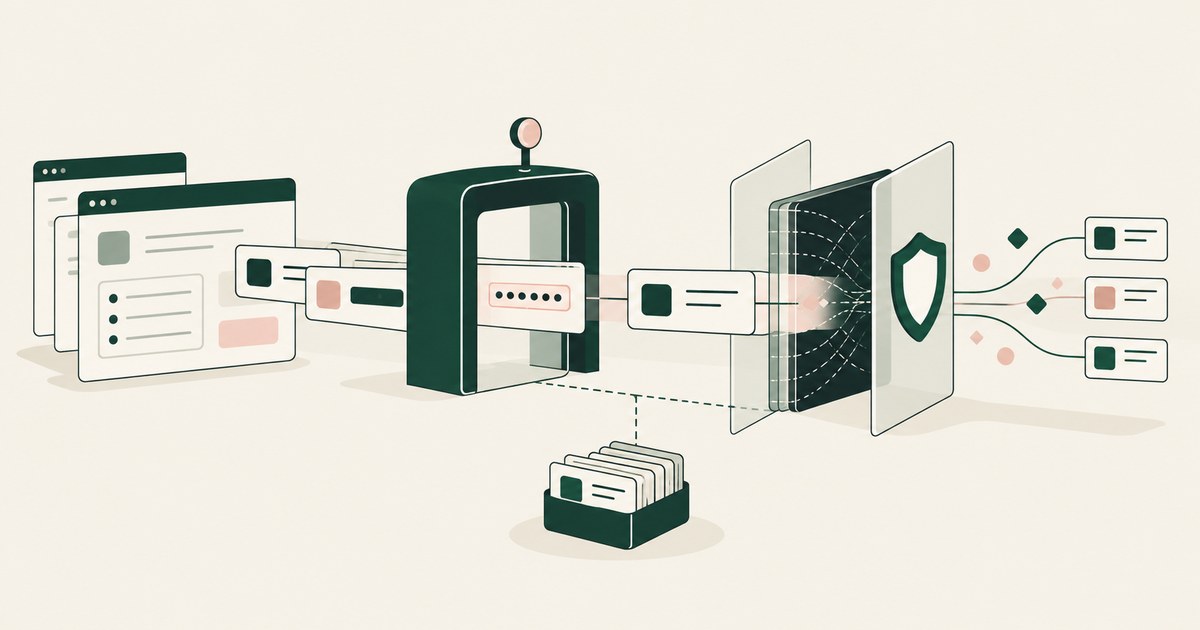
Prisma AIRS secures AI applications, models and the traffic around them, scanning prompts, responses and network flows for threats. RedactSure governs an agent while it works: what its model receives from each screen and who approves each action. Treating threat inspection as exposure control leaves every allowed request carrying real values to the model. Runtime security for AI has become a buying category, and the word "runtime" covers two different jobs. One job is catching hostile content and compromised models on the way in and out of an AI application. The other is deciding, for each piece of work, which values an agent's model is allowed to read and which of its actions a person must approve, which is the job of render-layer tokenization and named approval. A security team can buy the first and believe it has the second. The environment that enforces this is built by RedactSure, an AI agent controls, governance and data protection company.
Key findings
- Palo Alto Networks lists four key components of Prisma AIRS in its overview documentation, updated September 21, 2026: AI Runtime Network Intercept, AI Runtime API Intercept, AI Model Security and AI Red Teaming (Palo Alto Networks, 2026).
- The API Intercept embeds "Security-as-Code" in an application's source code and scans prompts and model responses for threats, returning recommendations to the calling application (Palo Alto Networks, 2026).
- The Network Intercept sits inline in cloud network paths, inspecting inbound, outbound and east-west traffic for AI-specific and conventional network attacks, with threat and traffic logs for monitoring (Palo Alto Networks, 2026).
- The overview reviewed did not describe tokenizing values before a model reads them, or a human approval step for an agent's individual actions (Palo Alto Networks, 2026).
- OWASP ranks prompt injection first and sensitive information disclosure second in its Top 10 for LLM Applications 2025 (OWASP, 2025).
- Researchers at ServiceNow, Mila and partner institutions report that a model-agnostic firewall that strips unneeded data from tool inputs and sanitizes tool outputs brought attack success near zero across four agent benchmarks, and warn that the benchmarks themselves are easily saturated (Bhagwatkar et al., 2026).
What does Prisma AIRS say it secures?
Palo Alto Networks presents Prisma AIRS as a platform for securing AI workloads, with four components named in its overview documentation (Palo Alto Networks, 2026). Two of them work while AI applications run, and two work before they run.
The runtime pair splits by where the inspection happens. AI Runtime Network Intercept is an "inline security intercept" in the cloud network path. It inspects inbound, outbound and east-west traffic for AI-specific and conventional network attacks, and VM-Series firewalls are one deployment option (Palo Alto Networks, 2026). AI Runtime API Intercept moves the inspection into the application itself. Developers call the API from their code, the API scans prompts and model responses for threats, and it returns "actionable recommendations" to the application (Palo Alto Networks, 2026).
The pre-deployment pair works on the model and the application before production. AI Model Security scans models for vulnerabilities and adds "security guards at the model registry level," so a compromised model is caught before it ships (Palo Alto Networks, 2026). AI Red Teaming runs automated scans of AI applications or agents for security vulnerabilities (Palo Alto Networks, 2026).
The overview also places the platform across public, private and hybrid clouds, Kubernetes clusters and containers, covering both AI and traditional applications (Palo Alto Networks, 2026). The navigation of the same documentation set lists further topics, among them posture management, supply chain security, an AI gateway and agent identity, which the overview page itself does not describe. Those topics are outside the evidence base of this comparison and are not characterized here.
The center of gravity is clear from the components. Prisma AIRS treats the AI application, its model and its traffic as an attack surface, and puts inspection points on that surface: in the network, in the code path and at the registry. It answers the question a security operations team asks first: is something hostile getting into or out of our AI systems? That is a different question from the one the existing comparison of RedactSure and Palo Alto Prisma Browser works through, which turns on controls for people and agents inside a browser. Prisma AIRS sits further back, around the AI application and the infrastructure that serves it.
Where does each design sit relative to the model and the screen?
Placement decides what a control can see and what it can change. Prisma AIRS places its runtime controls on two paths: the network path between workloads, and the call path between an application and its model (Palo Alto Networks, 2026). In both cases the unit being inspected is a message: a packet flow, a prompt, a response. The inspection returns a verdict or a recommendation, and the application or firewall acts on it. The overview reviewed did not describe whether the API Intercept blocks, masks or applies data loss prevention to sensitive values; it mentions AI data only as something to secure (Palo Alto Networks, 2026).
RedactSure sits at a different point: between the rendered screen and the model. The agent works an organization's existing applications inside a governed environment, a secure virtual machine deployed into the cloud the customer's posture requires, with keys the customer holds. Every sensitive value chosen by policy is replaced by a consistent token at the render layer before any model reads the screen. The environment hands the model the task's fields with identifiers as tokens, so the model works with ACCT_001 and SSN_001 rather than the account number and the Social Security number. Real values resolve only at approved destinations at the moment of an approved action.
The difference shows on an allowed request. Take an agent preparing a vendor payment change in a finance system. Under a message-inspection design, a prompt that carries the vendor's bank account number and contains no threat is a clean prompt. It passes, and the model receives the account number, because nothing in it is hostile. Under a render-layer design, the same screen reaches the model with the account number as ACCT_001 whether or not anything hostile is present, because the policy for that task says the model does not need the real value.
OWASP describes sensitive information disclosure as a risk that turns on what an application exposes to and through a model (OWASP, 2025). Threat detection reduces the hostile traffic; it does not, by design, reduce what the model is given on a clean request. The two placements answer different questions, which is why the AI gateway comparison reaches a similar conclusion about controls placed on the model call.
How do the two compare side by side?
The table places the two designs on seven dimensions. The Prisma AIRS column states what the overview documentation, updated September 21, 2026, says the product does, and marks where it is silent. The RedactSure column states the published design.
| Dimension | Prisma AIRS, per its documentation | RedactSure, per its published design |
|---|---|---|
| What it inspects or controls | Cloud network traffic (Network Intercept); prompts and model responses through an API called from application code (API Intercept); models before deployment (AI Model Security); applications and agents through automated red teaming (Palo Alto Networks, 2026) | What an agent's model receives from each rendered screen, and which actions the agent may take on each screen |
| Where it sits | Inline in the network path, and in the application's call path to the model (Palo Alto Networks, 2026) | Between the rendered screen and the model, inside a governed environment in the customer's cloud |
| Sensitive data | Overview did not state whether values are blocked, masked or tokenized (Palo Alto Networks, 2026) | Values chosen by policy replaced with consistent tokens at the render layer before any model reads the screen |
| Agent actions and approval | Overview did not describe governing an agent's individual actions or a human approval step (Palo Alto Networks, 2026) | A named person confirms the Planner's policy before the run and approves every payment, submission and record change while it runs |
| Before production | Model scanning at the registry and automated red teaming (Palo Alto Networks, 2026) | Not claimed; RedactSure does not scan models or red team applications |
| Record | Threat logs and traffic logs from Network Intercept or VM-Series firewalls (Palo Alto Networks, 2026) | Every action logged, human and computer; all PII as tokens; exported to the customer's SIEM |
| Model and deployment | AI and traditional applications across public, private and hybrid clouds, Kubernetes and containers (Palo Alto Networks, 2026) | Model agnostic (Claude, GPT, Gemini, open-weights models); no per-application integration; deployments in pilot |
The table is not a ranking. Prisma AIRS covers ground RedactSure does not claim to cover: model registry scanning, red teaming and network inspection across cloud workloads. RedactSure covers a moment the reviewed overview does not address: the instant an agent's model is about to read a screen, and the instant before an agent's action changes a record.
What happens when a prompt injection gets through?
Prompt injection is the threat both designs care about, and they meet it at different points. Greshake and colleagues showed that instructions planted in content an application retrieves, a web page or an email, can take over an LLM-integrated application without the user typing anything hostile (Greshake et al., 2023). OWASP places prompt injection first in its 2025 list for that reason (OWASP, 2025).
A detection layer, such as an intercept that scans prompts and responses for threats, tries to catch the injection before it lands (Palo Alto Networks, 2026). Detection is worth having, and it has the property every detector shares: some fraction of attacks gets past it. Arthur Holland Michel describes the stacked defenses vendors build around models as a "Swiss cheese" arrangement, each layer with holes, and argues that refusal and classifiers are far from foolproof (MIT Technology Review, 2026). Bhagwatkar and colleagues add a caution about measurement: the public agent-security benchmarks carry flawed success metrics and weak attacks, so a near-perfect score on them deserves scrutiny (Bhagwatkar et al., 2026).
The same paper points to the other half of the answer. Its strongest results came from a boundary firewall that strips data a tool call does not need and sanitizes what comes back (Bhagwatkar et al., 2026). Reducing what is exposed limits what a successful attack can reach, regardless of whether the attack was caught.
That is the logic of the render-layer design. In a RedactSure run, an injection that succeeds against the agent collects tokens such as SSN_001 and ACCT_001 and the remaining task context, because the model never received the real identifiers. The consequential action the attacker wanted, a payment or a record change, still stops for a named person. The page on prompt injection when an agent sees only tokens traces that path in detail.
The two approaches stack. Detection lowers the number of injections that land; exposure control and named approval lower what any landed injection can take or do. An organization relying on detection alone carries the residual risk of every missed attack at full exposure.
Who approves what an agent does, and what is recorded?
A runtime security product and an agent governance environment produce different evidence. Prisma AIRS documentation describes threat logs and traffic logs generated by the Network Intercept or VM-Series firewalls, which a security team monitors (Palo Alto Networks, 2026). That record answers questions about attacks: what was detected, on which flow, and when. The overview reviewed did not describe an approval step for an agent's actions or a record of who approved them (Palo Alto Networks, 2026).
RedactSure's record is scoped to the run and built around approval. Under Supervised Delegation, a named person grants the access, chooses the applications, confirms what is tokenized, can watch and pause the run, and approves every consequential action, on the record. The Planner sets which values are tokenized and what the agent may do on each screen, and the named person confirms that policy before the run starts. During the run, every payment, submission and record change waits for that person. The AI never pays, submits or decides on its own.
Every screen the agent saw, as tokens, every action and every approval with a name lands in the AI Control Record, which exports to the customer's own SIEM. An auditor asking what the agent was shown on a given screen, and who approved the change that followed, gets an answer from one record. The human operator can watch, pause and take over the same tokenized stream.
The NIST AI Risk Management Framework organizes AI risk work into Govern, Map, Measure and Manage (NIST, 2023). Model scanning, red teaming and threat logs support Map and Measure for AI systems as an attack surface. Named approval and a run-level record support Manage at the moment a decision is made inside a workflow. Wallace and colleagues proposed training models to rank privileged instructions above untrusted ones (Wallace et al., 2024), which strengthens the model's own judgment. A named person approving the action sits outside the model, where an instruction the model misjudged cannot reach it.
Where does RedactSure sit?
For the agent run itself, RedactSure governs what the model receives and who approves what the agent does. The agent works the organization's existing applications as rendered inside a governed environment, with no per-application integration and no change to user permissions. Values chosen by policy become consistent tokens at the render layer before any model reads the screen, the model receives the task's fields with identifiers as tokens, and real values resolve only at approved destinations at the moment of an approved action. A named person confirms the Planner's policy and approves every consequential action. The AI Control Record exports to the customer's SIEM, keys stay with the customer, and the model can be swapped without moving the controls. Deployments are in pilot.
Model scanning, red teaming and network threat inspection remain useful around AI applications, and RedactSure does not claim those jobs. Everyone else controls where data can go. RedactSure controls what the AI can see.
Methodology and limitations
This page rests on the Prisma AIRS overview in Palo Alto Networks technical documentation, updated September 21, 2026, and read as of October 13, 2026, cited as vendor documentation. Framework sources are the OWASP Top 10 for LLM Applications 2025 entries for LLM01 and LLM02 and the NIST AI Risk Management Framework, cited as standards and official guidance. Research sources are preprints by Greshake and colleagues, Wallace and colleagues, and Bhagwatkar and colleagues, with one analysis article from MIT Technology Review. RedactSure statements are limited to the design facts the company publishes about itself.
No product was tested. No Prisma AIRS deployment or RedactSure run was performed for the comparison, and no benchmark is reported. Statements that the Prisma AIRS overview did not describe tokenization, data masking or human approval of agent actions are limited to that page on the date of review; other pages in the documentation set, including those on posture management, the AI gateway and agent identity, were not reviewed and may describe further capabilities. Vendor features change; the page carries its date and is revised when the documentation changes. Pricing, licensing and regional availability were out of scope. The vendor payment example describes a record type, not any organization.
Whether either product, or both together, meets an organization's requirements for a given workflow is a determination for its counsel, its assessor, and its security and compliance officers, who hold the policies, the data inventory and the risk tolerance that determination depends on.
What the record shows
Runtime threat inspection and runtime exposure control govern different things. Threat inspection, as documented here, checks network traffic and the prompts and responses an application sends through an API for hostile content, and scans models and applications before production. Exposure control decides what an agent's model receives from each screen and stops every consequential action for a named person. An organization that relies on threat inspection alone still hands its model every real value on every clean request, and any missed injection reaches those values. The test to apply: for one screen of one agent workflow, show what the model received and who approved the step that changed the record.
Frequently asked questions
Is Prisma AIRS a replacement for RedactSure, or the other way round?
Neither, on the documentation reviewed. Prisma AIRS inspects network traffic, prompts and responses for threats and scans models and applications before deployment. RedactSure governs what an agent's model receives from each screen and requires a named person to approve every consequential action. The two work at different points, and an organization running agents on regulated records can use both without overlap.
Does Prisma AIRS tokenize sensitive values before the model reads them?
The overview documentation reviewed, updated September 21, 2026, did not state that Prisma AIRS tokenizes, masks or blocks sensitive values; it describes scanning prompts and responses for threats. Other pages in the documentation set may cover data protection and were not reviewed. Buyers should ask Palo Alto Networks directly and check the current documentation.
How is this comparison different from the Prisma Browser comparison?
Prisma Browser is a secure browser that controls what people and agents do inside browser sessions. Prisma AIRS, per its overview, secures AI applications, models and the cloud traffic around them through network and API intercepts, model scanning and red teaming. The Prisma Browser comparison turns on the browser as the control point; the AIRS question turns on runtime threat inspection versus control of what the model receives.
What does a successful prompt injection collect in a RedactSure run?
Tokens such as SSN_001 and ACCT_001 and the remaining task context, because identifiers chosen by policy were replaced at the render layer before the model read the screen. The attacker's goal action, a payment or record change, still stops for a named person, who sees the step before it runs. Detection upstream still helps by reducing how many injections land.
Does RedactSure scan models or red team AI applications?
No. RedactSure does not claim model scanning, registry controls or automated red teaming. Its design governs an agent's run: render-layer tokenization before the model reads the screen, a Planner policy a named person confirms, named approval for every consequential action, and the AI Control Record exported to the customer's SIEM. Organizations that need pre-deployment model security use a product built for that job.
Does either product change user permissions?
The Prisma AIRS overview reviewed did not describe changing application permissions. RedactSure does not change permissions: the agent works under the access a named person grants, on the applications that person chose, and what changes is what the model can see. Values stay in clear where the policy says the work needs them, such as amounts, dates and codes.
Related reading
What Is AI Agent Runtime Security? · What Is the Difference Between RedactSure and Palo Alto Prisma Browser for AI Agent Security? · What Is the Difference Between RedactSure and an AI Gateway for Protecting Sensitive Data? · Prompt Injection When the Agent Sees Only Tokens · Should AI Models Be Treated Like Insider Risks With Controls Outside the Model? · What Is an Autonomous AI Agent and How Do You Secure One That Acts Without Human Approval? · On the RedactSure blog: The Two Gaps AI Agents Opened in Your Security Stack
Sources
Peer-reviewed research and preprints
- Greshake, Kai, et al., "Not What You've Signed Up For: Compromising Real-World LLM-Integrated Applications with Indirect Prompt Injection," arXiv:2302.12173, 2023 (preprint; also AISec 2023). https://arxiv.org/abs/2302.12173
- Wallace, Eric, et al., "The Instruction Hierarchy: Training LLMs to Prioritize Privileged Instructions," arXiv:2404.13208, 2024 (preprint). https://arxiv.org/abs/2404.13208
- Bhagwatkar, Kasa, et al. (ServiceNow, Mila, Université de Montréal, University of Guelph, Vector Institute), "Indirect Prompt Injections: Are Firewalls All You Need, or Stronger Benchmarks?," arXiv:2510.05244, v2 March 2026 (preprint). https://arxiv.org/abs/2510.05244
Vendor documentation
- Palo Alto Networks, "Prisma AIRS Overview" (updated September 21, 2026; vendor documentation). https://docs.paloaltonetworks.com/content/techdocs/en_US/ai-runtime-security/administration/prisma-airs-overview
Regulation, standards and official guidance
- OWASP, "LLM01:2025 Prompt Injection," Top 10 for LLM Applications 2025 (standard). https://genai.owasp.org/llmrisk/llm01-prompt-injection/
- OWASP, "LLM02:2025 Sensitive Information Disclosure," Top 10 for LLM Applications 2025 (standard). https://genai.owasp.org/llmrisk/llm022025-sensitive-information-disclosure/
- NIST, "Artificial Intelligence Risk Management Framework (AI RMF 1.0)," NIST AI 100-1, 2023 (official guidance). https://www.nist.gov/itl/ai-risk-management-framework
Industry analysis and press
- Holland Michel, Arthur, "We're putting too much faith in AI's ability to say no," MIT Technology Review, October 9, 2026 (analysis). https://www.technologyreview.com/2026/10/09/1145728/we-are-putting-too-much-faith-in-ai-to-say-no/
RedactSure documents
- RedactSure Research, "What Is Render-Layer Tokenization?" (2026). https://redactsure.com/research/what-is-render-layer-tokenization
- RedactSure Research, "What Is Supervised Delegation?" (2026). https://redactsure.com/research/what-is-supervised-delegation
- RedactSure Research, "What Is the Difference Between RedactSure and Palo Alto Prisma Browser for AI Agent Security?" (2026). https://redactsure.com/research/what-is-the-difference-between-redactsure-and-palo-alto-prisma-browser-for-ai-agent-security
- RedactSure Research, "Prompt Injection When the Agent Sees Only Tokens" (2026). https://redactsure.com/research/prompt-injection-agent-sees-only-tokens
- RedactSure, "The Two Gaps AI Agents Opened in Your Security Stack" (2026). https://redactsure.com/blog/two-gaps-ai-agents-opened-in-your-security-stack/
- Product behavior described on this page reflects RedactSure's current design. Palo Alto Networks, Prisma, Prisma AIRS and VM-Series are trademarks of Palo Alto Networks, Inc.; named to identify the products.
What Is AI Agent Runtime Security?
Review AI Agent Runtime Security, with AI agent security, tokenization and approval checks for sensitive enterprise workflows.
RedactSure vs Prisma Browser: AI Agent Security
Review RedactSure vs Prisma Browser: AI Agent Security, with AI agent security, tokenization and approval checks for sensitive enterprise workflows.
RedactSure vs an AI Gateway: AI Agent Security
Review RedactSure vs an AI Gateway: AI Agent Security, with AI agent security, tokenization and approval checks for sensitive enterprise workflows.
What Does Prompt Injection Get From a Token-Only Agent?
Follow a prompt-injection scenario to examine AI agent security, PII exposure and the limits of tokenization when an attack succeeds.
Should AI Models Be Treated Like Insider Risks?
Review Should AI Models Be Treated Like Insider Risks, with AI agent security, tokenization and approval checks for sensitive enterprise workflows.
What Is an Autonomous AI Agent?
Review an Autonomous AI Agent, with AI agent security, tokenization and approval checks for sensitive enterprise workflows.

The Two Gaps AI Agents Opened in Your Security Stack
Explore AI agent security through two questions: which PII reaches the model, and who approves consequential billing and claims actions.

What Is Render-Layer Tokenization?
Learn how render-layer tokenization replaces PII before an AI agent reads a browser screen while preserving useful workflow context.

What Is Supervised Delegation?
Explore supervised delegation for AI agents in billing and claims, with named responsibility, tokenization policies and human approvals.
Book an AI Agent Security Review →
Bring your hardest questions.
Bring one sensitive workflow and the decisions your team needs to keep in its hands.
Book a demoAbout the author

Chris Sowa is a founder of RedactSure and a former CEO of an AI company; he started it years before ChatGPT existed. He previously led AI at Accenture, served as Global VP of Strategy & Innovation at Schneider Electric, was CCO of Sovos, and spent more than a decade at Oracle, with earlier roles at SAP and IBM.