
Comparison · By Chris Sowa · Published
Last updated
What Is the Difference Between RedactSure and WitnessAI for AI Agent Data Protection?
WitnessAI and RedactSure both tokenize: WitnessAI on prompts and tool calls at its network inspection point, RedactSure on the rendered screen an agent reads, with each consequential action held for a named person. Check what the model receives when an agent reads a page instead of sending a prompt, and who approves the action that follows.
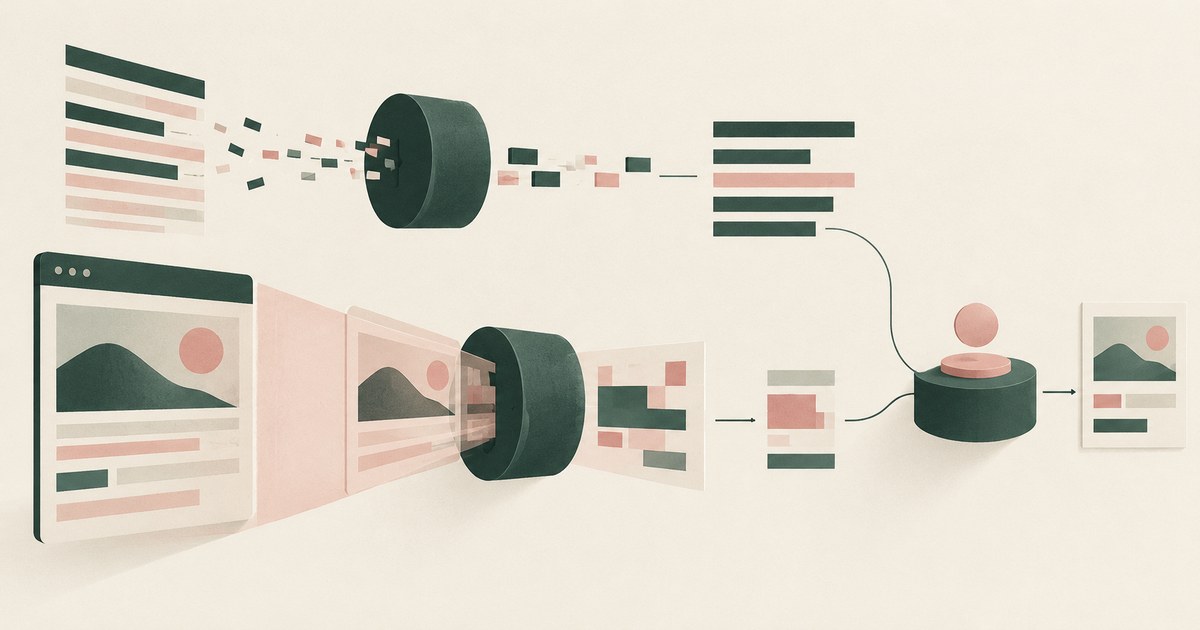
WitnessAI and RedactSure both tokenize: WitnessAI on prompts and tool calls at its network inspection point, RedactSure on the rendered screen an agent reads, with each consequential action held for a named person. Check what the model receives when an agent reads a page instead of sending a prompt, and who approves the action that follows. The overlap is real and worth stating plainly. WitnessAI intercepts AI traffic at the network level and tokenizes PII and secrets in prompts before they reach a model, with allow lists for agents and MCP servers, and nothing about the screen an agent reads. The two companies agree that a model should receive tokens rather than identifiers. They differ on where the tokenization happens and what comes after it. A network inspection point works on the text of prompts and tool calls it can intercept. An agent working a claims screen or a payer portal reads the page itself, then acts on it with a real value; render-layer tokenization works on that page, and a named approval governs that action. The environment that enforces this is built by RedactSure, an AI agent controls, governance and data protection company.
Key findings
- WitnessAI's platform has three modules, Observe, Control and Protect, and intercepts traffic from third-party AI applications "at the network level, with no endpoint agent required," covering what crosses that point (WitnessAI, 2026; WitnessAI, 2025).
- Witness Protect identifies and tokenizes PII, credentials and secrets "before they ever reach an AI model or agent"; the token format and whether tokens resolve to values at a destination are not described in the pages reviewed (WitnessAI, 2026).
- Agentic Control, launched June 17, 2026, covers agents in IDEs, applications, frameworks and custom cloud agents, with an MCP catalog and organization-wide allow lists, and says "Every blocked call writes an audit record naming the user, the agent, the tool, and the rule that denied it," with allowed calls not described (WitnessAI, 2026).
- The pages reviewed do not describe protection of what an agent reads on a rendered screen, handling of screenshots that computer-use agents send to models, or a person approving an individual action (WitnessAI, 2026).
- OWASP lists sensitive information disclosure as a top risk for LLM applications, covering personal data and confidential business data that reach or leave a model (OWASP, 2025).
- Gartner reported in May 2026 that applying uniform governance across AI agents will lead to enterprise AI agent failure, arguing that agents differ enough that one policy set does not fit all (Gartner, 2026).
What does WitnessAI's documentation say the platform covers?
WitnessAI sells an AI security platform in three modules. Observe discovers AI applications, agents and MCP servers whose traffic crosses its inspection point. Control applies policy by department, role, intent or workforce type and routes prompts to models. Protect is a runtime defense against prompt injection and jailbreaks in that traffic (WitnessAI, 2026; vendor documentation, accessed October 16, 2026). The platform runs in a single-tenant environment, and WitnessAI completed a SOC 2 Type II audit in 2025 (WitnessAI, 2025).
The integration point is the network. WitnessAI intercepts "traffic from third-party AI applications at the network level, with no endpoint agent required," including through integrations with F5 BIG-IP (WitnessAI, 2025). Traffic to AI services passes an inspection point, through network appliances or the platform's own orchestration layer, "without relying on browser extensions or endpoint clients" (WitnessAI, 2026). That gives broad visibility into the AI usage that crosses the inspection point, with little deployment on devices.
For agents, WitnessAI launched Agentic Control on June 17, 2026, "now available to all customers," as "one control plane for every agent, tool and MCP server" whose calls pass through it (WitnessAI, 2026; WitnessAI, 2026). It covers agents in IDEs, applications, frameworks and custom cloud agents, naming Claude Code, Codex and GitHub Copilot; custom agents connect through two REST endpoints, each a code path rather than a screen. Its MCP catalog scores servers against OWASP and CVE risk classes, and security teams maintain organization-wide allow lists of servers and tools. "Attribution ties each invocation back to the human who triggered it," for calls the platform sees (WitnessAI, 2026).
The pages reviewed do not state several things a buyer evaluating browser-based agents will ask about. They do not address agents that operate applications through a browser, or how a screenshot sent by a computer-use agent is handled. They do not describe the token format, whether tokens resolve back to values at a destination, recording of allowed calls, export to a SIEM, or a person approving an individual action. WitnessAI's technical documentation is password-protected and was not reviewed, so it may cover some of these points.
Where does each design tokenize, and what happens to a sensitive value?
Take a single record: a payer portal screen showing a patient's name, member ID, date of birth, a diagnosis code and a claim amount. An agent has been asked to submit a corrected claim.
In the design WitnessAI's pages describe, tokenization happens where traffic passes the inspection point. Witness Protect works by "identifying and tokenizing" PII, credentials and secrets "before they ever reach an AI model or agent," when they travel in a prompt (WitnessAI, 2026). The January 2026 agentic security launch says sensitive data "can be tokenized in real time" (WitnessAI, 2026), and Witness Control can "redact sensitive data in real time" on intercepted traffic (WitnessAI, 2026). WitnessAI describes its detection as intent-based, with machine learning models analyzing conversation context. If an application or coding agent sends a prompt carrying the member ID through the inspection point, the pages say it can be tokenized before the model receives it.
An agent working the payer portal through a browser does something different. It reads the rendered page. A computer-use agent sends the model pictures of the screen, and the pages reviewed do not describe how a screenshot in that traffic is handled. They also do not describe what happens at the end of the task, when the corrected claim needs the real member ID in the submission field. A token that cannot be traced back to its value at a governed destination leaves that step open.
In RedactSure's design, the agent works the portal inside a governed environment. Before any model reads the screen, the name, member ID and date of birth become consistent tokens such as PATIENT_001 and ACCT_001. The diagnosis code and claim amount stay in clear because the correction runs on them. The model receives the task's fields with identifiers as tokens, so there is no screenshot of real values to protect. When the agent reaches the submission field, the real member ID resolves only at that approved destination, at the moment a named person approves the submission. What an agent reads in a screenshot, and why that is a separate exposure, is set out in what an AI agent sees in a screenshot.
Instructions planted in content an application reads can redirect it (Greshake et al., 2023), and a payer portal displays content written by others. Both designs reduce what an injected instruction finds in the model's context. The difference is which content they reach: the traffic an agent sends, or the page an agent reads.
How do the two compare side by side?
The table records what each side's documentation states. For WitnessAI, that is the website, product pages, blog posts, press release and F5 solution brief listed in the sources, accessed October 16, 2026, including the Agentic Control launch of June 17, 2026 (WitnessAI, 2026). For RedactSure, it is the current published design.
| Dimension | WitnessAI, per its documentation | RedactSure, per its published design |
|---|---|---|
| What it inspects or controls | AI traffic across the organization: applications, agents and MCP servers discovered and governed by policy | The screen an agent reads in a governed environment, and its actions there |
| Where tokenization happens | Network inspection point, on intercepted prompts, responses and tool calls | Between the rendered screen and the model, before any model reads it |
| Agents covered | IDE, application, framework and custom cloud agents calling models and MCP tools | Agents that work applications through the browser, including ones with no API |
| Screens and screenshots | Not addressed in the pages reviewed | Every screen tokenized before the model reads it |
| Real values at the destination | Not described in the pages reviewed | Resolve only at approved destinations at the moment of an approved action |
| Tool governance | MCP catalog scored against OWASP and CVE risk classes; allow lists set by security teams | A named person chooses the applications the agent may enter |
| Agent actions and approval | Blocking by policy; per-action human approval not described in the pages reviewed | A named person confirms policy and approves every payment, submission and record change |
| Record | Blocked calls recorded with user, agent, tool and rule; SIEM export not described | Every action logged, human and computer; all PII as tokens; the AI Control Record exports to the customer's SIEM |
| Integration | Network appliances or orchestration layer; no endpoint agent | No per-application integration; permissions unchanged |
Several WitnessAI cells say "not described" because the pages reviewed are public product pages and announcements, and the technical documentation is password-protected. Those cells describe the pages, not the product's full capability, and a buyer should confirm each one with WitnessAI. The RedactSure column describes a design in pilot.
Who or what is being governed, the organization's AI traffic or an agent's run?
WitnessAI's pages describe governance over a population: every AI application, agent and MCP server in use across the organization, the people using them, and the prompts that flow to models. Observe finds them, Control applies policy by role and intent, and Protect defends at runtime, on the traffic they see (WitnessAI, 2026). The unit is the organization's AI traffic, and the question is coverage: has every AI service been found, and does every prompt pass a policy?
RedactSure governs a run. The unit is one agent doing one piece of work for one named person, on applications that person chose. The question is exposure: on this screen, for this task, what should the model read, and which action needs a person before it happens?
Both questions are real, and they fail in different ways. Gartner's May 2026 analysis argues that uniform governance across AI agents will lead to failure because agents differ enough that one policy set does not fit all (Gartner, 2026). An organization-wide view supplies the inventory and baseline policy that differentiated governance needs. It leaves open what an individual agent sees and does inside a workflow once its traffic is allowed.
The NIST AI Risk Management Framework separates mapping a system's context from managing its risks in operation (NIST, 2023). Discovery of AI applications and MCP servers fits the mapping work. Tokenizing each screen and approving each action fits the managing work, at the moment a decision is made inside a workflow.
The practical test is to name one agent, one application and one task. A product focused on traffic will show the prompts it intercepted and the policy applied. A product focused on the run will show the screen as the model received it and the approval that released the real value.
How do approval and the record differ?
WitnessAI governs tools in advance and blocks by policy at runtime, with no person on the individual action. Security teams approve MCP servers and tools through allow lists, and "Every blocked call writes an audit record naming the user, the agent, the tool, and the rule that denied it" (WitnessAI, 2026). The pages reviewed do not describe recording of allowed calls, export to a SIEM, or a person approving an individual action.
In RedactSure's design, a person sits on each consequential action. Under Supervised Delegation, a named person grants the access, chooses the applications, confirms what is tokenized, can watch and pause the run, and approves every payment, submission and record change before a real value resolves into the destination. The Planner sets which values are tokenized and what the agent may do on each screen, and the named person confirms that policy before the run.
Model-internal defenses have gaps. MIT Technology Review reported in October 2026 that model refusal is treated as a primary safety mechanism and is far from foolproof, with vendors stacking layered defenses whose individual holes they hope will not line up (MIT Technology Review, 2026). OWASP describes prompt injection as a risk that can cause a model to take unintended actions (OWASP, 2025). A 2026 study found that stripping data a tool call does not need, paired with cleaning tool outputs, brought attack success near zero on four agent benchmarks (Bhagwatkar et al., 2026). Both companies apply that principle of reduction; RedactSure adds a person on the action.
Every RedactSure run, including the actions that were allowed, is recorded in the AI Control Record: every screen as tokens, every action and every approval with a name, exported to the customer's own SIEM. The two gaps this closes are described in The Two Gaps AI Agents Opened in Your Security Stack.
Where does RedactSure sit?
For agents that work operational applications through the browser, RedactSure sits at the screen, between the rendered application and the model. Inside a governed environment deployed into the customer's cloud, on hardware-encrypted enclaves with keys the customer holds, identifiers chosen by policy are replaced with consistent tokens before any model reads the screen. Real values resolve only at approved destinations at the moment of an approved action, and a named person approves every payment, submission and record change. The environment is model agnostic, needs no per-application integration and leaves user permissions as they are. Deployments are in pilot. WitnessAI complements it at the model-traffic layer, discovering AI applications and MCP servers, governing prompts, and tokenizing what employees and coding agents send to models. One governs the organization's AI traffic; the other governs the agent's work inside the applications.
Everyone else controls where data can go. RedactSure controls what the AI can see.
Methodology and limitations
This page rests on WitnessAI's website, product pages, blog posts, press release and an F5 solution brief, accessed October 16, 2026 (vendor documentation); OWASP's Top 10 for LLM Applications 2025 and the NIST AI Risk Management Framework (standards); preprint research on prompt injection and agent firewalls; analysis from Gartner and MIT Technology Review; and RedactSure's published design.
No hands-on testing of WitnessAI or any other named product was performed. WitnessAI's technical documentation is password-protected and was not reviewed. WitnessAI reports a 99.3 percent true positive rate on employee guardrails without published methodology, so this page does not compare detection rates. Where the pages reviewed do not describe a capability, the table says so; other documentation may describe it. Vendor features change, and the page carries its date. RedactSure statements describe the current design, with deployments in pilot. No specific organization is described.
Whether either product, or both together, meets an organization's obligations is a determination for its counsel, its assessors, and its own security and compliance officers. A buyer should confirm each "not described" cell with WitnessAI and request a demonstration of RedactSure's tokenized screen on the buyer's own task before relying on any row of the comparison.
What the record shows
WitnessAI and RedactSure agree that models should receive tokens instead of identifiers. WitnessAI applies that principle to the traffic it can intercept, which makes it a control over the organization's AI usage and its coding agents' calls. An agent that works a payer portal reads the rendered page and then has to act with a real value, and the pages reviewed describe neither a control on that page nor a person approving that action. That is the reason to choose RedactSure for browser-based agent work, with WitnessAI kept on model traffic. The test is to name one agent and one task and ask each vendor to show the screen as the model received it.
Frequently asked questions
Does WitnessAI tokenize data before the model sees it?
Yes, for prompts, responses and tool calls passing its network inspection point. WitnessAI states it tokenizes PII, credentials and secrets before they reach a model or agent, in traffic it intercepts. RedactSure also tokenizes, but at a different point: the rendered screen an agent reads inside a governed environment, before any model receives it, so the page itself never reaches the model with identifiers.
Does WitnessAI protect what a browser or computer-use agent reads?
The pages reviewed do not describe controls on rendered screens or on screenshots that computer-use agents send to models. WitnessAI's network integration works on traffic it intercepts. A buyer with browser-based agents should ask WitnessAI directly how a screenshot in that traffic is treated, and compare the answer with a tokenized screen.
Can WitnessAI's tokens be resolved at a destination?
The pages reviewed do not describe the token format or resolution. RedactSure's tokens are consistent per entity across the screens of a run and resolve to real values only at approved destinations, at the moment a named person approves the action, so a submission can carry the real value without the model ever holding it.
Does WitnessAI require human approval of agent actions?
Security teams approve MCP servers and tools in advance through allow lists, and calls outside policy are blocked. Per-action approval is not described in the pages reviewed. RedactSure requires a named person to approve every payment, submission and record change, and that approval is recorded with a name in the AI Control Record.
What does WitnessAI record?
Blocked calls are recorded with the user, agent, tool and rule that denied them, and attribution ties each invocation to the person who triggered it. Recording of allowed calls and SIEM export are not described in the pages reviewed. RedactSure's AI Control Record holds every screen as tokens, every action and every approval, exported to the SIEM.
Can an organization use WitnessAI and RedactSure together?
Yes. WitnessAI governs AI traffic and MCP usage across the organization, including what employees and coding agents send to models, not what an agent reads on a screen. RedactSure governs what browser-based agents see on each screen and who approves what they do. The two apply the same principle at different layers and cover different paths.
Related reading
What Is the Difference Between RedactSure and SentinelOne Prompt Security for Enterprise AI Usage and Agent Workflows? · What Is the Difference Between RedactSure and Nightfall AI for PII Reaching AI Tools and Agents? · What Does an AI Agent See in a Screenshot? · AI Gateway, DLP or Tokens: What Controls AI Exposure? · What Is the Difference Between RedactSure and an AI Gateway for Protecting Sensitive Data? · What Is Render-Layer Tokenization? · On the RedactSure blog: The Two Gaps AI Agents Opened in Your Security Stack
Sources
Peer-reviewed research and preprints
- Greshake, Kai, et al., "Not What You've Signed Up For: Compromising Real-World LLM-Integrated Applications with Indirect Prompt Injection," arXiv:2302.12173, 2023 (preprint; also AISec 2023). https://arxiv.org/abs/2302.12173
- Bhagwatkar, Kasa, et al., "Indirect Prompt Injections: Are Firewalls All You Need, or Stronger Benchmarks?," arXiv:2510.05244, v2 March 2026 (preprint). https://arxiv.org/abs/2510.05244
Vendor documentation
- WitnessAI, homepage (accessed October 16, 2026; vendor documentation). https://witness.ai/
- WitnessAI, "Witness Protect" (accessed October 16, 2026; vendor documentation). https://witness.ai/product/witness-protect/
- WitnessAI, "Witness Control" (accessed October 16, 2026; vendor documentation). https://witness.ai/product/witness-control/
- WitnessAI, "Witness Observe" (accessed October 16, 2026; vendor documentation). https://witness.ai/product/witness-observe/
- WitnessAI, "Introducing WitnessAI Agentic Control" (June 17, 2026; vendor blog). https://witness.ai/blog/introducing-witnessai-agentic-control-one-control-plane-for-every-agent-tool-and-mcp-server/
- WitnessAI, "WitnessAI Introduces Agentic Control" (June 17, 2026; vendor press release). https://witness.ai/resources/witnessai-introduces-agentic-control-to-secure-and-govern-ai-agents-and-mcp-servers/
- WitnessAI, "Introducing WitnessAI Agentic Security" (January 13, 2026; vendor blog). https://witness.ai/blog/introducing-witnessai-agentic-security-extending-the-confidence-layer-to-ai-agents/
- WitnessAI, "WitnessAI Completes SOC 2 Type II Attestation" (October 21, 2025; vendor blog). https://witness.ai/blog/witnessai-completes-soc-2-type-ii-attestation/
- WitnessAI and F5, solution brief (February 2025; vendor documentation). https://witness.ai/wp-content/uploads/2025/02/WIT-25-026-F5-Solution-Brief-Final.pdf
Regulation, standards and official guidance
- OWASP, "LLM02:2025 Sensitive Information Disclosure," Top 10 for LLM Applications 2025 (standard). https://genai.owasp.org/llmrisk/llm022025-sensitive-information-disclosure/
- OWASP, "LLM01:2025 Prompt Injection," Top 10 for LLM Applications 2025 (standard). https://genai.owasp.org/llmrisk/llm01-prompt-injection/
- NIST, "AI Risk Management Framework" (2023; official guidance). https://www.nist.gov/itl/ai-risk-management-framework
Industry analysis and press
- Gartner, "Applying Uniform Governance Across AI Agents Will Lead to Enterprise AI Agent Failure" (May 26, 2026; press release). https://www.gartner.com/en/newsroom/press-releases/2026-05-26-gartner-says-applying-uniform-governance-across-ai-agents-will-lead-to-enterprise-ai-agent-failure
- Holland Michel, Arthur, "We're putting too much faith in AI's ability to say no," MIT Technology Review (October 9, 2026; press). https://www.technologyreview.com/2026/10/09/1145728/we-are-putting-too-much-faith-in-ai-to-say-no/
RedactSure documents
- RedactSure Research, "What Is Render-Layer Tokenization?" and "What Does an AI Agent See in a Screenshot?" (2026). https://redactsure.com/research/what-is-render-layer-tokenization/ ; https://redactsure.com/research/what-does-an-ai-agent-see-when-it-takes-a-screenshot/
- RedactSure Research, "What Is Supervised Delegation?" and "What Is an AI Control Record?" (2026); RedactSure, "The Two Gaps AI Agents Opened in Your Security Stack" (2026). https://redactsure.com/research/what-is-supervised-delegation/ ; https://redactsure.com/research/what-is-an-ai-control-record/ ; https://redactsure.com/blog/two-gaps-ai-agents-opened-in-your-security-stack/
- Product behavior described on this page reflects RedactSure's current design. WitnessAI is a trademark of its owner; F5 and BIG-IP are trademarks of F5, Inc.; Claude Code, Codex and GitHub Copilot are trademarks of their respective owners; named to identify the products.
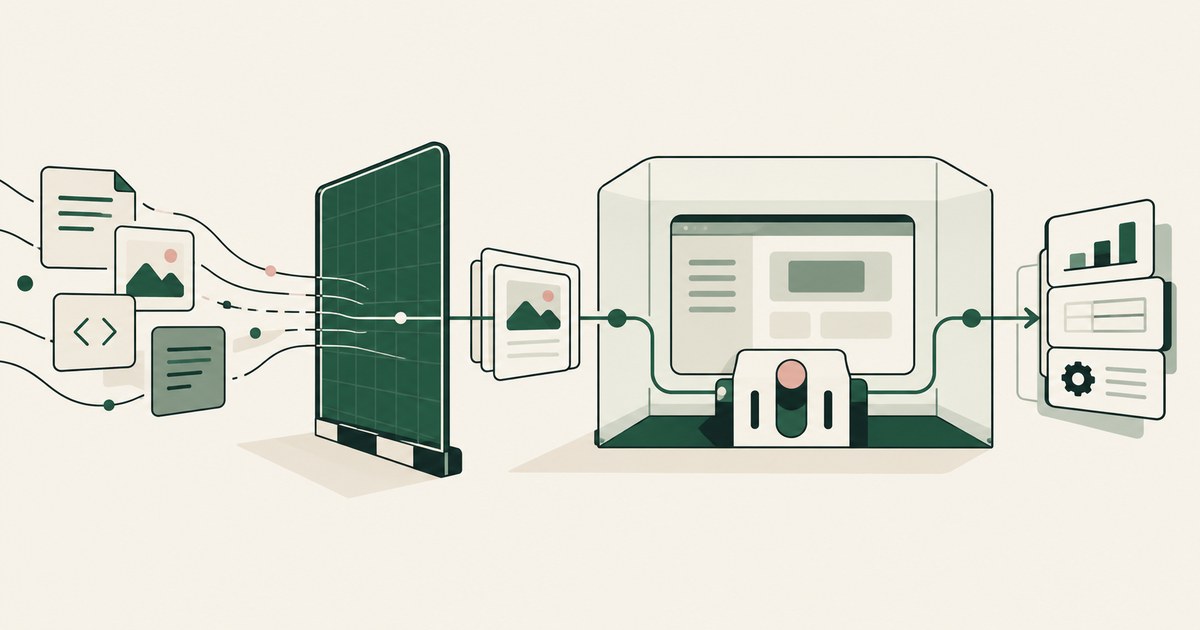
What Is the Difference Between RedactSure and SentinelOne Prompt Security for Enterprise AI Usage and Agent Workflows?
Prompt Security by SentinelOne enforces policy on data sent to and from AI services. RedactSure governs what an agent's model is shown while it works.
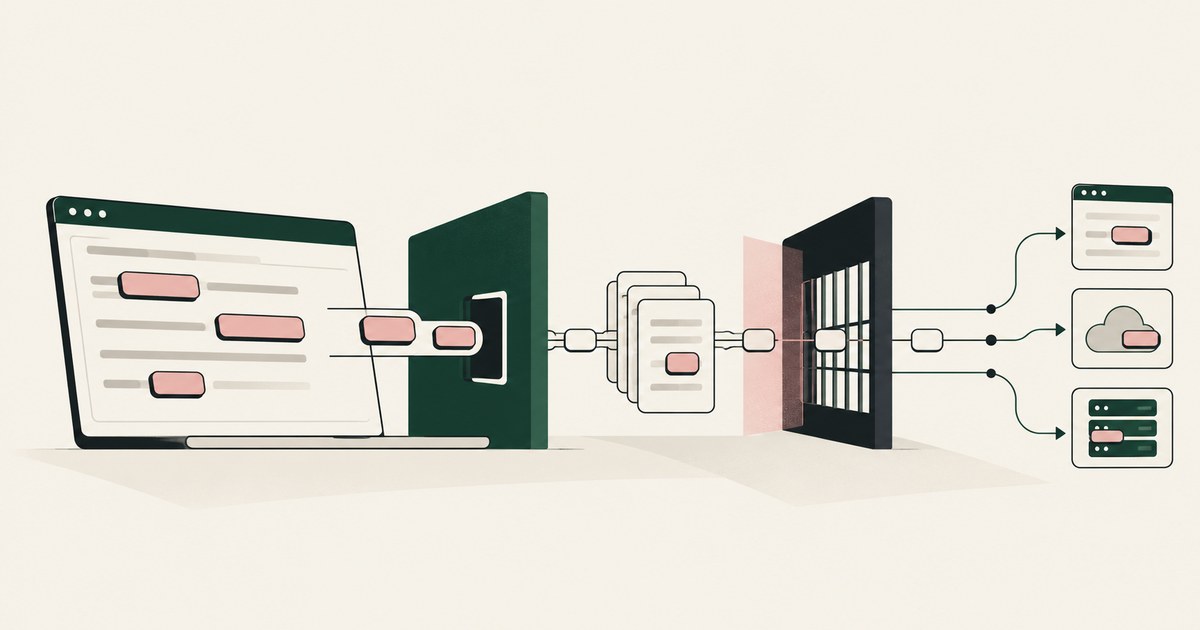
What Is the Difference Between RedactSure and Nightfall AI for PII Reaching AI Tools and Agents?
Nightfall AI inspects prompts, uploads and MCP tool calls, then blocks or redacts sensitive data. RedactSure tokenizes identifiers on screen first.

What Does an AI Agent See When It Takes a Screenshot? Everything on the Page, Including What the Task Never Needed
Explore what browser screenshots expose to AI agents, including unrelated PII, and how tokenization changes the model's view of a task.

AI Gateway, DLP, or Tokenization: Which Layer Decides What the AI Sees?
Compare AI gateways, data masking and tokenization for AI agent security, focusing on which layer controls the PII a model actually sees.
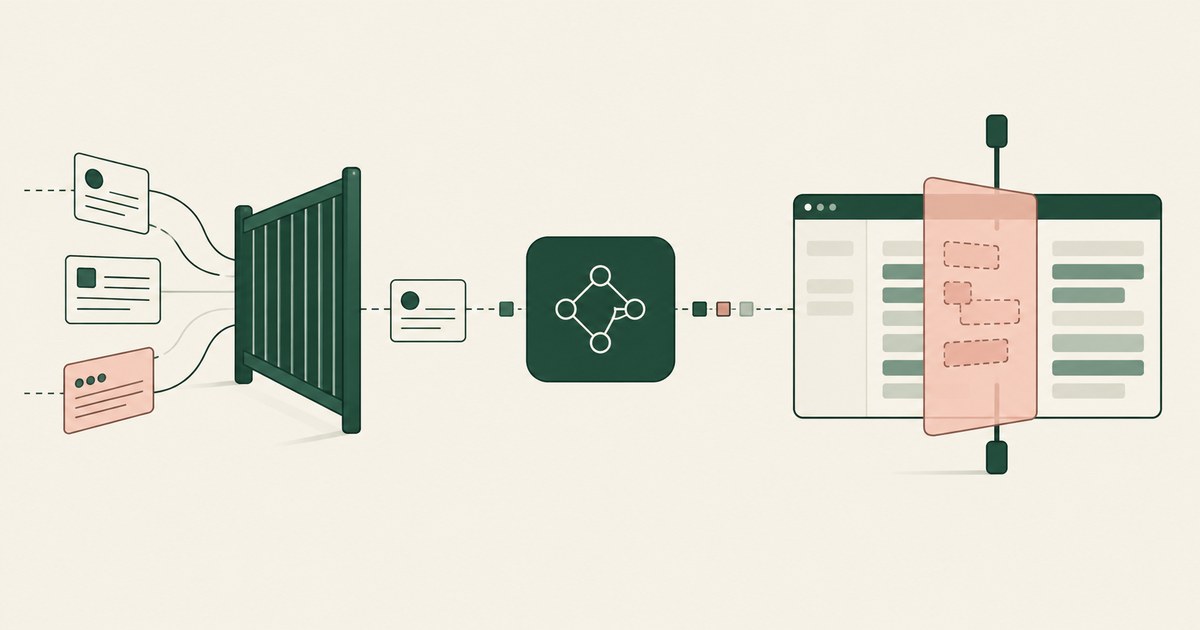
What Is the Difference Between RedactSure and an AI Gateway for Protecting Sensitive Data?
An AI gateway governs model calls that pass through it; RedactSure governs what appears on the screen an agent reads. A proxy never gets a rendered screen.

What Is Render-Layer Tokenization? The Control at the Layer Where the Agent Actually Reads
Learn how render-layer tokenization replaces PII before an AI agent reads a browser screen while preserving useful workflow context.

The Two Gaps AI Agents Opened in Your Security Stack
Explore AI agent security through two questions: which PII reaches the model, and who approves consequential billing and claims actions.
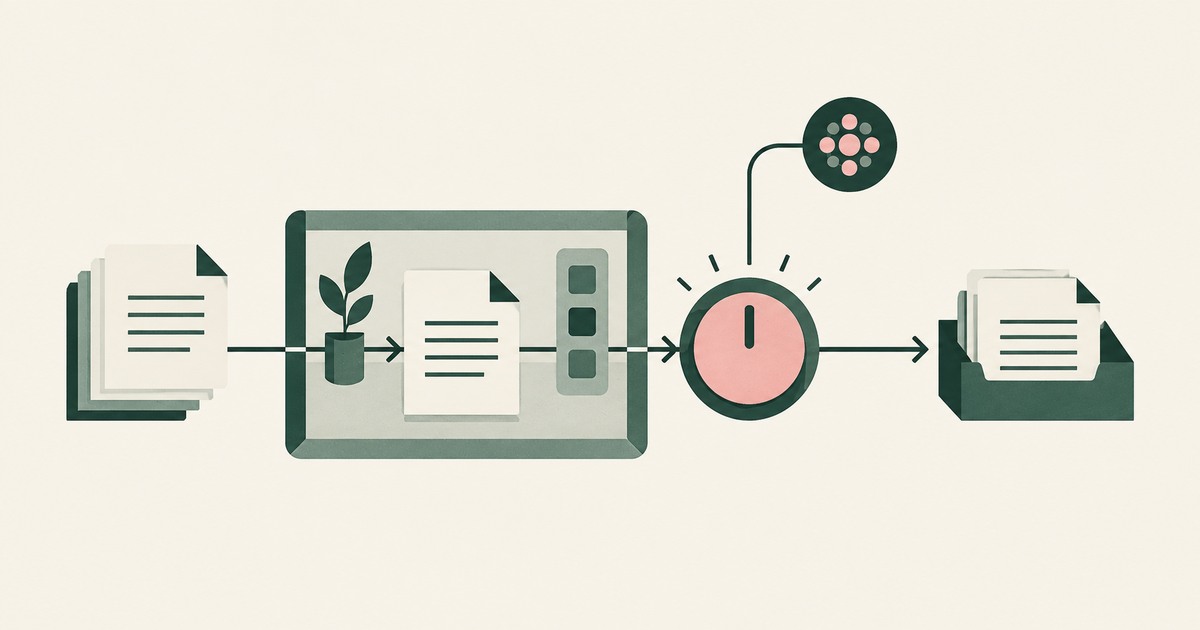
What Is Supervised Delegation? Who Answers for an AI Agent, and What the Record Shows
Explore supervised delegation for AI agents in billing and claims, with named responsibility, tokenization policies and human approvals.

What Is an AI Control Record? The Runtime System of Record for Sensitive AI Work
Explore an AI agent control record for billing and claims, linking permissions, tokenization decisions, approvals and audit evidence.
Book an AI Agent Security Review →
Bring your hardest questions.
Bring one sensitive workflow and the decisions your team needs to keep in its hands.
Book a demoAbout the author

Chris Sowa is a founder of RedactSure and a former CEO of an AI company; he started it years before ChatGPT existed. He previously led AI at Accenture, served as Global VP of Strategy & Innovation at Schneider Electric, was CCO of Sovos, and spent more than a decade at Oracle, with earlier roles at SAP and IBM.