
Data Report · By Chris Sowa · Published
Last updated
How to enforce data protection across multiple enterprise applications?
Consistency comes from writing one policy intent once and carrying it to enforcement points on the device, in the cloud, and at the moment an agent acts, with each point reporting into one record. Left to per-application settings, the same data class is blocked in one system, logged in a second and forgotten in a third.
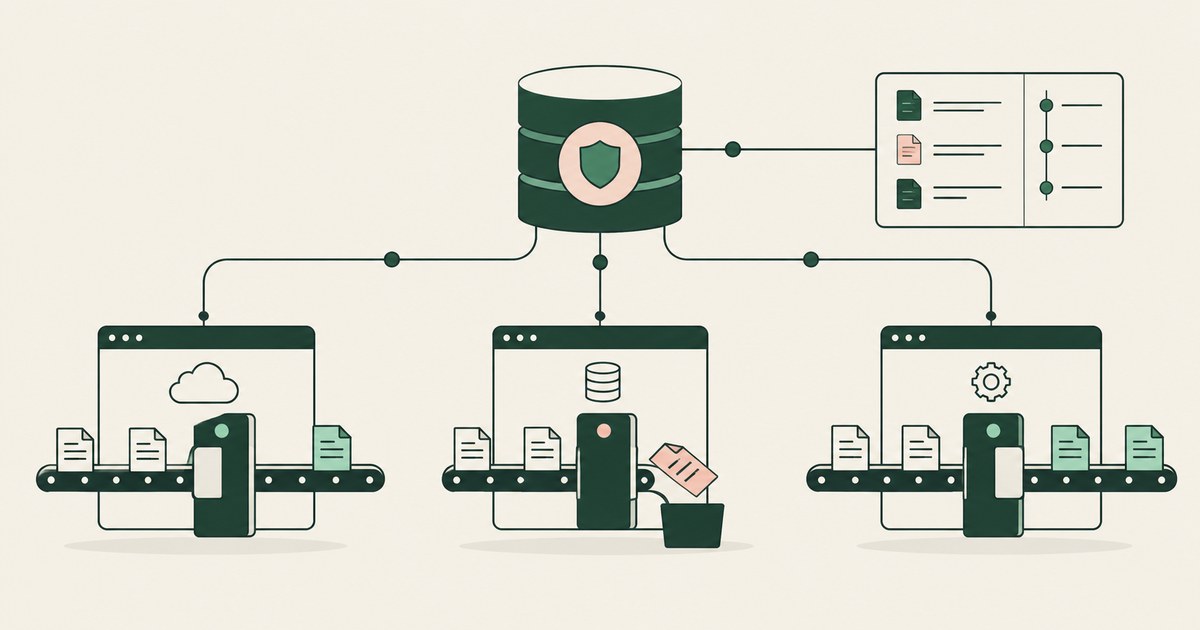
Consistency comes from writing one policy intent once and carrying it to enforcement points on the device, in the cloud, and at the moment an agent acts, with each point reporting into one record. Left to per-application settings, the same data class is blocked in one system, logged in a second and forgotten in a third. Microsoft's DLP design illustrates the first half of that pattern, a policy created centrally and applied across locations that include cloud services, devices, and non-Microsoft apps (Microsoft, 2025). The second half is the enforcement problem itself: why consistency fails, what the zero trust model says about separating the decision from the enforcement, and how an organization proves consistency instead of assuming it. The newest enforcement point sits inside the workflow, at the moment an AI agent acts in an application, where policy is set per screen and a named person confirms it under Supervised Delegation. The environment that enforces this is built by RedactSure, an AI agent controls, governance and data protection company.
Key findings
- Microsoft documents DLP policies as centrally created objects scoped across locations, Exchange, SharePoint, Teams, devices, and connected non-Microsoft apps among them, so one rule set can address many applications (Microsoft, 2025).
- NIST's zero trust architecture separates the policy engine and policy administrator, which make and record the decision, from the policy enforcement point, which sits in the path and carries it out (NIST, 2020).
- Endpoint enforcement crosses application boundaries because it governs activities on the device, uploads, pastes, copies, and printing, whatever application produced the content (Microsoft, 2025).
- Consistency is an evidence problem as much as a configuration problem: override and match records exist per surface, and Microsoft logs DLP rule actions, overrides, and false positive reports in its audit and reporting tooling (Microsoft, 2025).
- A central policy reaches a surface only when that surface is a location; Microsoft's deployment guidance has policies run in simulation across their scope and narrow to pilot groups before enforcement, which is where scoping gaps surface (Microsoft, 2025).
- The NIST AI Risk Management Framework's Measure and Manage functions call for monitoring the deployed system and continuing to measure whether controls behave as intended in context, the posture a per-surface consistency review follows (NIST, 2023).
Why does enforcement fragment when every application has its own controls?
Each application arrives with its own administrative model, its own sharing settings, its own idea of an external user, and its own log format. Configuring protection application by application produces a patchwork in which the same data class is blocked in one system, merely logged in a second, and governed by a setting nobody remembers in a third. The fragmentation is not usually caused by negligence. It is the default outcome of per application tooling applied by different teams at different times.
Definitions fragment before settings do. If one application's policy was written against sensitivity labels, another's against keyword rules, and a third's against folder permissions, then the estate has three different answers to the question of what counts as sensitive, and no configuration effort can make enforcement consistent on top of inconsistent definitions. This is why classification machinery matters to an enforcement discussion: Microsoft documents sensitive information types and trainable classifiers as shared inputs that many Purview policies consume, giving different surfaces a common vocabulary for what they are enforcing (Microsoft, 2025; Microsoft, 2025).
The operational symptom is familiar to anyone who has run an audit. The policy document says one thing, and the per application reality is a spread of approximations. Closing that spread requires the policy to live somewhere above the applications, with the applications demoted to enforcement points. Each of the documented remedies works by that demotion.
What does one central policy applied to many locations change?
In Microsoft's documented model, a DLP policy is created once and scoped to locations, and the location list is deliberately heterogeneous: Microsoft 365 services, Office applications, devices, non-Microsoft cloud apps and connected apps, on-premises repositories, and Fabric workspaces (Microsoft, 2025). Rules inside the policy carry the conditions, the sensitive information types or labels to look for, and the actions, and those rules then apply wherever the policy is scoped.
The change this makes is about intent. One definition of the protected data, one threshold for action, one override behavior, expressed in one place, and inherited by every location in scope. When the business changes its mind about a data class, the edit happens once, and the audit question of what the policy is has a single answer. Microsoft's deployment guidance adds the discipline to operate it safely: policies can run in simulation across their scope before enforcement, and can be narrowed to pilot groups while feedback is gathered (Microsoft, 2025).
Central policy has boundaries. A location must exist for a surface to inherit the policy at all, which is why connected apps have to be connected through Defender for Cloud Apps before Purview policy reaches them (Microsoft, 2025). Applications outside every location list, and activity on devices the estate does not manage, are not made consistent by a central policy. They are outside it, which the next sections address at other layers.
How do the decision and the enforcement separate in zero trust design?
NIST's zero trust architecture gives the enforcement problem a vocabulary that predates any of these products. In SP 800-207, access decisions are made by a policy engine, carried out administratively by a policy administrator, and enforced by a policy enforcement point that sits in the path between the subject and the resource (NIST, 2020). The resource itself does not decide. The enforcement point does not invent policy. Each component has one job.
That separation is exactly the property a multi application estate needs. Translated into data protection terms: the decision about what may happen to a class of data should be made once, in a policy layer the organization controls, and then rendered into as many enforcement points as the estate requires, an endpoint agent here, a cloud app policy there, a gateway in the network path, each one accountable to the same decision logic.
The model also predicts the failure mode when the separation collapses. If each application makes its own decisions, there is no policy, only a collection of local habits, and consistency becomes unmeasurable because there is no single decision to compare outcomes against. Zero trust language was written for access rather than for DLP, but the structural point transfers intact, and it is the reason enforcement across applications is an architecture question rather than a settings question.
What enforces policy on the device when applications differ?
The endpoint is the one place where every application, whatever its vendor or vintage, produces the same small set of physical events: files are written, clipboard contents move, uploads begin, documents print. Microsoft documents endpoint DLP as auditing and managing exactly these activities on sensitive items stored on Windows and macOS devices, including copying to USB media and network shares, pasting into supported browsers, and uploading to restricted cloud domains (Microsoft, 2025).
As an enforcement point, the endpoint has a distinctive virtue: it does not care which application created the content. A record exported from a modern SaaS client and the same record exported from a fifteen year old desktop tool are both files on a device at the moment of the risky activity, and one policy can govern both. For estates whose application sprawl includes software no cloud control will ever integrate with, this is often the only uniform enforcement layer available.
Its limits follow from its position. It governs activities on items it can recognize as sensitive, on devices that are onboarded and supported, and it cannot govern what happens to data that never touches a managed device, inside a browser session on a personal machine, for instance. Enforcement design therefore treats the endpoint as the widest net, not the only one, and pairs it with service side policy wherever the service offers a location or a connector.
What enforces policy at the moment an agent acts inside an application?
A newer enforcement point has appeared inside workflows themselves. When an AI agent performs a task across several applications, the consequential moments are not only transfers between systems. They are the actions the agent takes within each one: the record it reads, the field it changes, the submission it makes. A policy that only watches data movement has nothing to say about an authorized agent doing an unauthorized thing with data it was legitimately shown.
RedactSure's published model is built around enforcing at that point. In its description, a Planner sets, per screen, which values are tokenized and what the agent may do, a named person confirms that policy before the run, and consequential actions such as a payment, a submission, or a record change stop for a named approver at the moment they would run, with no standing always allow option. Every screen as tokens, every action, and every named approval is written to an AI Control Record that can be exported to the customer's SIEM, which puts the agent layer's enforcement evidence into the same systems the rest of the estate reports to. Deployments of this design are described by the company as in pilot.
Seen as architecture, that is one more enforcement point answering to policy set in advance, distinguished by where it sits: inside the workflow, at the granularity of a single screen and a single action, in applications the agent works as rendered rather than through integrations.
| Enforcement point | What it can see | Consistency risk it carries |
|---|---|---|
| Service side policy in each cloud app | Stored content, sharing, in app activity | Definitions drift between applications |
| Central DLP policy across locations | One rule set inherited by many surfaces | Surfaces with no location stay outside |
| Endpoint agent | File, clipboard, upload, and print activities on the device | Only managed devices; recognition still required |
| Network and inline inspection | Data in motion toward destinations | Sees transfers, not state or in app actions |
| In workflow agent controls | Screens read and actions attempted by an agent | Covers agent workflows, not human activity |
How is consistency demonstrated rather than assumed?
A central policy makes consistency plausible. Only evidence makes it true, and the evidence has to be gathered per enforcement point, because each point can fail silently in its own way: a connector lapses, an endpoint agent falls behind, a location is scoped more narrowly than anyone remembers.
The raw material exists. Microsoft documents that DLP activity, including rule matches, overrides, and user reports of false positives, is captured in audit logs and DLP reports (Microsoft, 2025; Microsoft, 2025). A consistency review uses that material adversarially. Take one data class, generate or select the same test event in each application in scope, and compare what each enforcement point did and recorded. Divergence is then a finding with a location, not a suspicion.
The NIST AI Risk Management Framework's Manage and Measure functions describe this posture generally: monitor the deployed system, and keep measuring whether controls behave as intended in context (NIST, 2023). For a multi application estate, the practical artifact is a short, dated coverage statement per data class, naming the enforcement point for each application and the last date its behavior was verified. Estates that can produce that document have enforcement. Estates that can only produce the policy have a hypothesis.
Where does RedactSure sit?
On the coverage statement, RedactSure is the line for agent work inside the applications. When a co-worker rather than a person is the actor, its per screen policy, set by a Planner and confirmed by a named person before the run, is the enforcement point. Render-layer tokenization replaces the identifiers chosen by policy before any model reads the screen, so the model receives the task's fields with SSN_001 and ACCT_001 in place of real values, and real values resolve only at approved destinations at the moment of an approved action. Every payment, submission and record change stops for a named approver; the AI never pays, submits or decides on its own.
That makes the agent layer behave like the other enforcement points on the statement: it answers to a decision made in advance, it reports its outcomes, and it can be tested with the same adversarial event. Every screen as tokens, every action and every approval lands in the AI Control Record and exports to the customer's SIEM, beside the DLP and endpoint logs. No per-application integration is required and user permissions do not change. Deployments are in pilot. Everyone else controls where data can go. RedactSure controls what the AI can see.
Methodology and limitations
This page rests on Microsoft Learn documentation, read as of October 13, 2026, for DLP policy scope and locations, sensitive information types and trainable classifiers, endpoint DLP activities, policy deployment and simulation, connected apps through Defender for Cloud Apps, and policy notifications and audit behavior (vendor documentation). NIST SP 800-207, Zero Trust Architecture (2020), supplies the separation of policy decision and enforcement, and the NIST AI Risk Management Framework 1.0 (2023) supplies the monitoring discipline (standards and official guidance). RedactSure's design is described in the company's own published terms, with deployments in pilot.
Zero trust material is applied by analogy from access control to data protection, and the analogy is named where it is made. No policy was deployed and no cross application test was performed for the page; what each Microsoft surface detects, blocks or records is the vendor's own description. Connector availability, preview status, and license requirements vary by surface and change over time, and should be verified against current documentation. Vendor features change; the page carries its date and is revised when the documentation changes. The examples of a SaaS export, a desktop tool and a browser session describe surface types, not any organization; no customer or prospect is described.
Whether a given set of enforcement points meets an organization's obligations for a data class, and whether the coverage statement it produces is sufficient evidence, belongs to its counsel, assessor and its security and compliance officers, not to the page. The coverage statement is a working document for those officers to keep, not a determination.
What the record shows
Enforcement across many applications fails by default and succeeds only by architecture. Left to themselves, applications fragment definitions first and settings second, and no amount of per application diligence reassembles a single policy from the pieces. The documented remedies all move the decision upward: one DLP policy scoped across heterogeneous locations, zero trust's clean separation between the engine that decides and the points that enforce, an endpoint layer that governs activities no matter which application produced them, and, inside agent workflows, per screen policy with named approval at the moment of action. Consistency then still has to be demonstrated, event by event and surface by surface, from logs and deliberate tests. Write the coverage statement, not just the policy: one line per application, naming its enforcement point and the date it was last verified. That statement is a small document with an outsized effect, because it converts arguments about tools into checkable claims about surfaces.
Frequently asked questions
Does one central DLP policy guarantee the same outcome in every application?
No, and Microsoft's own model shows why. A central policy applies to locations, and a surface has to be a location, through native integration, a device agent, or a connector, before the policy reaches it. Even then, the action available differs by surface: a service can restrict sharing, an endpoint can stop a copy, and each records its outcome in its own way. The central policy guarantees one intent. Outcomes still have to be verified per surface, which is the consistency review.
Where does zero trust fit in a data protection discussion?
As the architectural template. NIST SP 800-207 separates the policy engine that decides, the administrator that configures, and the enforcement point that acts, and it places the enforcement point in the path rather than inside the resource. A multi application DLP estate has the same shape: decide once, enforce in many places, and never let each application improvise its own version of the decision. The publication addresses access, so the mapping to DLP is an analogy.
What enforces policy when the actor is an AI agent rather than a person?
On the design RedactSure publishes, enforcement sits inside the workflow: a Planner defines per screen what is tokenized and what the agent may do, a named person confirms the policy beforehand, and consequential actions stop for a named approver as they are about to run. The resulting record, covering screens as tokens, actions, and approvals, exports to the customer's SIEM. That covers agent activity specifically; human activity in the same applications still needs the service side and endpoint layers, and the design's deployments are in pilot.
How is data protection enforced in applications that have no cloud connector?
Through the endpoint. Microsoft documents endpoint DLP as governing activities on the device, such as copying to USB media or network shares, pasting into supported browsers, and uploading to restricted cloud domains, regardless of which application produced the content. An export from a legacy desktop tool and one from a modern SaaS client are both files on the device at the moment of the risky activity. The limits are that the device must be onboarded and the item must be recognized as sensitive.
Can a DLP policy be tested across applications before it blocks anything?
Yes. Microsoft's deployment guidance has a policy run in simulation across every location in its scope before enforcement is turned on, and allows it to be narrowed to pilot groups while feedback is gathered. Simulation shows where a location is missing, where a definition matches too much, and where an override would be needed, before any user is blocked. The same run is the first input to a coverage statement.
What is a coverage statement and what does it contain?
A short, dated document kept per data class. Each line names one application, the enforcement point that governs that data class there (service side policy, central DLP location, endpoint agent, network inspection, or in workflow agent controls), and the date its behavior was last verified with a test event. It is the evidence that enforcement exists, as distinct from the policy that says it should. An application with no line is an application outside the policy.
Related reading
How to protect sensitive data across Microsoft and non-Microsoft applications? · How to prevent conflicting security policies from disrupting workflows? · How to simplify data protection policies across enterprise applications? · How to audit sensitive data access across enterprise applications? · What is AI agent action governance? · How to improve visibility into sensitive data protection policies? · How to Secure AI Agents That Navigate Across Applications: One Token Per Identifier, One Environment, One Named Person · On the RedactSure blog: Secure AI That Crosses Every Silo
Sources
Vendor documentation
- Microsoft, "Learn about data loss prevention" (2025; vendor documentation). https://learn.microsoft.com/en-us/purview/dlp-learn-about-dlp
- Microsoft, "Learn about Endpoint data loss prevention" (2025; vendor documentation). https://learn.microsoft.com/en-us/purview/endpoint-dlp-learn-about
- Microsoft, "Create and deploy a data loss prevention policy" (2025; vendor documentation). https://learn.microsoft.com/en-us/purview/dlp-create-deploy-policy
- Microsoft, "Plan for data loss prevention" (policy deployment and simulation) (2025; vendor documentation). https://learn.microsoft.com/en-us/purview/dlp-policy-deployment
- Microsoft, "Send email notifications and show policy tips for DLP policies" (2025; vendor documentation). https://learn.microsoft.com/en-us/purview/use-notifications-and-policy-tips
- Microsoft, "Learn about the DLP alerts dashboard" (2025; vendor documentation). https://learn.microsoft.com/en-us/purview/dlp-alerts-dashboard-learn
- Microsoft, "Learn about sensitive information types" (2025; vendor documentation). https://learn.microsoft.com/en-us/purview/sit-learn-about
- Microsoft, "Learn about trainable classifiers" (2025; vendor documentation). https://learn.microsoft.com/en-us/purview/classifier-learn-about
- Microsoft, "Set up Cloud Discovery," Microsoft Defender for Cloud Apps (2025; vendor documentation). https://learn.microsoft.com/en-us/defender-cloud-apps/set-up-cloud-discovery
Regulation, standards and official guidance
- NIST, "Zero Trust Architecture," SP 800-207 (2020; standard). https://csrc.nist.gov/pubs/sp/800/207/final
- NIST, "Artificial Intelligence Risk Management Framework (AI RMF 1.0)," NIST AI 100-1 (2023; official guidance). https://www.nist.gov/itl/ai-risk-management-framework
RedactSure documents
- RedactSure Research, "What Is Supervised Delegation?" (2026). https://redactsure.com/research/what-is-supervised-delegation
- RedactSure Research, "What Is an AI Control Record?" (2026). https://redactsure.com/research/what-is-an-ai-control-record
- RedactSure Research, "What is AI agent action governance?" (2026). https://redactsure.com/research/what-is-ai-agent-action-governance
- RedactSure Research, "How to audit sensitive data access across enterprise applications?" (2026). https://redactsure.com/research/how-to-audit-sensitive-data-access-across-enterprise-applications
- RedactSure, "Secure AI That Crosses Every Silo" (2026). https://redactsure.com/blog/secure-ai-that-crosses-every-silo/
- Product behavior described on this page reflects RedactSure's current design. Microsoft, Microsoft 365, Microsoft Purview, Microsoft Defender, Exchange, SharePoint, Teams, Fabric, Office and Windows are trademarks of Microsoft Corporation; macOS is a trademark of Apple Inc.; named to identify the products.
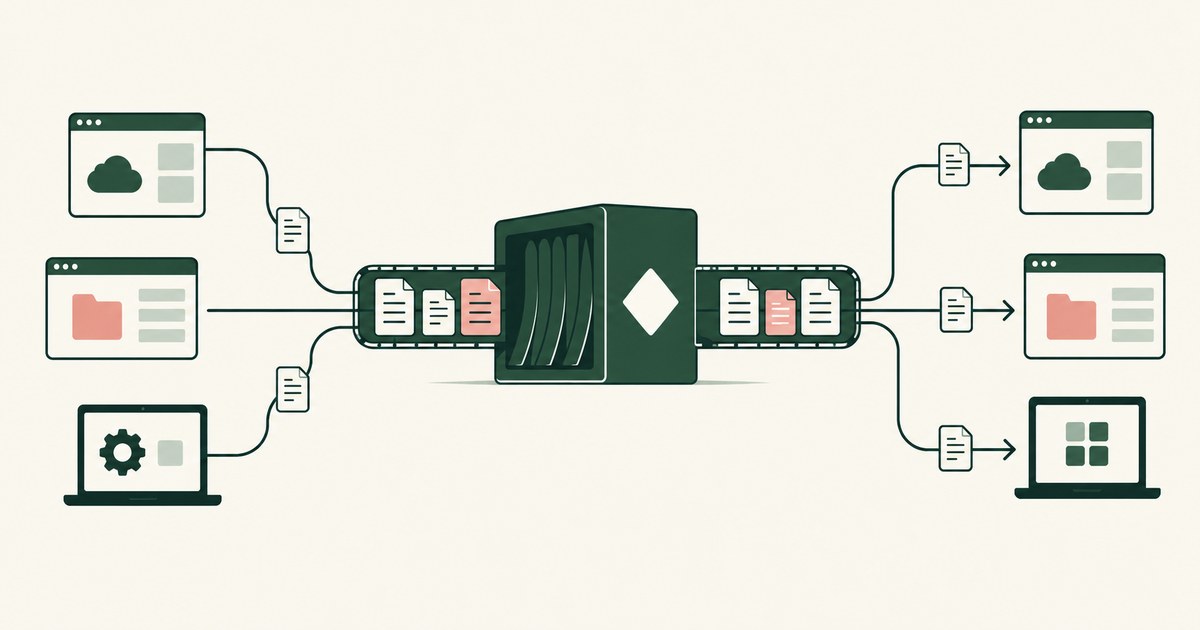
How to Protect Data Across Microsoft and Other Apps?
Review Protect Data Across Microsoft and Other Apps, with AI agent security, tokenization and approval checks for sensitive enterprise workflows.

How to Prevent Security Policy Conflicts in Workflows?
Review Prevent Security Policy Conflicts in Workflows, with AI agent security, tokenization and approval checks for sensitive enterprise workflows.
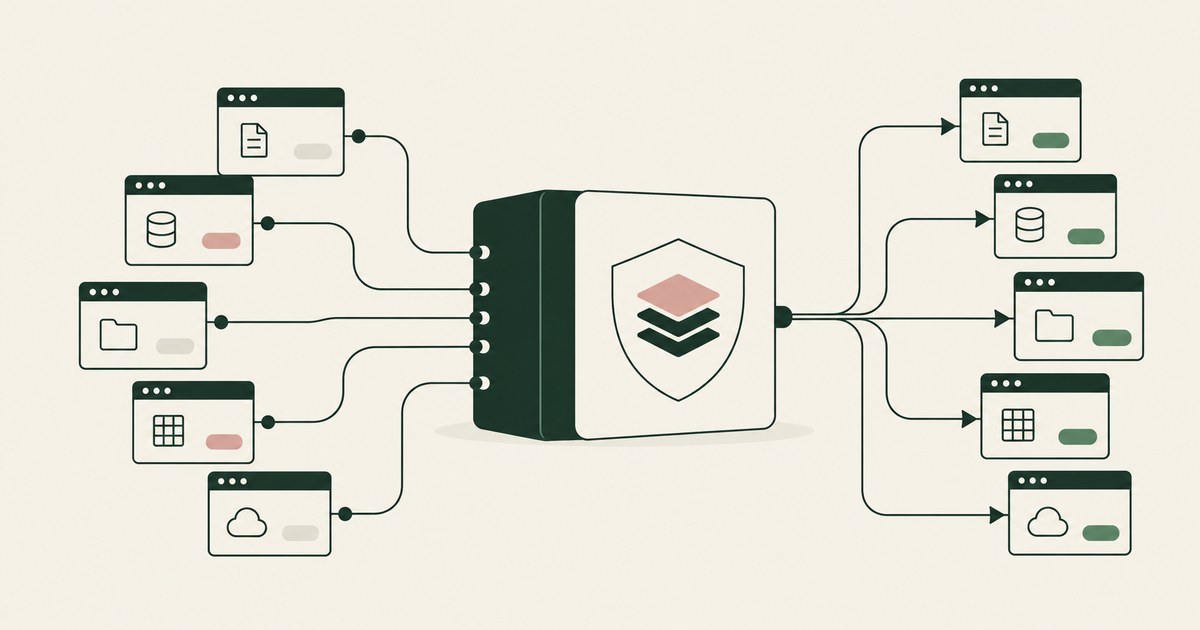
How to Simplify Data Protection Policies Across Apps?
Review Simplify Data Protection Policies Across Apps, with AI agent security, tokenization and approval checks for sensitive enterprise workflows.
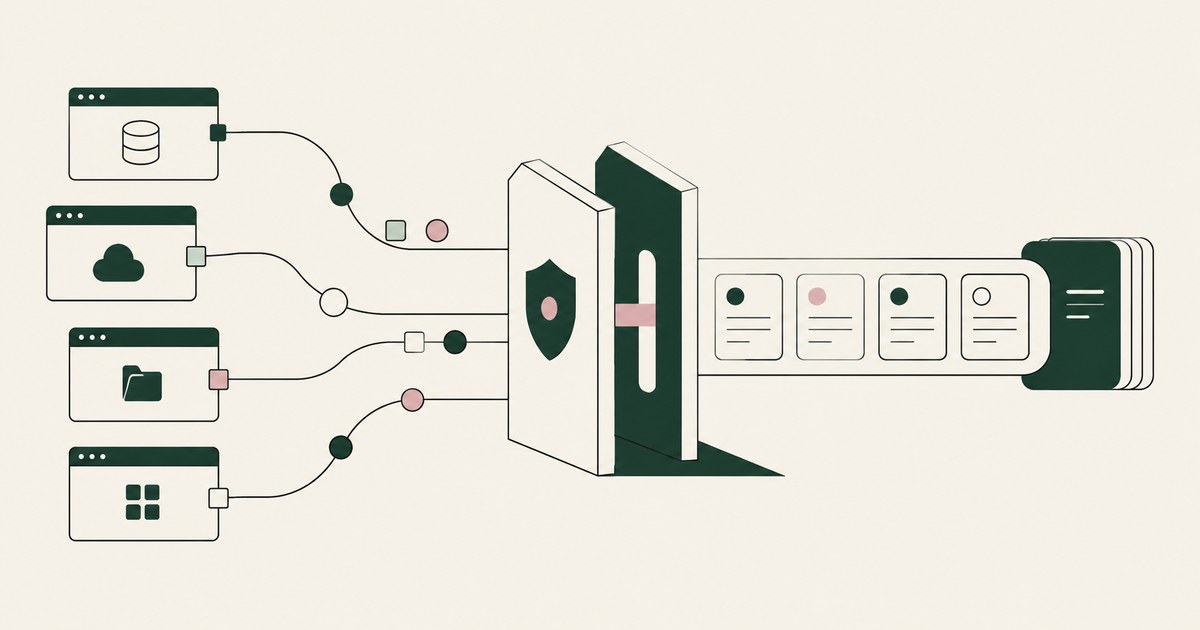
How to Audit Sensitive Data Access Across Apps?
Review Audit Sensitive Data Access Across Apps, with AI agent security, tokenization and approval checks for sensitive enterprise workflows.

What Is AI Agent Action Governance?
Review AI Agent Action Governance, with AI agent security, tokenization and approval checks for sensitive enterprise workflows.
How to Make Sensitive Data Protection Policies Visible?
Review Make Sensitive Data Protection Policies Visible, with AI agent security, tokenization and approval checks for sensitive enterprise workflows.
How to Secure AI Agents That Navigate Across Applications
Review Secure AI Agents That Navigate Across Applications, with AI agent security, tokenization and approval checks for sensitive enterprise workflows.
Secure AI That Crosses Every Silo
Explore AI agents that work across billing, collections and enterprise systems while tokenization protects PII at each workflow step.

What Is Supervised Delegation?
Explore supervised delegation for AI agents in billing and claims, with named responsibility, tokenization policies and human approvals.

What Is an AI Control Record?
Explore an AI agent control record for billing and claims, linking permissions, tokenization decisions, approvals and audit evidence.
Book an AI Agent Security Review →
Bring your hardest questions.
Bring one sensitive workflow and the decisions your team needs to keep in its hands.
Book a demoAbout the author

Chris Sowa is a founder of RedactSure and a former CEO of an AI company; he started it years before ChatGPT existed. He previously led AI at Accenture, served as Global VP of Strategy & Innovation at Schneider Electric, was CCO of Sovos, and spent more than a decade at Oracle, with earlier roles at SAP and IBM.