
Data Report · By Chris Sowa · Published
Last updated
How to prevent conflicting security policies from disrupting workflows?
Conflicts fade when every control shares one definition of the data, every policy has a single owner, and changes are rehearsed in test modes before employees meet them. Without that discipline each tool enforces its own policy correctly, the employee meets the contradiction, routes around it, and learns to treat every block as noise.
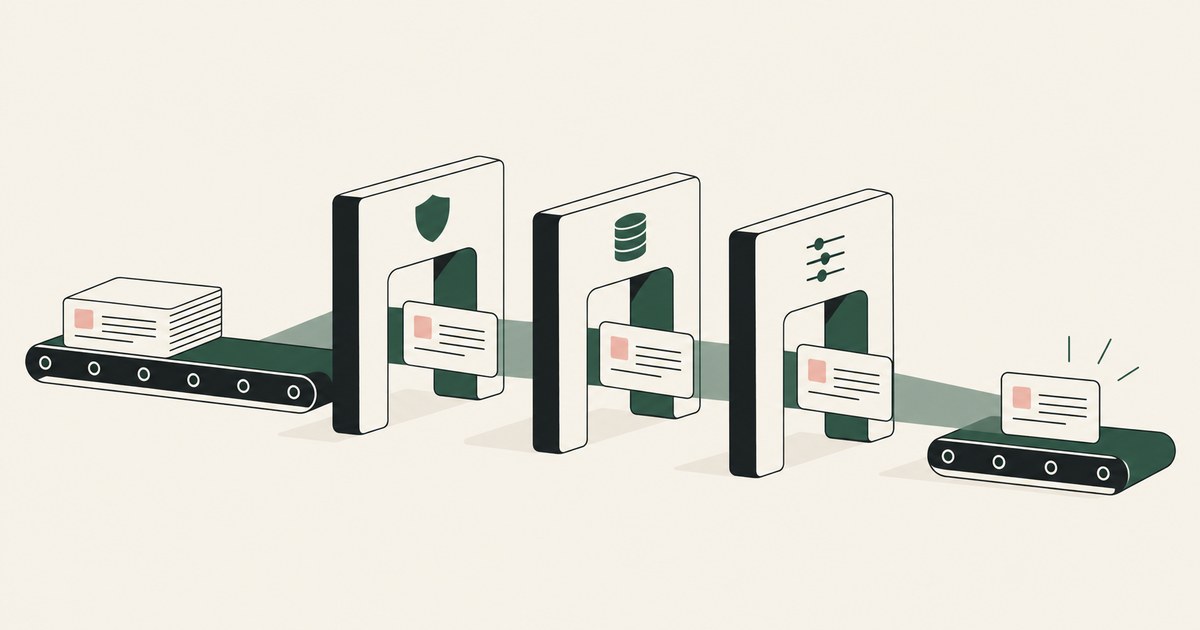
Conflicts fade when every control shares one definition of the data, every policy has a single owner, and changes are rehearsed in test modes before employees meet them. Without that discipline each tool enforces its own policy correctly, the employee meets the contradiction, routes around it, and learns to treat every block as noise. Conflicting policies stop disrupting workflows when every control draws on one shared definition of the data, every policy has a single accountable owner, overlaps are resolved by a stated precedence rule rather than by accident, and changes are rehearsed in test modes before they reach employees. Inside a single product, vendors already supply part of this discipline: Microsoft Purview evaluates DLP rules in priority order and applies the most restrictive matching action, so the outcome of an overlap is at least defined (Microsoft, 2026). Across separate products there is no such arbiter, which is where most disruption is born. For supervised AI agent work, Supervised Delegation answers the same problem with one authored policy per screen and a named person who confirms it. The environment that enforces this is built by RedactSure, an AI agent controls, governance and data protection company.
Key findings
- Within Purview DLP, rules are evaluated in priority order and the most restrictive action prevails when several rules match, so intra-product conflicts resolve deterministically (Microsoft, 2026).
- Microsoft label policies resolve overlapping settings by policy priority for items such as the default label, while the labels themselves from all matching policies are merged for the user (Microsoft, 2026).
- No equivalent arbiter exists between separate tools, so a file allowed by an endpoint control can still be blocked by a browser control, with each tool correctly enforcing its own policy; the documentation for each control category describes only that category's behavior (Microsoft, 2026).
- NIST's zero trust model concentrates decisions in a policy engine so that enforcement points do not improvise conflicting answers (NIST, 2020).
- Test and simulation modes, and staged rollouts, are the documented mechanisms for discovering conflicts during change rather than during work (Microsoft, 2026).
- The NIST AI Risk Management Framework's Govern function locates accountability for risk decisions in defined roles and processes rather than in individual tools, the same shape a cross-tool precedence register needs (NIST, 2023).
What does a policy conflict look like from the employee's side of the screen?
From the employee's chair, a conflict rarely announces itself as a conflict. It looks like inconsistency. The same file uploads successfully from the desktop application and is blocked in the browser. A document the user is allowed to open cannot be attached to the email the user is allowed to send. A warning appears with an override button in one tool and a hard stop with no explanation in another, for what the user reasonably experiences as the same action. Because each message names only the tool that produced it, the employee cannot tell whether they face a policy, a malfunction, or a mistake, and the help desk ticket inherits that confusion.
The workflow damage compounds quietly. Employees route around the inconsistency, moving work to whichever channel blocks least, which is often the channel with the weakest governance. Teams develop folklore about which application to use for which task, and that folklore, not the policy library, becomes the operating reality. The security cost is the part leaders underestimate: a control that fires unpredictably trains users to treat all blocks as noise, including the blocks that matter. Predictability is therefore a security property in its own right. A stricter policy that behaves identically everywhere will usually outperform, in real risk terms, a nominally stronger set of policies whose combined behavior nobody, including their authors, can forecast.
How does a single product resolve conflicts internally, and why does that stop at the product boundary?
Mature platforms define precedence because their designers know overlaps are inevitable. In Purview data loss prevention, Microsoft documents that when an item matches multiple rules, the rules are evaluated in priority order and the most restrictive action is the one enforced (Microsoft, 2026). The administrator may dislike the outcome in a given case, but the outcome is derivable: read the matching rules, apply the documented precedence, and the behavior is explained. Sensitivity labeling shows a second resolution style. When a user falls under several label policies, the highest-priority policy supplies settings such as the default label, while the set of available labels is the union of what the policies publish (Microsoft, 2026). Two different mechanisms, one winner-takes-all and one merge, but both are specified in advance.
At the product boundary, specification ends. The endpoint agent does not know the browser's policy, the mail gateway does not know the collaboration platform's sharing rules, and each evaluates the action against its own definitions of the data, its own thresholds, and its own action vocabulary. Even the shared ground is shakier than it appears, because two tools may classify the same document differently, one by label and one by pattern match, and reach opposite conclusions about what the document is. NIST's architecture writing addresses exactly this shape of problem: decisions should be made by a policy engine with a consistent view, and enforcement points should execute rather than independently decide (NIST, 2020). Most estates cannot literally unify every tool under one engine, but they can adopt the principle as a design test: wherever two controls can judge the same action, someone must be able to state which judgment governs, in writing, before an employee finds out empirically.
Which kinds of cross-tool conflict cause the most workflow damage?
Four patterns recur. The first is the contradictory verdict: tool A permits an action that tool B blocks, as when a file passes endpoint checks and is stopped at upload. This pattern produces the routing-around behavior described earlier, because the employee's rational response is to find the permissive path. The second is the stacked restriction, where each tool's control is reasonable alone but the combination is not: a document must be encrypted by policy, the encryption breaks the collaboration tool's co-authoring, and the workaround demanded by the collaboration policy violates the sharing policy. Nobody designed the deadlock, yet the employee experiences it as a single system refusing all options.
| Conflict pattern | What the employee experiences | Structural remedy |
|---|---|---|
| Contradictory verdict | The same action succeeds in one surface and is blocked in another | A precedence register stating which control governs that action |
| Stacked restriction | Each control is reasonable alone and the combination deadlocks the task | Domain ownership that reviews combined behavior before release |
| Threshold mismatch | Similar actions fail at different counts in different tools | One shared taxonomy with harmonized thresholds per data class |
| Override asymmetry | An approved justification works in one tool and dead-ends in the next | Exception design checked against every control on the workflow path |
The third pattern is the threshold mismatch. Two tools detect the same data type with different counts or confidence levels, so an action succeeds at nine items and fails at ten in one surface, and fails at five in another. Users experience the boundary as arbitrary because the underlying definitions were never harmonized. The fourth is the override asymmetry: one tool allows a business-justification override and its neighbor does not, so the documented, approved path dead-ends at the second tool and the justification the organization collected becomes worthless. Ranking these by damage, contradictory verdicts and stacked restrictions do the most harm because they directly teach circumvention. Threshold and override mismatches mostly cost time and trust, which is slower damage but still real. A conflict inventory that names live examples of each pattern, gathered from help desk records and override logs, is the fastest way to make this abstract problem concrete for leadership.
What governance structure gives every control one owner and one arbiter?
The structure has three elements. First, one taxonomy: every tool's policies should reference the same definitions of sensitive data classes, whether that taxonomy lives in a classification platform or a governed register, so that verdict differences come from policy intent rather than from divergent pattern lists. Second, one owner per policy domain, with authority across tools. The owner of the "external sharing" domain, for instance, should own the sharing rules in the DLP platform, the browser, and the collaboration suite jointly, and be accountable for their combined behavior. Domain ownership by data flow, rather than by product, is the change that makes conflicts somebody's job.
Third, one arbiter for disputes: a named forum, which can be as light as a weekly change review chaired by the security architecture function, where cross-tool conflicts are decided and the decision is recorded in a precedence register. The register is a humble but powerful artifact. For each pair of controls that can judge the same action, it states which governs and what the governed tool should do, audit, warn, or stand down. NIST's AI Risk Management Framework supports this shape of arrangement through its Govern function, which locates accountability for risk decisions in defined roles and processes rather than in individual tools (NIST, 2023). None of this requires new technology. It requires the organization to admit that the combined behavior of its controls is a designed thing, and to staff the design.
How do test modes and staged rollouts catch conflicts before employees do?
Conflicts are cheapest at the moment of change, so change process is where prevention concentrates. Microsoft provides simulation mode for data loss prevention policies, in which a policy evaluates real content and reports matches without enforcing, and directs administrators to review those matches before enforcement (Microsoft, 2026). The conflict-hunting use of simulation is specific: run the new or changed policy while the neighboring tools are in their production state, and examine not only what the new policy catches but where its intended actions would collide with actions those tools already take on the same content. A simulated block on content that a business workflow demonstrably uploads every day is a conflict discovered at the price of a report rather than a stalled process.
Staged rollout is the second mechanism. Apply changes to a pilot group whose work represents the affected workflows, with help desk briefed to tag tickets as policy-conflict candidates, and hold the change for an agreed observation period before general release. Pair this with a change calendar that forbids two teams from altering overlapping controls in the same window, because simultaneous changes make attribution impossible when behavior shifts. Finally, rehearse the rollback. A change that cannot be reversed quickly will be defended long after it should have been withdrawn, and employees pay for the defense. These practices are unglamorous, and they are also the difference between an estate whose conflicts are found in review meetings and one whose conflicts are found by the sales team during a customer deadline.
What should an exception process look like so exceptions stop becoming shadow policy?
Exceptions are where conflicts go to hide. A team blocked by a contradictory pair of controls requests an exception from one tool, then the other, and over time the exception set becomes an undocumented parallel policy that nobody designed and nobody reviews. The corrective design has four properties. Exceptions are granted against a workflow, not against a tool: the request describes the business process, and the approver checks every control on that process's path, granting a coordinated set or none. Exceptions expire: each carries a review date, after which it lapses unless re-justified, which forces the underlying conflict back onto the agenda instead of letting the workaround fossilize. Exceptions are visible: a single register lists them all, searchable by workflow and by control, so the arbiter forum can see where exception density signals a policy that needs redesigning rather than more holes.
Approvals should also record the compensating measure, even if the measure is only enhanced logging of the excepted activity, because an exception without a compensating control is a risk acceptance that should be signed as one. In RedactSure's narrower domain, supervised AI agent work, the corresponding discipline is built into the operating model: a named person confirms the Planner's policy before a run and approves consequential actions as they occur, so the exception-like decision, allowing this action on this occasion, is explicit, attributed, and recorded in the AI Control Record. Deployments there are in pilot. The general principle transfers: decisions that bend policy should be the most visible decisions in the system, not the least, because visibility is what keeps them exceptional.
Where does RedactSure sit?
Inside a RedactSure workflow, the cross-tool precedence problem does not arise for the agent work itself. A single Planner policy for each screen sets both which values are tokenized and which actions the agent may take there, a named person confirms that policy before the run, and consequential actions pause for that person's approval as they occur, so one authored decision governs that screen instead of several tools competing to interpret it. The policy is enforced at the render layer: identifiers chosen by policy are replaced by consistent tokens such as SSN_001 and ACCT_001 before any model reads the screen, the model is handed the task's fields rather than a picture of the page, and real values resolve only at approved destinations at the moment of an approved action.
The agent works across the organization's existing applications with no per-application integration and no change to user permissions. Every screen as tokens, every action and every approval lands in the AI Control Record and exports to the customer's own SIEM, one record for the arbiter forum to read. Keys stay with the customer, and the model is swappable. Deployments are in pilot. Everyone else controls where data can go. RedactSure controls what the AI can see.
Methodology and limitations
This page rests on Microsoft Learn documentation, read as of October 13, 2026, for the conflict-resolution behavior inside one platform: priority-order rule evaluation with the most restrictive action prevailing in data loss prevention, priority-based resolution of label policy settings with merged label availability, and simulation mode for DLP policy deployment (vendor documentation). It rests on NIST SP 800-207 for the policy engine and enforcement point model, and on the NIST AI Risk Management Framework for governance accountability (official guidance). Where a vendor page is cited, the behavior described is the vendor's own statement of it, dated, and not an inference.
No hands-on testing of Microsoft Purview or any other named product was performed. Cross-tool conflict patterns are described from the documented behavior of the control categories involved rather than from incident data, and no organization's ticket or override records were examined. The governance recommendations are structural and widely applicable, but their adoption cost and effect in a specific organization cannot be established from documentation. Microsoft behaviors cited should be re-verified against current Learn documentation, which changes over time; the page carries its date and is revised when the documentation changes. The file, email, encryption and collaboration examples describe control categories, not any organization; no customer or prospect is described.
Whether a precedence register, exception process or any control described here meets an organization's requirements belongs to its counsel, assessor, security architecture function and compliance officers, not to this page. The arbiter forum, domain ownership and register are organizational designs whose fit depends on the estate, the tools in it and the workflows they touch.
What the record shows
Policy conflicts disrupt workflows because, across tools, nobody designed the combined behavior employees actually meet. Inside one platform the vendors have done that design work: Purview resolves overlapping DLP rules by priority and restrictiveness, and resolves overlapping label policies by priority and merging. Between platforms the organization must supply the equivalent itself: one data taxonomy every control references, one accountable owner per policy domain, a written precedence register, rehearsed changes using simulation and staged rollout, and exceptions that are coordinated, expiring, and visible. The one test is whether, for any action two controls can judge, someone can state in writing which judgment governs before an employee discovers it. Treat those seams as the product, because predictability is what protection is made of for the employee deciding whether to follow or circumvent a control.
Frequently asked questions
Which conflict should we fix first?
Start with the contradictory verdict that affects the most frequent workflow, because that is the one teaching the most employees to route around controls. Help desk records and override logs usually surface it quickly: look for repeated tickets about the same file type or the same business process blocked in one surface and allowed in another. Fix one visible contradiction completely, including the precedence register entry it produces, and the program gains the credibility it needs for the slower harmonization work behind it.
Can we eliminate conflicts by consolidating onto one vendor?
Consolidation reduces the number of seams but does not remove the problem. A single platform still contains overlapping rules, label policies, and workloads whose interactions must be resolved, which is why the platform itself ships precedence mechanisms. Consolidation also rarely survives contact with a real estate, where endpoints, browsers, and specialist tools persist. The governance disciplines above, shared taxonomy, domain ownership, precedence register, remain necessary at any vendor count, and estates that adopt them find vendor decisions matter less.
How do we detect conflicts we do not know about?
Look where employees have already absorbed them. Clusters of help desk tickets about inconsistent blocks, high override rates on particular rules, and the informal guidance teams give new joiners about which application to use for which task are all conflict telemetry. Periodic exercises help too: take the ten most sensitive everyday workflows and trace, on paper, every control each step touches and what each control would do. Disagreements between the trace and observed behavior are undiscovered conflicts, found at desk cost rather than deadline cost.
What is a precedence register?
A written record that, for each pair of controls able to judge the same action, states which control governs and what the other should do: audit, warn, or stand down. It is maintained by the arbiter forum, often a weekly change review chaired by security architecture, and each decision is entered when a cross-tool conflict is resolved. The register makes the combined behavior of the estate's controls a designed and documented thing rather than something employees discover empirically.
How does Microsoft Purview resolve overlapping DLP rules and label policies?
Microsoft's documentation describes two mechanisms. In data loss prevention, when an item matches multiple rules, the rules are evaluated in priority order and the most restrictive action is enforced. For sensitivity labels, when a user falls under several label policies, the highest-priority policy supplies settings such as the default label, while the available labels are the union of what the policies publish. Both are specified in advance, which is what makes outcomes inside the product derivable.
Should exceptions be granted per tool or per workflow?
Per workflow. An exception granted against one tool leaves the next control on the path to block the same action, and the sequence of single-tool exceptions grows into an undocumented parallel policy. The request should describe the business process, the approver should check every control on that process's path, and the grant should be a coordinated set or nothing. Each exception should carry an expiry date, a compensating measure, and an entry in a single searchable register.
Related reading
How to see exactly why a security policy blocked an action? · How to prevent legitimate work from being blocked by DLP rules? · How to simplify data protection policies across enterprise applications? · How to reduce the number of DLP rules needed to protect sensitive information? · How to reduce false positives in Microsoft Purview DLP? · What Is Supervised Delegation? · How to Map All the Data an AI Agent Can Reach: From the Permission Inventory to the Per-Task Map · What Is AI Agent Action Governance? · On the RedactSure blog: Accountable AI and Workflow Governance
Sources
Vendor documentation
- Microsoft, "Learn about data loss prevention," Microsoft Learn (2026; vendor documentation). https://learn.microsoft.com/en-us/purview/dlp-learn-about-dlp
- Microsoft, "Learn about sensitivity labels," Microsoft Learn (2026; vendor documentation). https://learn.microsoft.com/en-us/purview/sensitivity-labels
- Microsoft, "Learn about Endpoint data loss prevention," Microsoft Learn (2026; vendor documentation). https://learn.microsoft.com/en-us/purview/endpoint-dlp-learn-about
- Microsoft, "Plan for and deploy data loss prevention policies," Microsoft Learn (2026; vendor documentation). https://learn.microsoft.com/en-us/purview/dlp-policy-deployment
- Microsoft, "Describe sensitivity labels and policies in Microsoft Purview Information Protection," Microsoft Learn training (2026; vendor documentation). https://learn.microsoft.com/en-us/training/
Regulation, standards and official guidance
- NIST, "Zero Trust Architecture," SP 800-207, 2020 (standard). https://csrc.nist.gov/pubs/sp/800/207/final
- NIST, "Artificial Intelligence Risk Management Framework (AI RMF 1.0)," 2023 (official guidance). https://www.nist.gov/itl/ai-risk-management-framework
RedactSure documents
- RedactSure Research, "What Is Supervised Delegation?" (2026). https://redactsure.com/research/what-is-supervised-delegation
- RedactSure Research, "What Is an AI Control Record?" (2026). https://redactsure.com/research/what-is-an-ai-control-record
- RedactSure Research, "How to see exactly why a security policy blocked an action?" (2026). https://redactsure.com/research/how-to-see-exactly-why-a-security-policy-blocked-an-action
- RedactSure Research, "How to prevent legitimate work from being blocked by DLP rules?" (2026). https://redactsure.com/research/how-to-prevent-legitimate-work-from-being-blocked-by-dlp-rules
- RedactSure, "Accountable AI and Workflow Governance" (2026). https://redactsure.com/blog/accountable-ai-and-workflow-governance/
- Product behavior described on this page reflects RedactSure's current design. Microsoft and Microsoft Purview are trademarks of Microsoft Corporation; named to identify the products.
How to see exactly why a security policy blocked an action?
Review see exactly why a security policy blocked an action, with AI agent security, tokenization and approval checks for sensitive enterprise workflows.
How to Keep DLP Rules From Blocking Legitimate Work?
Review Keep DLP Rules From Blocking Legitimate Work, with AI agent security, tokenization and approval checks for sensitive enterprise workflows.
How to Simplify Data Protection Policies Across Apps?
Review Simplify Data Protection Policies Across Apps, with AI agent security, tokenization and approval checks for sensitive enterprise workflows.
How to Protect Sensitive Data With Fewer DLP Rules?
Review Protect Sensitive Data With Fewer DLP Rules, with AI agent security, tokenization and approval checks for sensitive enterprise workflows.
How to reduce false positives in Microsoft Purview DLP?
Review reduce false positives in Microsoft Purview DLP, with AI agent security, tokenization and approval checks for sensitive enterprise workflows.

What Is Supervised Delegation?
Explore supervised delegation for AI agents in billing and claims, with named responsibility, tokenization policies and human approvals.
How to Map All the Data an AI Agent Can Reach
Review Map All the Data an AI Agent Can Reach, with AI agent security, tokenization and approval checks for sensitive enterprise workflows.
What Is AI Agent Action Governance?
Review AI Agent Action Governance, with AI agent security, tokenization and approval checks for sensitive enterprise workflows.

Accountable AI and Workflow Governance
Explore AI agent governance for billing and claims, with named supervisors, data masking, approval boundaries and a useful audit record.

What Is an AI Control Record?
Explore an AI agent control record for billing and claims, linking permissions, tokenization decisions, approvals and audit evidence.
Book an AI Agent Security Review →
Bring your hardest questions.
Bring one sensitive workflow and the decisions your team needs to keep in its hands.
Book a demoAbout the author

Chris Sowa is a founder of RedactSure and a former CEO of an AI company; he started it years before ChatGPT existed. He previously led AI at Accenture, served as Global VP of Strategy & Innovation at Schneider Electric, was CCO of Sovos, and spent more than a decade at Oracle, with earlier roles at SAP and IBM.