
Data Report · By Chris Sowa · Published
Last updated
How to prevent legitimate work from being blocked by DLP rules?
Simulation mode, narrow scoping, and block with override are the documented mechanisms that keep a rule from becoming a dead end. A policy that blocks first and explains nothing teaches staff to route around it, and the transfers it was written to stop then move through channels it cannot see.
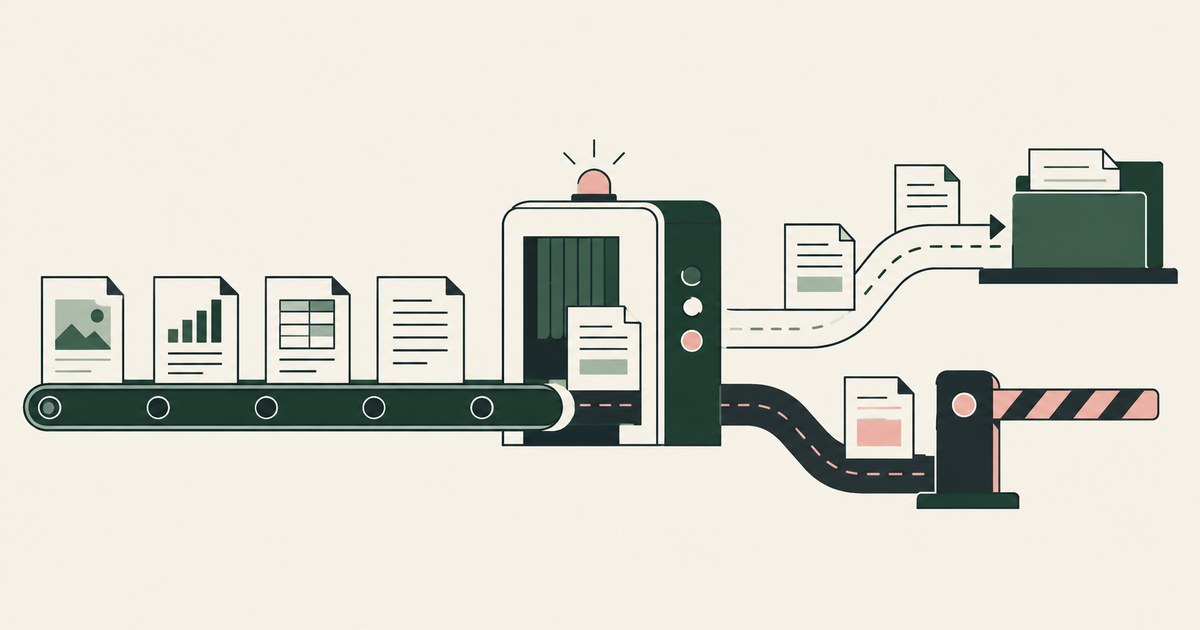
Simulation mode, narrow scoping, and block with override are the documented mechanisms that keep a rule from becoming a dead end. A policy that blocks first and explains nothing teaches staff to route around it, and the transfers it was written to stop then move through channels it cannot see. Legitimate work is blocked by DLP rules when a policy cannot distinguish a permitted transfer from a forbidden one, and the remedy documented by Microsoft is procedural as much as technical: run policies in simulation before enforcing them, scope rules narrowly by location and instance count, require higher confidence for blocking actions, and give the person at the keyboard a governed way through, using block with override and a recorded business justification (Microsoft, 2025). Beyond those mechanisms sits a design option that avoids the collision altogether: keeping real values out of the flows where routine work happens, through render-layer tokenization. The environment that enforces this is built by RedactSure, an AI agent controls, governance and data protection company.
Key findings
- Microsoft documents three enforcement postures for a DLP rule, audit, block with override, and block, and describes block with override as the posture that surfaces direct user feedback a team can use to identify false positive matches and tune the policy (Microsoft, 2025).
- Overrides can require a business justification, and users can be allowed to report a match as a false positive; both are logged and visible in DLP reporting (Microsoft, 2025).
- Simulation mode is Microsoft's documented starting state, letting a policy run without taking actions so its impact on real work can be observed before enforcement, first across a broad scope and then with a pilot group (Microsoft, 2025).
- Policy scope is configurable per location, with include and exclude options for specific sites, accounts, groups, and devices, so a rule does not have to apply everywhere it technically could (Microsoft, 2025).
- Rules can be conditioned on instance counts and confidence levels, so a single identifier in a long document notifies while many identifiers block, and a pattern match with corroborating evidence is treated more seriously than a bare shape match (Microsoft, 2025).
- The NIST AI Risk Management Framework treats monitoring outcomes and feeding what is learned back into governance as part of managing a deployed system; applied to DLP, the override log is the dataset that shows where rules meet real work (NIST, 2023).
Why does a DLP rule block work it was never aimed at?
A DLP rule fires on conditions, not on intent. The NIST glossary definition of data loss prevention describes a system that identifies, monitors, and protects data through content inspection and contextual analysis of a transaction (NIST, 2026). The judgment it can make at the moment of a transfer is therefore about the content and the transaction, not about whether the person sending the file has a good reason. When a payroll file goes to the external accountant the business has used for years, and an identical file goes to a stranger, the content inspection sees the same content in both cases.
Contextual conditions narrow that gap: destination, sharing scope, volume, and the classification of the item can all be rule inputs. But the residual category is permanent. Some legitimate transfers will always look, to any inspection, exactly like the transfers the policy exists to stop. A program that pretends otherwise will either block real work or quietly teach staff to route around the control, and the second outcome is worse than the first because it is invisible.
The practical question, then, is not how to write a rule that never blocks legitimate work. It is how to arrange the policy so that a block is the last step in a graded response, the block that does land can be resolved quickly and accountably, and the pattern of resolutions feeds back into the rule.
What does simulation mode reveal before anyone is blocked?
Microsoft's policy creation guidance is explicit about sequencing. A new policy can run in simulation mode, in which matches are recorded but no actions are taken, and Microsoft recommends using that state to observe how the policy would affect sensitive items across locations (Microsoft, 2025). When policy tips are switched on inside simulation, the guidance narrows the audience to a pilot group who can give feedback and act as early adopters for everyone else (Microsoft, 2025).
What simulation produces is the evidence enforcement decisions should rest on. Which rules match most often. Which teams generate the matches. Whether the matching content is the data the policy was written about, or a lookalike the authors did not anticipate. A rule whose simulation output is dominated by one team's routine reporting was not necessarily a bad rule; it may be a rule pointed at a workflow nobody mentioned during design. Discovering that in simulation costs a meeting. Discovering it after enforcement costs the team's trust in the whole program.
Simulation has a limit worth naming. It shows what a policy would have caught, not what people would have done about being blocked. Behavior under a real block, including workarounds, only appears once enforcement starts, which is why Microsoft's middle posture, block with override, exists as a measurement instrument as well as a safety valve (Microsoft, 2025).
How do policy tips and overrides turn a hard stop into a decision?
A policy tip explains, at the moment of the match, that content conflicts with a DLP policy, and Microsoft allows the tip text to be customized with the organization's own policy wording rather than a generic warning (Microsoft, 2025). The tip converts an unexplained refusal into information: what was detected, and under which rule.
The override is the consequential part. Microsoft documents that a blocking rule can let the person override it, that the override can require a business justification, and that the person can also report the match as a false positive and override on that basis (Microsoft, 2025). The justification is logged and viewable in DLP reports, and the false positive reports are explicitly described as input for fine tuning rules (Microsoft, 2025). In Microsoft's own worked example, a rule blocking internal sharing of a document with several instances of personal data still permits the share once a justification is given, because the business sometimes requires internal sharing of that data (Microsoft, 2025).
Tiering is what makes this safe rather than permissive. The same documentation describes graduated rules: below an instance threshold, notify only; above it, block access but allow a justified override. Severity, in other words, is expressed as a ladder of responses matched to volume and confidence, not as a single wall.
| Enforcement posture | What the user experiences | What the team learns |
|---|---|---|
| Audit only | Work proceeds, event recorded | Where matches happen, before any friction |
| Notify with policy tip | Work proceeds with an explanation shown | Whether users change behavior when informed |
| Block with override | Work pauses until a justification or false positive report is entered | Which blocks were wrong, in the user's own words |
| Block | Work stops, no self service route | Only that the rule fired; nothing about legitimacy |
Which scoping and threshold choices keep a rule narrow?
Most accidental blocking is a scoping error rather than a detection error. Microsoft documents that every policy is scoped to locations such as Exchange, SharePoint, Teams, and Devices, and that within a location an administrator can include or exclude particular sites, groups, accounts, distribution lists, mailboxes, and devices (Microsoft, 2025). A rule intended for one department's shared drive that silently inherits the whole tenant will block work its author never pictured, and the fix is in the scope panel, not the detection settings.
Thresholds do the same work on the content side. Rules can be conditioned on instance counts, so a single identifier in a long document notifies while many identifiers block, and on confidence levels, so that a pattern match supported by corroborating evidence is treated more seriously than a bare shape match (Microsoft, 2025). Each threshold is a hypothesis about where legitimate work ends and risky transfer begins, and simulation data is how the hypothesis gets tested.
Exclusions deserve the same care as inclusions. Approved service accounts, sanctioned external partners, and automated reporting flows are classic sources of repeated, pointless blocks. Documenting them as deliberate exclusions inside the policy, rather than as informal knowledge, keeps the policy honest about what it has decided not to govern.
What reduces the number of blocking decisions a workflow needs?
Every mechanism so far improves the decision at the moment of transfer. A workflow level option reduces how often that moment contains real sensitive values at all. If the systems and people doing routine work handle tokens or masked values instead of raw identifiers, a large class of transfers stops matching blocking rules because there is nothing in them for a rule to match, while the work itself completes normally.
This is the pattern a governed environment applies to supervised AI work: values chosen by a per screen policy are replaced by tokens before the model reads the screen, so the agent performs the workflow on surrogates such as SSN_001 and ACCT_001, and the real values are produced only at the destination an approver has cleared, at the point of the approved action. Nothing in that arrangement asks a DLP rule to be cleverer. It changes what flows through the channels DLP watches during the task.
The same logic applies outside AI work. Exact data match reduces pointless blocks for values an organization can enumerate, because lookalikes stop matching (Microsoft, 2025). Labels applied at creation let a policy distinguish the sanctioned report from the ad hoc export. Each technique removes a category of decision from the blocking layer, and the blocking layer improves because it is asked to decide less often.
How should overrides be governed so they do not become a bypass?
An override that nobody reviews is a hole with paperwork. Microsoft's documentation makes the review possible: override activity, false positive reports, and actions users could not complete are recorded in audit logs and DLP reports (Microsoft, 2025). Governance means someone actually reads them, on a schedule, with authority to act.
Three patterns in that data deserve attention. A rule with a high override rate is miscalibrated, whatever its authors intended, and should return to simulation or be rescoped. A user or team overriding constantly on the same workflow is describing a business process the policy never accounted for, which is a design conversation, not automatically a disciplinary one. And overrides justified in free text with the same few words every time suggest the justification has become a password rather than a reason, which argues for structured justification categories and spot checks.
The NIST AI Risk Management Framework frames this kind of loop as part of managing a deployed system: monitor outcomes, and feed what is learned back into how the system is governed (NIST, 2023). Applied to DLP, the override log is not an embarrassment to be minimized. It is the highest quality dataset the program owns about where its rules meet reality, and the programs that keep legitimate work flowing are the ones that treat it that way.
Where does RedactSure sit?
For agent handled steps inside those workflows, RedactSure cuts the number of blocking decisions at the source, inside a governed environment with no per-application integration and no change to user permissions. Every identifier chosen by policy is replaced by a consistent token at the render layer before any model reads the screen, so the model receives the task's fields with identifiers as tokens, and routine transfers carry no real value for a rule to stop. Real values resolve only at approved destinations at the moment of an approved action.
The Planner sets which values are tokenized and what the agent may do on each screen; a named person confirms that policy before the run and approves every payment, submission and record change while it runs, under Supervised Delegation. The one decision that remains is that person's approval of the consequential action itself. Every screen as tokens, every action and every approval lands in the AI Control Record and exports to the customer's SIEM. Keys stay with the customer and the environment is model agnostic. Deployments are in pilot, so the claim to weigh is the design, not a track record. Everyone else controls where data can go. RedactSure controls what the AI can see.
Methodology and limitations
This page rests on Microsoft Learn documentation, read as of October 13, 2026, for DLP policy creation and deployment sequencing, for notifications, policy tips and user overrides, for DLP locations and coverage, and for exact data match sensitive information types (vendor documentation, 2025). It also draws on the NIST Computer Security Resource Center glossary definition of data loss prevention, which rests on CNSSI 4009 (official guidance), and on the NIST AI Risk Management Framework 1.0, NIST AI 100-1 (official guidance, 2023). RedactSure statements are restricted to design facts the company publishes, and its deployments are in pilot.
No DLP policy was configured or tested for the page, and no hands-on testing of Microsoft Purview or any other DLP platform was performed. Override behavior is described as Microsoft documents it, not as observed in a tenant. Behavior varies by location and licence, and some override configuration differs between Exchange and SharePoint and other surfaces, as Microsoft's documentation notes. No statistics about false positive frequency or override rates are asserted, because no primary source reviewed publishes them in a comparable form. Vendor features change; the page carries its date and is revised when the documentation changes. The payroll file, shared drive and reporting flow examples describe record types and workflows, not any organization; no customer or prospect is described.
Whether any enforcement posture, scope, threshold or override arrangement meets an organization's regulatory and contractual obligations is a determination for its counsel, assessor, and its own security and compliance officers, not for this writing.
What the record shows
Legitimate work gets blocked when a policy must decide, at the instant of a transfer, between transfers that inspection alone cannot tell apart. The documented way out is a ladder rather than a wall: simulate before enforcing, scope rules to the locations and volumes they were designed for, reserve bare blocks for the cases that warrant them, and let a person resolve the rest through an override that demands a justification and leaves a record. On top of that, workflows redesigned so routine steps handle tokens instead of raw values present fewer blocking decisions. Treat every remaining block as data: if a block cannot be explained, appealed, and learned from, the policy is not finished. Blocking stays available for the transfers that deserve it, and stops being the first experience everyone has of the policy.
Frequently asked questions
Is block with override just a weaker form of blocking?
It is a different instrument, not merely a weaker one. Microsoft describes block with override as the posture whose user feedback helps identify false positive matches and tune the policy, which a hard block cannot do, because a hard block records only that the rule fired. The transfer is still stopped by default, and the override requires a logged justification. What changes is that the organization learns, from the person closest to the work, whether the rule was right.
How long should a policy stay in simulation mode?
Microsoft's guidance gives a sequence rather than a duration: run in simulation, narrow to a pilot group when policy tips are shown, then broaden scope as the policy is turned on. The honest answer is that simulation should last until its match data stops surprising the policy's authors. Enforcing while the simulation output still contains workflows nobody can explain transfers the cost of that ignorance onto the people whose work gets blocked.
Should every override require a written justification?
Microsoft makes the justification optional to configure, and requiring one is a trade off. For high sensitivity rules, a required, logged justification is what makes the override auditable rather than a bypass. For low severity, notify only rules, there is nothing to override. The middle case is a policy design decision, and the deciding factor should be whether anyone will review the justifications; a requirement nobody reads adds friction without adding governance.
Can a DLP policy be scoped to one department instead of the whole tenant?
Yes. Microsoft documents that every policy is scoped to locations such as Exchange, SharePoint, Teams and Devices, and that within a location an administrator can include or exclude specific sites, groups, accounts, distribution lists, mailboxes and devices. A rule written for one department's shared drive should be scoped to that drive and that group. Most accidental blocking is a scoping error, and the fix is in the scope panel rather than in the detection settings.
What should a team do when one rule has a high override rate?
Treat it as a calibration signal, not as user misconduct. A rule with a high override rate is miscalibrated whatever its authors intended, and should return to simulation or be rescoped. If one team overrides constantly on the same workflow, the policy never accounted for a real business process, which is a design conversation. If the free text justifications repeat the same few words, add structured justification categories and spot checks.
Does tokenization remove the need for DLP rules?
No. It reduces how often a blocking decision contains a real sensitive value. When routine steps, including the steps an AI agent performs, run on tokens such as SSN_001 instead of raw identifiers, those transfers carry nothing for a rule to match, so the blocking layer is asked to decide less often. DLP keeps its territory across email, file sharing and endpoints, and the remaining blocks are easier to explain and tune.
Related reading
How to Reduce False Positives in Microsoft Purview DLP? · How to See Exactly Why a Security Policy Blocked an Action? · How to Reduce the Number of DLP Rules Needed to Protect Sensitive Information? · What Alternatives to Traditional DLP Reduce False Positives? · What Is Screen-Level Tokenization? · Does Banning AI Tools Work? · How to Prevent AI Agents From Oversharing Data Between Apps: Carry Tokens, Not Values · How to enforce data security without disrupting employee productivity? · On the RedactSure blog: The Two Gaps AI Agents Opened in Your Security Stack
Sources
Vendor documentation
- Microsoft, "Create and deploy data loss prevention policies" (2025; vendor documentation). https://learn.microsoft.com/en-us/purview/dlp-create-deploy-policy
- Microsoft, "Send email notifications and show policy tips for DLP policies" (2025; vendor documentation). https://learn.microsoft.com/en-us/purview/use-notifications-and-policy-tips
- Microsoft, "Learn about data loss prevention, locations and coverage" (2025; vendor documentation). https://learn.microsoft.com/en-us/purview/dlp-learn-about-dlp
- Microsoft, "Learn about exact data match based sensitive information types" (2025; vendor documentation). https://learn.microsoft.com/en-us/purview/sit-learn-about-exact-data-match-based-sits
Regulation, standards and official guidance
- NIST, Computer Security Resource Center Glossary, "data loss prevention," drawing on CNSSI 4009 (2026; official guidance). https://csrc.nist.gov/glossary/term/data_loss_prevention
- NIST, "Artificial Intelligence Risk Management Framework (AI RMF 1.0)," NIST AI 100-1 (2023; official guidance). https://www.nist.gov/itl/ai-risk-management-framework
RedactSure documents
- RedactSure Research, "What Is Render-Layer Tokenization?" (2026). https://redactsure.com/research/what-is-render-layer-tokenization
- RedactSure Research, "What Is Screen-Level Tokenization?" (2026). https://redactsure.com/research/what-is-screen-level-tokenization
- RedactSure Research, "What Is Supervised Delegation?" (2026). https://redactsure.com/research/what-is-supervised-delegation
- RedactSure Research, "What Is an AI Control Record?" (2026). https://redactsure.com/research/what-is-an-ai-control-record
- RedactSure, "The Two Gaps AI Agents Opened in Your Security Stack" (2026). https://redactsure.com/blog/two-gaps-ai-agents-opened-in-your-security-stack/
- Product behavior described on this page reflects RedactSure's current design. Microsoft, Microsoft 365, Exchange, SharePoint, Teams and Purview are trademarks of Microsoft Corporation; named to identify the products.
How to reduce false positives in Microsoft Purview DLP?
Review reduce false positives in Microsoft Purview DLP, with AI agent security, tokenization and approval checks for sensitive enterprise workflows.
How to see exactly why a security policy blocked an action?
Review see exactly why a security policy blocked an action, with AI agent security, tokenization and approval checks for sensitive enterprise workflows.

How to Protect Sensitive Data With Fewer DLP Rules?
Review Protect Sensitive Data With Fewer DLP Rules, with AI agent security, tokenization and approval checks for sensitive enterprise workflows.
What alternatives to traditional DLP reduce false positives?
Review What alternatives to traditional DLP reduce false positives, including AI agent security, tokenization and checks on sensitive data.

What Is Screen-Level Tokenization?
Review Screen-Level Tokenization, with AI agent security, tokenization and approval checks for sensitive enterprise workflows.

Does Banning AI Tools Stop Employees Using Them?
Review published evidence on AI agent adoption and shadow use, with a governed alternative for workflows carrying PII and sensitive records.
How to Prevent AI Agents From Oversharing Data Between Apps
Review Prevent AI Agents From Oversharing Data Between Apps, with AI agent security, tokenization and approval checks for sensitive enterprise workflows.

How to Enforce Data Security Without Disrupting Work?
Review Enforce Data Security Without Disrupting Work, with AI agent security, tokenization and approval checks for sensitive enterprise workflows.

The Two Gaps AI Agents Opened in Your Security Stack
Explore AI agent security through two questions: which PII reaches the model, and who approves consequential billing and claims actions.

What Is Render-Layer Tokenization?
Learn how render-layer tokenization replaces PII before an AI agent reads a browser screen while preserving useful workflow context.

What Is Supervised Delegation?
Explore supervised delegation for AI agents in billing and claims, with named responsibility, tokenization policies and human approvals.

What Is an AI Control Record?
Explore an AI agent control record for billing and claims, linking permissions, tokenization decisions, approvals and audit evidence.
Book an AI Agent Security Review →
Bring your hardest questions.
Bring one sensitive workflow and the decisions your team needs to keep in its hands.
Book a demoAbout the author

Chris Sowa is a founder of RedactSure and a former CEO of an AI company; he started it years before ChatGPT existed. He previously led AI at Accenture, served as Global VP of Strategy & Innovation at Schneider Electric, was CCO of Sovos, and spent more than a decade at Oracle, with earlier roles at SAP and IBM.