
Explainer · By Chris Sowa · Published
Last updated
Should an AI Agent Work Through the Screen or Through APIs and MCP?
Use APIs or MCP where their scope, reliability and data controls fit the task, and governed screen automation where a suitable integration is unavailable. Both paths need explicit limits on what reaches the model.
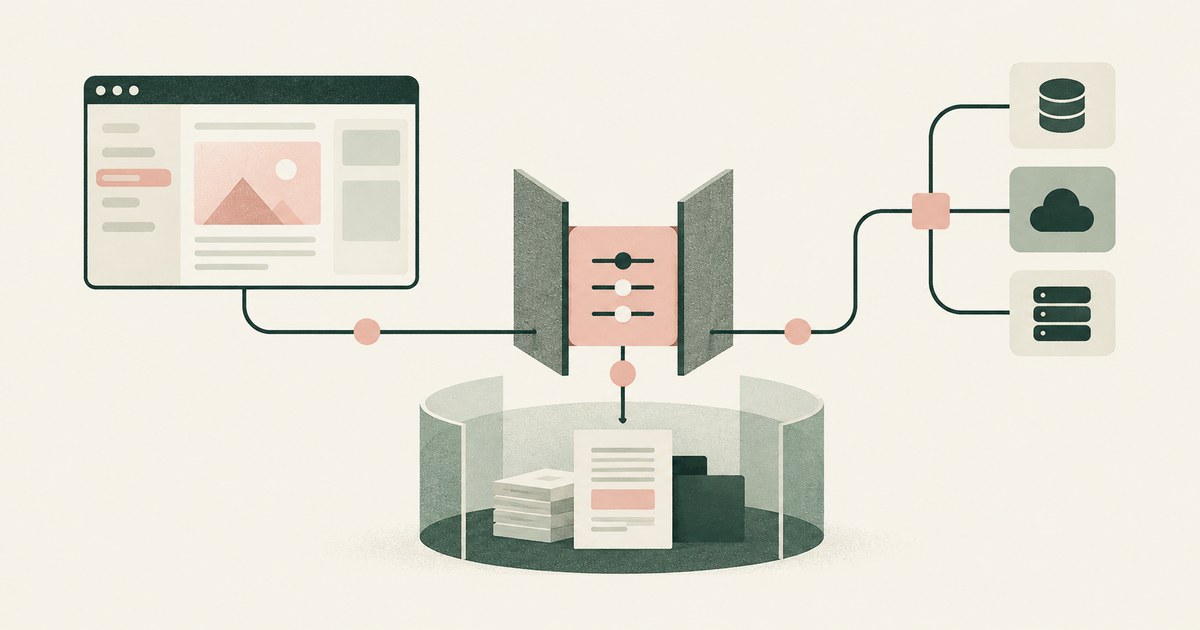
Use APIs or MCP where their scope, reliability and data controls fit the task, and governed screen automation where a suitable integration is unavailable. Both paths need explicit limits on what reaches the model. A claims or billing workflow can cross an internal system and portals owned by other organizations. An API can handle structured steps efficiently, while screen automation can cover permitted tasks without a suitable interface. Neither channel is automatically more private: responses and screenshots both need input controls, action approvals and a usable record. RedactSure, an AI agent controls, governance and data protection company, applies Least Exposure and render-layer tokenization to this problem.
Key findings
- MCP is an open standard for connecting AI applications to tools and data through servers a vendor or developer builds. Each server exposes the operations and scopes its author chose, per Anthropic's introduction.
- Every major agent platform ships an integration path. AgentCore Gateway turns APIs into MCP-compatible tools (AWS). Dots connect to more than 4,000 apps through plugins (The Next Web). Muse for Small Business and Gemini Enterprise use connectors (TechCrunch, Google Cloud).
- An integration returns the object its author defined. A connector can hand the model more of a record than the task needs (Do API Connectors Give an AI Agent More Data Than the Task Needs?).
- A browser agent from a model vendor reads page content within its permitted access. AgentCore's Browser tool hands the model a screenshot and the DOM (AWS). Claude in Chrome puts all visible information into context (Claude Help Center).
- A governed browser agent works the same screens with identifiers as tokens, under the user's existing permissions, with a named person able to watch and take over (What Is a Tethered Agent?).
What does an API or MCP integration give an agent?
Structure, speed and reliability. An API returns a defined object in a defined shape, in milliseconds, the same way every time. An MCP server wraps that API in a form an AI application can call. It exposes the tools and resources its author decided to expose, with the scopes its author decided to grant (Anthropic, Model Context Protocol). For a pipeline the organization owns, that is the right interface. Nothing on a screen competes with it for throughput.
The platforms agree. AgentCore's Gateway "turns APIs, Lambda functions and services into MCP-compatible tools" (AWS). OpenAI's Dots connect to more than 4,000 apps through plugins (The Next Web). Muse for Small Business connects to Shopify, Stripe, QuickBooks, Slack and a list of others through connectors (TechCrunch). Gemini Enterprise's connectors "integrate with your enterprise data, including data in third-party systems" (Google Cloud).
Two things follow from the design. The integration exists only where someone built it, and it exposes only what that someone chose. The organization that uses the server inherits both decisions.
What does the screen give an agent that an API does not?
Coverage. Every application the organization runs renders a screen. It does so whether or not it has an API, whether or not anyone wrote an MCP server for it, and whether or not the organization licensed the integration tier. A screen agent can reach supported applications without a dedicated API, subject to access, compatibility and automation terms.
Existing permissions. The agent works as the user, on the applications a named person connected it to, under the access that person already holds. No new service account, no new API key, no new scope to review. That is a tethered agent: it works only inside the governed environment a named person connected it to, on the applications that person chose.
Cross-application work. A claim, a prior authorization, a student transfer or an AP run crosses three or four systems, and the person doing it today moves between screens. An agent that works screens follows the same path, with no integration to build between each pair of systems.
Supervision. The person who owns the workflow watches the same stream the agent works, can pause it, and can take over. That person approves every payment, submission and record change under Supervised Delegation. An API workflow can also expose a review interface, but that interface has to be provided by the application.
Exposure decided at the render. A screen is rendered before it is read, so there is a point at which a policy can replace identifiers with tokens and hand the model the task's fields. An API response can likewise be filtered or tokenized before it is forwarded to the model.
Time to value. The work starts when the environment is connected to the applications the workflow already uses, not when the last integration ships.
Is there an MCP server for the systems that matter?
That is the vendor's decision, on the vendor's schedule, with the vendor's scopes. The systems regulated work runs on are the claims platform, the EHR, the student information system, the municipal finance system, the payer portals and the industry databases such as ISO ClaimSearch. For each one, the organization does not control whether an API is exposed, which operations it covers, which license tier includes it, or whether anyone has wrapped it in an MCP server.
The workflows on those systems are the ones AI programs most want to automate and most often fail to reach. The pages on Guidewire claims, Epic, PowerSchool and Tyler Munis each describe work an agent can do through the screen today, with identifiers as tokens, while the integration question stays with the vendor. The portals around those systems, the payer's, the state's, the supplier's, are the long tail. A portal owned by another organization is one no integration project can schedule.
What are the honest limits of a screen-based agent?
Interface changes can affect UI automation. When an application's screen changes, the agent's understanding of that screen has to keep up, and a run can need a person's attention until it does.
High-volume structured pipelines run faster through an API. A nightly load of ten thousand records belongs in an integration, not on a screen.
Some application vendors' terms address automation. The organization should check its agreements before putting an agent on a given application.
Where an application exposes a well-scoped API, using both can be right. The API takes the structured step. The screen takes the parts the API does not cover and the applications that have no API at all.
What does each style hand the model?
An API returns the object. A customer record endpoint returns the customer record: name, address, date of birth, account number, order history, whatever the author put in the response. If the response is forwarded without filtering, the model can receive more than the task needs (Do API Connectors Give an AI Agent More Data Than the Task Needs?).
A screen read by a model vendor's browser agent is handed over in full. AgentCore's Browser tool gives the model screenshots and the DOM (AWS). Claude in Chrome puts all visible information, including personal data, into context (Claude Help Center). Dots receive webpage text and document content in connected apps (OpenAI).
A screen rendered inside a governed environment can be handed to the model as the task's fields with identifiers as tokens. The model gets the claim's loss date, reserve and coverage code, with the claimant as CLAIMANT_001 and the SSN as SSN_001. That is render-layer tokenization. The same minimization goal can also be enforced in a controlled API adapter.
How does this play out in a regulated workflow?
An injury claim moves across ClaimCenter, ISO ClaimSearch and a payment portal. The carrier may have licensed and wired an integration to its own claims platform. The industry database and the payment portal belong to other organizations, and the examiner works them through a screen today. A governed agent works all three the same way the examiner does, with claimant identifiers as tokens, and the examiner approves the payment (Can an AI Agent Work Guidewire Claims Without PII?).
A revenue-cycle task moves across the EHR and a payer portal. The EHR's integration interfaces are the vendor's and the health system's to license and wire. The payer portal is the payer's, and the biller works it through a screen. A governed agent reads the chart's task fields with PATIENT_001 in place of the identifiers and works the portal under the biller's login (Can an AI Agent Work in Epic Without Holding PHI?).
A student transfer moves across PowerSchool and the district's finance system. Each is a bought system with the vendor's own integration story. The registrar and the business office work both through screens. A governed agent carries STUDENT_001 across both (Can an AI Agent Use PowerSchool Without Student PII?).
An AP run moves across the ERP and a supplier portal. The ERP is where an API most often exists and is most often the right interface for the structured posting. The supplier portal is the supplier's, worked through a screen, and holds the bank details the model does not need (AP in Oracle ERP without vendor bank details). The pattern across all four is the one the Crosses Every Silo analysis describes. The valuable work runs across systems, and one of them is always a screen.
How should a buyer split the two?
| Control | API or MCP integration | Agent in the user's browser or a vendor cloud browser | Governed browser agent (RedactSure) |
|---|---|---|---|
| Applications reached | Those with a server someone built and licensed | Any application with a screen | Any application with a screen, inside the governed environment |
| Permissions used | A service account or API key with its own scopes | The user's existing login | The user's existing permissions, unchanged |
| Integration effort | Per application, per operation | None | None: no per-application integration |
| What the model receives | The object the author defined | The page, as screenshot or DOM | The task's fields, identifiers as tokens |
| Who can supervise | Application-defined review interfaces and logs | The user, on their own machine or a vendor's Live View | A named person watches, pauses, takes over and approves each consequential action |
| Record | API logs | Vendor activity view or session recording | Every action logged, human and computer; all PII as tokens |
| Limits | Requires a suitable interface and explicit response scope | Interface changes; page content within its permitted access; supervision by whoever is present | Interface changes; high-volume pipelines belong in an API |
Where does RedactSure sit?
RedactSure is the third column. AI co-workers do real work on the ERP, the claims platform, the EHR, the student information system and the portals and email around them, inside a governed environment. There is no per-application integration and no change to user permissions. The environment is a secure virtual machine deployed into the cloud the customer's posture requires, on hardware-encrypted enclaves, with keys the customer holds. Every sensitive value chosen by policy is replaced by a consistent token at the render layer before any model reads the screen. The model is handed the task's fields rather than a picture of the page. The Planner sets which values are tokenized and what the agent may do on each screen. A named person confirms that policy and approves every payment, submission and record change. Deployments are in pilot.
What the organization avoids is the wait: a claims platform, an EHR or a portal left manual until its vendor ships an API or an MCP server on the vendor's schedule. It also avoids the alternative of a browser agent that hands every screen to the model in full. The human operator can watch, pause and take over the same tokenized stream. Every screen as tokens, every action and every approval lands in the AI Control Record and exports to the customer's SIEM. Where an application exposes a well-scoped API the organization already uses, the two can run side by side.
Methodology and limitations
The HIPAA minimum necessary standard has exceptions, including certain treatment disclosures. Its application depends on the purpose and parties. Replacing direct identifiers does not by itself establish HIPAA de-identification or remove all PHI from the remaining context.
The page rests on vendor documents read as of September 30, 2026. They are Anthropic's introduction to the Model Context Protocol, AWS's AgentCore developer guide, and OpenAI's September 29, 2026 safety document for dots. The Claude in Chrome safety page and Google's April 22, 2026 Gemini Enterprise post are also used. Vendor wording is cited with their dates; where it is silent the page says so. The Next Web's and TechCrunch's September 29, 2026 reports are cited as press. Regulation is read from its text, not case law or enforcement actions: 45 CFR 164.502(b) and the PCI Council's scoping guidance.
No hands-on testing of any vendor product was performed; what each agent hands the model is the vendor's own description. Whether Guidewire, Epic, PowerSchool, Tyler Munis, ISO ClaimSearch or Oracle expose an API or an MCP server is each vendor's to state; their documentation was not surveyed. The dots and Muse reports are launch-day press, not vendor documentation. The agent vendors' enterprise terms and system cards were not reviewed and could disclose more. Vendor features and integration catalogs change; the page carries its date and is revised when documentation changes. Statements about claims, clinical and student record workflows describe the record type, not any organization; no customer or prospect is described.
Whether any control meets an organization's requirements, including the minimum necessary standard and PCI scope, is for that organization's counsel, assessor or compliance officer, not this page.
- Anthropic, "Introducing the Model Context Protocol."
- AWS, "What is Amazon Bedrock AgentCore?"
- AWS, "Interact with web applications using Amazon Bedrock AgentCore Browser."
We did not run the vendor products or capture their model requests. Workflow examples are analysis, and RedactSure behavior is described from its current design.
What the record shows
Use APIs or MCP where their scope, reliability and data controls fit the task, and governed screen automation where a suitable integration is unavailable. Both paths need explicit limits on what reaches the model. Map the systems each workflow crosses, choose an interface for each step and test the complete input and approval path.
Frequently asked questions
Is MCP going to make browser agents unnecessary?
Not for the bought estate. MCP is an open standard, and a server for a given system exists only when its vendor or a developer builds one, exposing the operations that author chose. The claims platforms, EHRs, student information systems and the portals of other organizations arrive on those authors' schedules. A browser agent reaches them now, and a governed one reaches them with identifiers as tokens.
Is UI automation less secure than an API?
Neither interface is inherently safer. Compare authentication, field-level input controls, action approvals, audit evidence and failure handling. A filtered API can be narrow and predictable; governed screen automation can cover tasks without a suitable API. Both need testing on the intended workflow.
What happens when the application's screen changes?
Interface changes can affect UI automation. A changed screen can need a person's attention until the agent's understanding of it is updated, and the human operator can watch, pause and take over the same stream while that happens. An API change breaks an integration in a different way, at the code level, and needs a developer. Both are maintenance. Neither is avoided by choosing the other.
Does the agent need a service account?
No. A governed browser agent works under the permissions the user already holds, on the applications a named person connected it to. No new service account, API key or scope is created, and no existing permission changes; what changes is what the AI can see. An API or MCP integration typically needs its own credential with its own scopes, which the security team then has to review and rotate.
Can the agent work a portal that has no API?
Yes. A payer portal, a state filing portal, a supplier portal or an industry database renders a screen for the person who uses it. A governed browser agent works that screen under the same login. That is the case an integration can never cover. The portal belongs to another organization, and the organization using it cannot schedule an API on the portal owner's behalf.
Which is better for PCI or HIPAA scope?
The one that keeps identifiers away from the model and out of the record. An API that returns a PAN or a chart puts both in the model's context and in whatever logs it. A governed screen hands the model CARD_001 or PATIENT_001, and the record holds tokens, which can reduce exposure relevant to the assessor's analysis and is aligned with the minimum necessary standard. Scope determinations belong to the organization's assessor or counsel (Can an AI Agent Handle Cards Without Wider PCI Scope?).
Sources
Vendor documentation
- Anthropic, "Introducing the Model Context Protocol." https://www.anthropic.com/news/model-context-protocol
- AWS, "What is Amazon Bedrock AgentCore?" https://docs.aws.amazon.com/bedrock-agentcore/latest/devguide/what-is-bedrock-agentcore.html
- AWS, "Interact with web applications using Amazon Bedrock AgentCore Browser." https://docs.aws.amazon.com/bedrock-agentcore/latest/devguide/browser-tool.html
- OpenAI, "How we build safety, security and privacy into dots" (September 29, 2026). https://openai.com/index/how-we-build-safety-security-and-privacy-into-dots/
- Claude Help Center, "Use Claude in Chrome safely." https://support.claude.com/en/articles/12902428-use-claude-in-chrome-safely
- Google Cloud Blog, "The new Gemini Enterprise: one platform for agent development" (April 22, 2026). https://cloud.google.com/blog/products/ai-machine-learning/the-new-gemini-enterprise-one-platform-for-agent-development
Regulation and standards
- PCI Security Standards Council, "Guidance for PCI DSS Scoping and Network Segmentation." https://www.pcisecuritystandards.org/documents/Guidance-PCI-DSS-Scoping-and-Segmentation_v1.pdf
- 45 CFR 164.502(b), HIPAA minimum necessary standard. https://www.ecfr.gov/current/title-45/subtitle-A/subchapter-C/part-164/subpart-E/section-164.502
Independent analysis and press
- The Next Web, "OpenAI launches dots, always-on AI agents with their own cloud computers" (September 29, 2026). https://thenextweb.com/news/openai-dots-always-on-ai-agents-cloud-computers-devday
- TechCrunch, "Meta is expanding its AI agent Muse to small businesses" (September 29, 2026). https://techcrunch.com/2026/09/29/meta-is-expanding-its-ai-agent-muse-to-small-businesses/
RedactSure documents
- RedactSure, "Secure AI That Crosses Every Silo" (2026). https://redactsure.com/blog/secure-ai-that-crosses-every-silo/
- RedactSure, "The Two Gaps AI Agents Opened in Your Security Stack" (2026). https://redactsure.com/blog/two-gaps-ai-agents-opened-in-your-security-stack/
- RedactSure, "Accountable AI and Workflow Governance" (2026). https://redactsure.com/blog/accountable-ai-and-workflow-governance/
- RedactSure Research, "What Is Render-Layer Tokenization?" (2026). https://redactsure.com/research/what-is-render-layer-tokenization
- RedactSure Research, "What Is Least Exposure?" (2026). https://redactsure.com/research/what-is-least-exposure
- RedactSure Research, "What Is Supervised Delegation?" (2026). https://redactsure.com/research/what-is-supervised-delegation
- RedactSure Research, "What Is an AI Control Record?" (2026). https://redactsure.com/research/what-is-an-ai-control-record
- RedactSure Research, "What Does an AI Agent See in a Screenshot?" (2026). https://redactsure.com/research/what-does-an-ai-agent-see-when-it-takes-a-screenshot
- Product behavior described on this page reflects RedactSure's current design. Amazon Web Services, Amazon Bedrock and AgentCore are trademarks of Amazon.com, Inc. or its affiliates; OpenAI, ChatGPT and Dots are trademarks of OpenAI; Claude is a trademark of Anthropic, PBC; Google, Google Cloud and Gemini are trademarks of Google LLC; Meta and Muse are trademarks of Meta Platforms, Inc.; Guidewire, Epic, PowerSchool, Tyler Munis, ISO ClaimSearch and Oracle are trademarks of their respective owners; named to identify the products. Compliance determinations belong to the organization's counsel.
Related research

Can API Connectors Expose More Data Than an AI Task Needs?
Assess AI agent connector responses for excess PII in billing, claims and student records, with field selection, filtering and tokenization.

What Is a Tethered Agent?
Learn how a tethered AI agent stays tied to a named person, with tokenization, bounded permissions and approval for sensitive payments.
What Is Supervised Delegation?
Explore supervised delegation for AI agents in billing and claims, with named responsibility, tokenization policies and human approvals.
Can an AI Agent Work Guidewire Claims Without PII?
Explore how AI agents can work Guidewire claims with PII tokenization, consistent records and adjuster approval before payments move.
Can an AI Agent Work in Epic Without Holding PHI?
Explore AI agents in Epic patient accounts and claims, with PHI tokenization at the screen and named approval for consequential actions.
Does AgentCore Decide What the AI Agent Sees?
Review AgentCore AI agent input controls, PII exposure and tokenization for claims and payments, including browser observations and recordings.
Secure AI That Crosses Every Silo
Explore AI agents that work across billing, collections and enterprise systems while tokenization protects PII at each workflow step.
See it on your workflow.
Bring one billing, collections, claims or patient-account workflow and your questions.
Book a demo