
Comparison · By Chris Sowa · Published
Last updated
What Is the Difference Between RedactSure and Netskope for Sensitive Data Reaching AI Tools?
Netskope describes AI Guardrails as a runtime layer between a user or agent and the model that inspects prompts and responses and blocks sensitive data leaks through Netskope DLP. RedactSure governs what an AI agent's model receives from each screen and who approves each action. The page reviewed does not state that Netskope redacts, masks or tokenizes values before the model reads them.
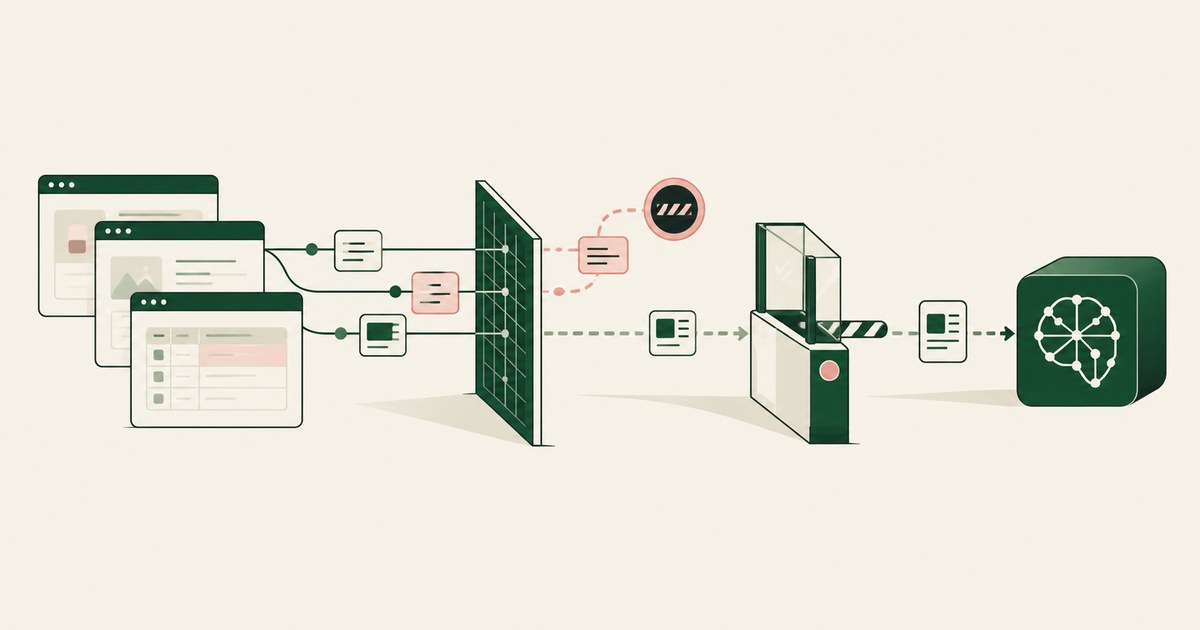
Netskope describes AI Guardrails as a runtime layer between a user or agent and the model that inspects prompts and responses and blocks sensitive data leaks through Netskope DLP. RedactSure governs what an AI agent's model receives from each screen and who approves each action. The page reviewed does not state that Netskope redacts, masks or tokenizes values before the model reads them. The question matters because sensitive data now reaches AI tools by two routes. One is a person pasting or uploading content into a generative AI application, which is a traffic event a network control can see. The other is an agent that opens business applications and reads what they render, where the exposure happens inside a session the organization has already allowed. RedactSure addresses the second route with render-layer tokenization: values chosen by policy become consistent tokens before any model reads the screen. The environment that enforces this is built by RedactSure, an AI agent controls, governance and data protection company.
Key findings
- Netskope describes Skylight AI Guardrails as a dedicated runtime layer for AI environments that sits between the user or autonomous agent and the LLM, inspects every request and response, and blocks sensitive data leaks through integration with Netskope DLP (Netskope, 2026).
- OWASP lists sensitive information disclosure as LLM02 in its Top 10 for LLM Applications 2025, a risk that turns on what data a model is given in the first place (OWASP, 2025).
- OWASP lists prompt injection as LLM01, the first entry in the same Top 10, and includes indirect injection through external content the model processes (OWASP, 2025).
- Researchers showed that instructions planted in content an LLM-integrated application retrieves can redirect its behavior, which means the data an agent reads is also an attack path (Greshake et al., 2023).
- A 2026 study found that a model-agnostic Tool-Input Firewall that strips data a tool call does not need, paired with an output sanitizer, brought attack success near zero on four agent benchmarks with high utility (Bhagwatkar et al., 2026).
- RedactSure operates at the render layer inside a governed environment: a Planner policy confirmed by a named person before the run, tokens in place of identifiers before the model reads the screen, and named approval for each consequential action under Supervised Delegation, with deployments in pilot.
What does Netskope say it does?
Netskope describes Skylight AI Guardrails as a dedicated runtime layer for AI environments (Netskope, 2026). The page places it between the user, or an autonomous agent, and the LLM, where it analyzes traffic in real time and inspects every request and response across generative AI SaaS, private deployments and autonomous agent workflows (Netskope, 2026).
On sensitive data, the page states that the product identifies and blocks patented or copyrighted data in AI responses and blocks sensitive data leaks through integration with Netskope DLP (Netskope, 2026). The page reviewed does not state whether it classifies, redacts, masks or tokenizes values, or whether it raises alerts. For agents, the page states that it protects autonomous agents from manipulation and blocks attempts to bypass system rules or exfiltrate data; it does not state how policies, approvals or tool-call blocking work. For records, it lists searchable conversation logs and detections mapped to MITRE ATLAS and the OWASP Top 10 for LLMs (Netskope, 2026).
That positioning locates the unit of control. It is the exchange with the model: a prompt going in and a response coming back, inspected at runtime. The outcome the page describes is a decision to block or let the exchange proceed. That is a central concern for any organization whose staff and agents use AI tools, and it is the concern a ban alone does not settle.
What the page reviewed does not state is a change to what an AI model reads once a request is allowed. It does not state the product's position relative to the screen an agent reads, and it does not state that values are replaced with tokens before a model receives them.
What happens to sensitive data on the way to an AI tool under each design?
Take an employee who pastes a customer record into a generative AI application. Under Netskope AI Guardrails, the paste becomes a prompt that the runtime layer inspects. The page states that Netskope DLP blocks sensitive data leaks (Netskope, 2026); the page reviewed does not state that the value can be redacted, masked or tokenized instead. The decision depends on the content being recognized, which is why the companion page on runtime tokenization and DLP for AI agents separates detection from transformation.
The same employee working with a RedactSure co-worker does not paste anything. The agent opens the application inside the governed environment. The Planner has set which values are tokenized for the task, and a named person confirmed that policy before the run. Values covered by the policy are replaced at the render layer by consistent tokens such as ACCT_001 and SSN_001, so the model receives the task's fields with identifiers as tokens. Amounts, dates and codes the work runs on stay in clear where the policy says so. Real values resolve only at approved destinations at the moment of an approved action.
The difference is in what the decision is about. A runtime inspection layer, as Netskope describes it, decides whether a prompt or response may proceed. A render-layer control decides what the model may see while the work happens. Both are data protection, but they answer separate questions, and the second question is the one OWASP's LLM02 entry turns on, since disclosure risk starts with what the model was handed (OWASP, 2025).
The companion page on AI gateways, DLP or tokenization works through the same split for prompt traffic. A block stops the work. An allow sends the real value. Neither gives the model a usable stand-in, which is the case where a workflow has to continue on regulated records.
What changes when the AI tool is an agent reading screens?
A person using a chat application creates traffic a network control can inspect. An agent working inside business applications behaves differently. It opens a claims record, a vendor master or a student file through a session the organization already permits, and it reads the page as rendered. The sensitive values reach the model as part of the agent's normal work, not as an upload. That is the pattern the research page on AI agent data exposure describes: exposure is defined by what the agent can read, not only by where data is sent.
The research on injection adds a second reason the screen matters. Greshake and colleagues showed that instructions hidden in content an LLM-integrated application retrieves can take over its behavior (Greshake et al., 2023). OWASP's LLM01 entry treats indirect injection through processed content as part of the top risk (OWASP, 2025). An agent reading screens reads whatever those screens contain, including text an attacker placed in a field, an email or a document. If the agent's model also holds real identifiers, a successful injection has something to collect.
The defense the evidence favors is minimization at a boundary. Bhagwatkar and colleagues found that stripping data a tool call does not need, and cleaning what comes back, brought attack success close to zero on AgentDojo, Agent Security Bench, InjecAgent and tau-Bench while keeping utility high (Bhagwatkar et al., 2026). The same paper warns that public agent benchmarks have flawed metrics and weak attacks, so near-perfect scores deserve scrutiny (Bhagwatkar et al., 2026). The principle that holds up is to reduce what reaches the model before anything else runs.
Render-layer tokenization applies that principle at the screen. In a RedactSure run, an injection that succeeds collects tokens and remaining task context, and the consequential action still stops for a named person. Netskope describes inspecting every request and response in autonomous agent workflows (Netskope, 2026); the page reviewed does not state that it removes values a request does not need before the model receives them. For an agent inside an allowed session, the screen is where the model's input is formed.
How do the two compare side by side?
The table compares the two on what each governs, where it sits, what it does with sensitive values and how actions are controlled. The Netskope column follows the AI Guardrails page on the vendor's site (Netskope, 2026); where that page is silent, the cell says so.
| Dimension | Netskope, per its AI Guardrails page | RedactSure, per its published design |
|---|---|---|
| What it is | A dedicated runtime layer for AI environments, Skylight AI Guardrails, with sensitive data blocking through Netskope DLP (Netskope, 2026) | AI agent controls, governance and data protection for supervised AI co-workers working across an organization's applications |
| Where it sits | Between the user or autonomous agent and the LLM; position relative to the screen not stated on the page reviewed | Inside a governed virtual environment, at the render layer of the screens the agent reads |
| What it inspects or controls | Every request and response across generative AI SaaS, private deployments and autonomous agent workflows | What the model receives from each screen: the task's fields, with identifiers as tokens |
| Treatment of sensitive values | Identifies and blocks copyrighted data in responses; blocks sensitive data leaks through Netskope DLP; redaction, masking and tokenization not stated on the page reviewed | Replace with consistent tokens before any model reads the screen; real values resolve only at approved destinations at the moment of an approved action |
| Agent actions and approval | Protects autonomous agents from manipulation and blocks attempts to bypass system rules or exfiltrate data; policies, approvals and tool-call blocking not stated on the page reviewed | A named person confirms the Planner policy before the run and approves every payment, submission and record change |
| Record | Searchable conversation logs with role-based access control; detections mapped to MITRE ATLAS and the OWASP Top 10 for LLMs, in one consolidated view | Every action logged, human and computer; all PII as tokens, in the AI Control Record, exported to the customer's SIEM |
| Integration | Not stated on the page reviewed | No per-application integration and no change to user permissions; model agnostic |
The table is not a ranking. Netskope's runtime layer covers prompts and responses across an organization's AI use, more ground than any single agent run, and RedactSure does not claim to do that job. RedactSure acts at a moment the page reviewed does not describe: the point at which a model is about to read a rendered screen during a workflow.
Who approves what the AI does in each design?
Netskope's page describes decisions made when a request or response is inspected, including blocking attempts to bypass system rules or exfiltrate data (Netskope, 2026). The page reviewed does not state that a named person approves an agent's individual actions in a business application.
An agent's consequential actions are of a different kind. Paying an invoice, submitting a claim decision, changing a vendor's bank details or posting a budget transfer happen inside the application, through a session that is already allowed. The page reviewed places Netskope's layer between the agent and the LLM and does not state that it asks whether this payment on this record should go now.
RedactSure puts that question to a person. Under Supervised Delegation, a named person grants the access, chooses the applications, confirms what is tokenized, can watch and pause the run, and approves every consequential action, on the record. The AI prepares the work and a named person decides. There is no always-allow setting in the design. The approval is an event in the AI Control Record, tied to a name, a screen and an action.
The reason to keep this control outside the model is the evidence on model-internal safeguards. MIT Technology Review reported in October 2026 that model refusal is treated as a primary safety mechanism even though stacked layers of refusals, classifiers and probes each have gaps (MIT Technology Review, 2026). A named approval at the moment of action is a control the model cannot talk its way past. The NIST AI Risk Management Framework places that kind of decision under Manage, where risks are acted on while work is in progress (NIST, 2023).
How do the two fit together in one organization?
The two designs answer different questions, so an organization can run both without overlap. Netskope AI Guardrails inspects prompts and responses between users or agents and the model and blocks sensitive data leaks through Netskope DLP (Netskope, 2026). That covers exchanges with AI tools, and it gives the security team visibility it would otherwise lack. The research page on what the AI should see treats that visibility as the starting point for any AI program.
RedactSure answers what a delegated agent's model receives inside an allowed session and who approves the action that follows. It does not inspect network traffic, does not vault databases and does not change user permissions. The agent works the applications as rendered inside the governed environment, the model receives tokens in place of identifiers, and the AI Control Record exports to the customer's SIEM, where it sits beside the logs Netskope already produces.
A practical way to divide the work follows from the routes data takes. Whether a prompt or response may proceed is an inspection question, and Netskope's runtime layer is placed to answer it. Agents reading records in business applications is a screen question, and a render-layer control is placed to answer it. The failure to avoid is assuming that a prompt allowed through inspection carries tokens rather than real values. On the page reviewed, Netskope describes the first decision and does not state the second.
The decision also maps to the PII Wall. When the valuable workflow runs on data the security team will not let a model see, a block keeps the data safe and stops the work. Tokenizing at the screen lets the work proceed while the model holds stand-ins, which is the condition under which regulated workflows move forward at all.
Where does RedactSure sit?
For sensitive data reaching an agent's model, RedactSure sits at the screen. The Planner sets which values are tokenized and what the agent may do on each screen, a named person confirms that policy before the run, and values covered by it become consistent tokens at the render layer before any model reads the screen. The model receives the task's fields with identifiers as tokens, real values resolve only at approved destinations at the moment of an approved action, and a named person approves every payment, submission and record change. The environment runs on hardware-encrypted enclaves with keys the customer holds, works with any vendor's model, needs no per-application integration and leaves permissions as they are. Every screen as tokens, every action and every approval lands in the AI Control Record and exports to the customer's SIEM. Deployments are in pilot.
Everyone else controls where data can go. RedactSure controls what the AI can see.
Methodology and limitations
This page rests on Netskope's AI Guardrails product page, accessed October 14, 2026, as vendor documentation (published in German and read through an English rendering); the OWASP Top 10 for LLM Applications 2025 entries for LLM01 and LLM02 and the NIST AI Risk Management Framework as standards and official guidance; two research works on prompt injection, Greshake and colleagues (2023) and Bhagwatkar and colleagues (2026), as preprints; and MIT Technology Review (2026) as press. RedactSure statements are limited to the design the company publishes about itself.
Statements about Netskope are limited to what that page states, and points where it is silent should be checked against Netskope's current documentation before reliance. No product was tested, no agent or network session was run and no benchmark is reported. Vendor features change; the page carries its date and is revised when documentation changes. Pricing, licensing and deployment requirements were out of scope. The record types used as examples describe kinds of data, not any organization, and no customer or prospect is described.
Whether either product, or the two together, meets an organization's requirements for a given workflow is a determination for its counsel, its assessor, and its security and compliance officers, who hold the policies, the data inventory and the risk tolerance that the determination depends on.
What the record shows
Traffic controls decide whether content may travel; a render-layer control decides what an agent's model receives on each screen and who approves each action. An agent inside an allowed session reads real values unless the screen changes first, and a successful injection then has real values to collect. The test: for one screen of one workflow, show what the model received and who approved the step that changed the record.
Frequently asked questions
Can Netskope replace RedactSure for agent work?
Not on the page reviewed. Netskope describes a runtime layer that inspects prompts and responses, blocks sensitive data leaks through Netskope DLP and logs conversations (Netskope, 2026). The page reviewed does not state that it replaces values on rendered screens with tokens before a model reads them, or that a named person approves an agent's individual actions inside business applications. An organization that needs those run-level controls would add a control designed for the agent.
Does a DLP block mean the AI never sees sensitive values?
No. A block stops a flow that matches a policy, and an allowed flow carries real values. An agent working inside a sanctioned application through an allowed session reads what the application renders. Blocking governs whether data travels. It does not give the model a token in place of the value, so the work either stops or proceeds with the real data.
Which product should a security team evaluate first?
Start from the route the data is taking. Employees pasting or uploading records into public AI applications is a traffic question, and an inspection layer such as Netskope AI Guardrails is placed to answer it. Agents reading records and acting inside business applications is a screen and approval question, which is the one to put to RedactSure: what the model received and who approved each action.
Can RedactSure and Netskope run in the same organization?
Yes. They sit at different points. Netskope describes its layer as sitting between the user or agent and the LLM (Netskope, 2026). RedactSure works inside a governed environment at the render layer of the screens an agent reads. RedactSure does not inspect network traffic, does not change user permissions and exports its AI Control Record to the customer's SIEM, beside Netskope's conversation logs.
What does a prompt injection collect in each design?
Where an agent's model reads real values inside an allowed session, a successful injection has whatever the agent read. In a RedactSure run, the model holds tokens such as ACCT_001 and SSN_001 in place of identifiers, so an injection collects tokens and remaining task context, and the consequential action still stops for a named person before it runs.
Does RedactSure need an integration with each application?
No. The agent works the organization's applications as rendered inside the governed environment, under the user's existing permissions, with no per-application integration. The Planner sets the tokenization policy for each task and a named person confirms it. The Netskope page reviewed does not state its integration requirements, and it describes inspecting prompts and responses rather than what the model reads on screen.
Related reading
What Is AI Agent Data Exposure? · What Is the Difference Between Runtime Tokenization and DLP for AI Agents? · AI Gateway, DLP or Tokenization? · What Is the Difference Between RedactSure and Microsoft Purview for AI Agent Security? · What Is the Difference Between RedactSure and an AI Gateway for Protecting Sensitive Data? · Does Banning AI Tools Work? · What Is AI Agent Data Access and How Much Enterprise Data Can an Agent Actually Reach? · On the RedactSure blog: The Two Gaps AI Agents Opened in Your Security Stack
Sources
Peer-reviewed research and preprints
- Greshake, Kai, et al., "Not What You've Signed Up For: Compromising Real-World LLM-Integrated Applications with Indirect Prompt Injection," arXiv:2302.12173, 2023 (preprint; also AISec 2023). https://arxiv.org/abs/2302.12173
- Bhagwatkar, Rishika, et al., "Indirect Prompt Injections: Are Firewalls All You Need, or Stronger Benchmarks?," arXiv:2510.05244, v2 2026 (preprint). https://arxiv.org/abs/2510.05244
Vendor documentation
- Netskope, "AI Guardrails" product page (German). https://www.netskope.com/de/products/ai-guardrails (vendor documentation, accessed October 14, 2026)
Regulation, standards and official guidance
- NIST, "Artificial Intelligence Risk Management Framework (AI RMF 1.0)," NIST AI 100-1, 2023 (official guidance). https://www.nist.gov/itl/ai-risk-management-framework
- OWASP, "LLM01:2025 Prompt Injection," Top 10 for LLM Applications 2025 (standard). https://genai.owasp.org/llmrisk/llm01-prompt-injection/
- OWASP, "LLM02:2025 Sensitive Information Disclosure," Top 10 for LLM Applications 2025 (standard). https://genai.owasp.org/llmrisk/llm022025-sensitive-information-disclosure/
Industry analysis and press
- Holland Michel, Arthur, "We're putting too much faith in AI's ability to say no," MIT Technology Review, October 9, 2026 (press). https://www.technologyreview.com/2026/10/09/1145728/we-are-putting-too-much-faith-in-ai-to-say-no/
RedactSure documents
- RedactSure Research, "What Is Render-Layer Tokenization?" (2026). https://redactsure.com/research/what-is-render-layer-tokenization
- RedactSure Research, "What Is Supervised Delegation?" (2026). https://redactsure.com/research/what-is-supervised-delegation
- RedactSure Research, "What Is an AI Control Record?" (2026). https://redactsure.com/research/what-is-an-ai-control-record
- RedactSure Research, "What Is the PII Wall?" (2026). https://redactsure.com/research/what-is-the-pii-wall
- RedactSure, "The Two Gaps AI Agents Opened in Your Security Stack" (2026). https://redactsure.com/blog/two-gaps-ai-agents-opened-in-your-security-stack/
- Product behavior described on this page reflects RedactSure's current design. Netskope is a trademark of Netskope, Inc.; named to identify the products.
What Is AI Agent Data Exposure?
Review AI Agent Data Exposure, with AI agent security, tokenization and approval checks for sensitive enterprise workflows.
Runtime Tokenization vs DLP for AI Agents
Review Runtime Tokenization vs DLP for AI Agents, with AI agent security, tokenization and approval checks for sensitive enterprise workflows.
AI Gateway, DLP or Tokens: What Controls AI Exposure?
Compare AI gateways, data masking and tokenization for AI agent security, focusing on which layer controls the PII a model actually sees.

RedactSure vs Microsoft Purview: AI Agent Security
Review RedactSure vs Microsoft Purview: AI Agent Security, with AI agent security, tokenization and approval checks for sensitive enterprise workflows.
RedactSure vs an AI Gateway: AI Agent Security
Review RedactSure vs an AI Gateway: AI Agent Security, with AI agent security, tokenization and approval checks for sensitive enterprise workflows.

Does Banning AI Tools Stop Employees Using Them?
Review published evidence on AI agent adoption and shadow use, with a governed alternative for workflows carrying PII and sensitive records.
What Is AI Agent Data Access?
Review AI Agent Data Access, with AI agent security, tokenization and approval checks for sensitive enterprise workflows.

The Two Gaps AI Agents Opened in Your Security Stack
Explore AI agent security through two questions: which PII reaches the model, and who approves consequential billing and claims actions.

What Is Render-Layer Tokenization?
Learn how render-layer tokenization replaces PII before an AI agent reads a browser screen while preserving useful workflow context.

What Is Supervised Delegation?
Explore supervised delegation for AI agents in billing and claims, with named responsibility, tokenization policies and human approvals.

What Is an AI Control Record?
Explore an AI agent control record for billing and claims, linking permissions, tokenization decisions, approvals and audit evidence.

What Is the PII Wall?
Explore why PII exposure stalls AI agent projects in claims, patient accounts and student records, and what a governed workflow requires.
Book an AI Agent Security Review →
Bring your hardest questions.
Bring one sensitive workflow and the decisions your team needs to keep in its hands.
Book a demoAbout the author

Chris Sowa is a founder of RedactSure and a former CEO of an AI company; he started it years before ChatGPT existed. He previously led AI at Accenture, served as Global VP of Strategy & Innovation at Schneider Electric, was CCO of Sovos, and spent more than a decade at Oracle, with earlier roles at SAP and IBM.