
Comparison · By Chris Sowa · Published
Last updated
What Is the Difference Between RedactSure and Varonis for AI Access to Sensitive Data?
Varonis and RedactSure work at different points. Varonis describes its AI Security product as visibility and control over AI tools, detecting sensitive data flows and revoking excessive permissions. RedactSure governs what an AI agent's model receives from each screen and who approves each action. Treating access cleanup as control over what the model reads leaves every permitted value exposed.
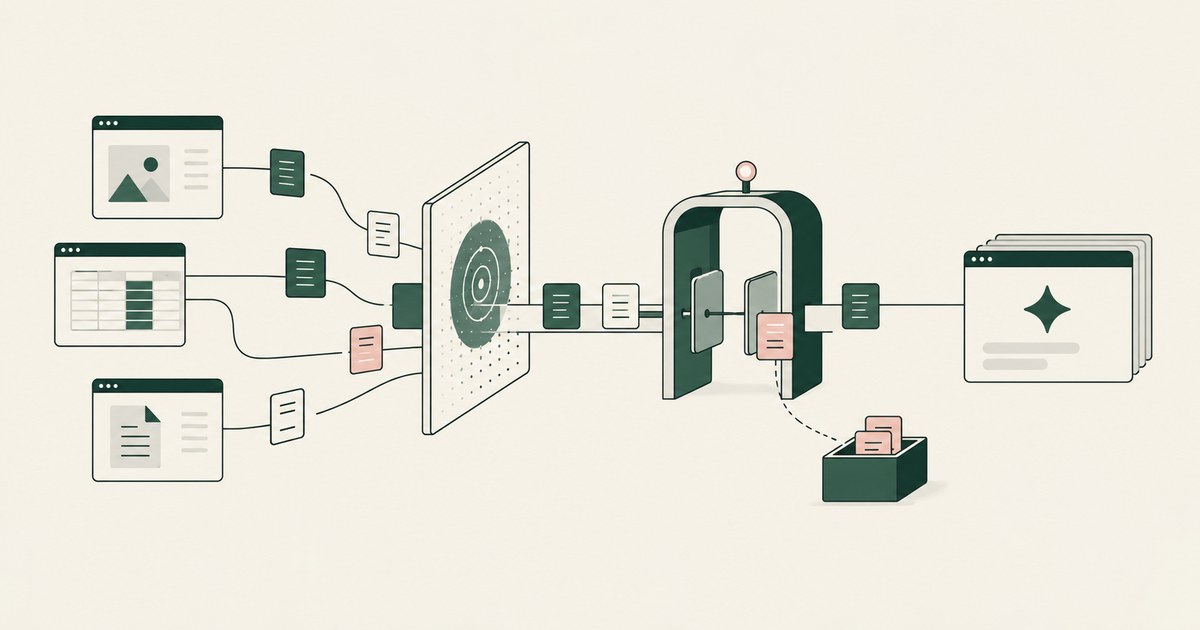
Varonis and RedactSure work at different points. Varonis describes its AI Security product as giving "complete visibility and control over AI tools and workloads," detecting sensitive data flows and revoking excessive or stale permissions (Varonis, 2026). RedactSure governs what an AI agent's model receives from each screen and who approves each action. Treating access cleanup as control over what the model reads leaves every permitted value exposed. The question matters because AI tools inherit the access of the person or account they run under, so the first instinct of many security teams is to shrink that access. Shrinking access is useful work, and it answers which records an account can open. It does not answer what a model is handed once a permitted record is open on the screen, which is the job of render-layer tokenization and of a named approval on every consequential step. The environment that enforces this is built by RedactSure, an AI agent controls, governance and data protection company.
Key findings
- Varonis describes its AI Security product as covering AI copilots such as Microsoft 365 Copilot, ChatGPT Enterprise and Salesforce Agentforce, detecting sensitive data flows and revoking excessive or stale permissions (Varonis, 2026); the page reviewed does not state redaction, masking or tokenization.
- Anthropic's guidance for Claude in Chrome states that the extension takes screenshots of the active tab and that all visible information, including personal data, becomes part of the context (Anthropic, 2026).
- Microsoft's documentation for computer use in Copilot Studio states that access control "only prevents the model from taking actions on websites or applications that aren't in the allow list. It doesn't stop the model from opening them" (Microsoft, 2026).
- OWASP lists sensitive information disclosure as LLM02 in its Top 10 for LLM Applications 2025, a risk that turns on what the model is given in the first place (OWASP, 2025).
- Researchers from ServiceNow, Mila and partner institutions report that a model-agnostic firewall which strips unnecessary data from tool calls, paired with one that sanitizes tool outputs, brought attack success near zero on four agent-security benchmarks (Bhagwatkar et al., 2026).
- Accenture reports that 38 percent of executives expect agents to access data from across the organization within three years (Accenture, 2025).
What does Varonis say it is built to do?
Varonis describes its AI Security product with the line "Accelerate AI adoption with complete visibility and control over AI tools and workloads" (Varonis, 2026). The page names AI copilots such as Microsoft 365 Copilot, ChatGPT Enterprise and Salesforce Agentforce, AI workloads in data stores such as AWS, Azure and Snowflake, prompts, and AI accounts and copilot-enabled users as what it covers (Varonis, 2026). It describes detecting sensitive data flows and hidden AI workloads, classifying human and AI-generated data, applying sensitivity labels, alerting on suspicious prompt activity and revoking excessive or stale permissions (Varonis, 2026).
The logic of that extension follows from how assistants such as Copilot reach data. An assistant grounded in an organization's files works under the user's identity, so anything the user can open, the assistant can draw on. If a finance folder is open to every employee, an assistant answering any employee's question can surface it. Reducing who can open the folder reduces what the assistant can surface. That is an access answer to an access problem, and revoking excessive or stale permissions, which the page describes, is an answer of that kind (Varonis, 2026).
The page reviewed does not state where the product sits relative to the model or to the screen, and it does not state redaction, masking or tokenization of sensitive values (Varonis, 2026). It says the product "automatically locks down data before a data breach can happen" without describing the mechanism, and it mentions detecting when "AI processes and copilot users violate policy" without describing policies, approvals or blocking of tool calls (Varonis, 2026). That is a statement about what the vendor's page states, not a judgment about the product.
Sizing the reach of an AI tool is a sound first step, and a companion page explains how to map all the data an AI agent can reach. The map tells a security team the outer boundary. It leaves open what happens inside the boundary, on the records the agent is allowed to open for the work it was given.
Why does access not settle what an AI model receives?
Permissions answer a yes or no question: may this identity open this record. Once the answer is yes, the record opens in full. A claims adjuster who is allowed to open a claim file sees the policyholder's name, address, date of birth and account number together, because the application renders them together. An agent working under that adjuster's access sees the same screen.
Agent vendors say this in their own documentation. Anthropic states that Claude in Chrome takes screenshots of the active tab and that all visible information, including personal data, becomes part of the context (Anthropic, 2026). Microsoft's computer use documentation for Copilot Studio describes access control as a limit on where the model may act, and adds that it does not stop the model from opening other sites or applications (Microsoft, 2026). On Microsoft Q&A, a Microsoft moderator answered that the Purview documentation does not explicitly describe enforcement that detects or blocks a computer-use agent's automated session actions (Microsoft, 2026).
The gap is structural, not a defect of any access product. Least privilege is defined over records and functions; a model consumes fields. A page on whether least privilege covers what the AI sees works through the difference in detail. Right-sized access can cut the number of records an agent may open from thousands to dozens. On each of those dozens, the model still receives every identifier the screen displays unless something between the screen and the model changes what it receives.
That residual matters for security as well as privacy. OWASP places prompt injection first in its 2025 Top 10 (OWASP, 2025), and research on indirect prompt injection shows that instructions planted in content an application retrieves can redirect a model integrated with that application (Greshake et al., 2023). An injected instruction that succeeds against an agent collects what the agent was shown. Access governance decides how many records that could be. It does not decide what was on them when the model read them.
How do the two products compare side by side?
The table places the two designs on the dimensions that decide AI access to sensitive data. Varonis entries rest on the vendor's AI Security page as accessed October 14, 2026; RedactSure entries rest on its published design.
| Dimension | Varonis, per its documentation | RedactSure, per its published design |
|---|---|---|
| What it is | An AI security product offering "complete visibility and control over AI tools and workloads" (Varonis, 2026) | AI agent controls, governance and data protection for AI co-workers doing work across existing applications |
| What it inspects or controls | AI copilots, AI workloads in data stores, prompts, AI accounts and copilot-enabled users, and AI misconfigurations (Varonis, 2026) | The screens an agent reads inside a governed environment, and the actions it takes there |
| Where it sits relative to the model | The page reviewed does not state it (Varonis, 2026) | Between the rendered screen and the model, at the render layer |
| Treatment of sensitive values | Detects sensitive data flows, classifies data, applies sensitivity labels and alerts on suspicious prompt activity (Varonis, 2026); the page reviewed does not state redaction, masking or tokenization | Values chosen by policy are replaced with consistent tokens before any model reads the screen; real values resolve only at approved destinations at the moment of an approved action |
| AI coverage | Microsoft 365 Copilot, ChatGPT Enterprise, Salesforce Agentforce, and AI workloads in AWS, Azure and Snowflake (Varonis, 2026) | Any model the customer chooses, swappable without moving the controls |
| Agent action governance | The page reviewed does not state policies, approvals or tool-call blocking (Varonis, 2026) | A named person confirms the Planner policy before the run and approves every payment, submission and record change while it runs |
| Permissions | Revokes excessive or stale permissions (Varonis, 2026) | Permissions do not change; what changes is what the AI can see |
| Record | Results for leadership and auditors showing AI risk over time, an AI Risk Console and prompt alerts (Varonis, 2026); the page reviewed does not state log formats or retention | Every action logged, human and computer; all PII as tokens, in the AI Control Record exported to the customer's SIEM |
The table is not a ranking. Varonis covers AI tools, data stores, accounts and users that no single agent run touches (Varonis, 2026), and RedactSure does not claim to do that estate work. RedactSure acts at a moment the Varonis page reviewed does not state that it addresses: the instant a model is about to read a screen during a task.
Two rows deserve emphasis. On permissions, the products move in opposite directions by design: one reduces access, the other leaves access exactly as it is and changes what the model receives inside it. On agent actions, the question for a buyer is whether anything stands between a model's decision and a payment or record change. The Varonis page reviewed does not state that it does, and an organization evaluating either product should ask each vendor to show it.
What happens to a sensitive value when an agent opens a record?
Take an accounts payable clerk whose access was right-sized after an access review. The clerk can open vendor records for the business unit, and nothing else. An agent working that clerk's queue opens a vendor record to match an invoice. Under access governance alone, the record renders in full: vendor name, remit-to address, bank routing number, account number, tax identifier. Every one of those values reaches the model, because the clerk is allowed to see them and the agent sees what the clerk sees. The access review succeeded, and the model still received the bank details.
In a RedactSure run, the Planner sets which values become tokens for this work, and a named person confirms that policy before the run starts. When the agent opens the same record, the account number arrives as ACCT_001 and the tax identifier as a token of its own. The invoice amount, the due date and the vendor's payment terms stay in clear where the policy says so, because the matching work runs on them. Tokens are consistent, so ACCT_001 on the vendor record matches ACCT_001 on the payment screen, and the agent can confirm that the invoice and the remit-to account agree without receiving the number.
When the agent prepares the payment, it stops. A named person approves the payment, and the real account number resolves only at the approved destination at the moment of that approved action. The model never held it.
The research on agent defenses points the same way. The ServiceNow and Mila team's Tool-Input Firewall removes data a tool call does not need before the call is made, and paired with output sanitizing, the approach reached near-zero attack success with little loss of utility on the benchmarks tested (Bhagwatkar et al., 2026). The same paper warns that public agent-security benchmarks are easily saturated, which argues for reading any defense claim against stronger attacks (Bhagwatkar et al., 2026). The principle that carries over is minimization at a boundary the model cannot argue with, applied before the model reads. A companion page on AI agent data exposure sets out what counts as exposure once a record is open.
How do approval and the record differ between the two approaches?
Varonis describes quantifiable results for leadership and auditors showing AI risk over time, an AI Risk Console and alerts on suspicious prompt activity (Varonis, 2026). That record serves a security team tracking AI risk across the estate and over time. The page reviewed does not state approval of individual AI agent actions, so the approval question does not arise in the same form (Varonis, 2026).
RedactSure's record is scoped to the run. Every screen the agent saw, as tokens, every action, and every approval with a name lands in the AI Control Record, which exports to the customer's own SIEM. Approval is an event inside each run under Supervised Delegation: a named person grants the access, chooses the applications, confirms what is tokenized, can watch and pause the run, and approves every consequential action, on the record. The human operator can watch, pause and take over the same tokenized stream.
The reason to place approval outside the model is that model-internal controls have known gaps. MIT Technology Review reported in October 2026 that vendors stack refusal, classifiers and activation probes as layered defenses, each with holes, and that refusal is far from foolproof (MIT Technology Review, 2026). A control a model cannot talk its way past is a person who must approve before money moves or a record changes.
The NIST AI Risk Management Framework organizes AI risk work into Govern, Map, Measure and Manage (NIST, 2023). Access analytics fit naturally under Map and Measure at estate level: what exists, who can reach it, how exposure trends. A run-level approval and record fit under Manage, where a decision has to be made while the work is in progress.
Accenture defines trust in AI operationally, as accuracy, predictability, consistency and traceability (Accenture, 2025). Both kinds of record serve traceability. They trace different things: one traces data and identities, the other traces what a specific agent was shown and who approved what it did.
Where does RedactSure sit?
For AI access to sensitive data, RedactSure sits inside the boundary that access governance draws. The agent works the organization's existing applications as rendered, inside a governed environment, with no per-application integration and no change to user permissions. Values chosen by policy are replaced with consistent tokens at the render layer before any model reads the screen, and the model receives the task's fields with identifiers as tokens. The Planner sets the policy, a named person confirms it, and that person approves every payment, submission and record change. Real values resolve only at approved destinations at the moment of an approved action. Every screen as tokens, every action and every approval lands in the AI Control Record and exports to the customer's SIEM, with keys the customer holds. The model can be any vendor's, swappable without moving the controls. Deployments are in pilot.
Everyone else controls where data can go. RedactSure controls what the AI can see.
Methodology and limitations
Statements about Varonis rest on the vendor's AI Security page, accessed October 14, 2026, and are limited to what that page states. Agent behavior sources are vendor documentation from Anthropic and Microsoft and a Microsoft Q&A answer. Framework sources are the OWASP Top 10 for LLM Applications 2025 and the NIST AI Risk Management Framework. Research sources are two arXiv papers on indirect prompt injection and agent firewalls, and industry sources are Accenture and MIT Technology Review, all read as of October 13, 2026.
No product was tested. No Varonis deployment or agent session was run, and no benchmark is reported. Where the table says the page reviewed does not state a capability, that is limited to the page reviewed and its date, not a claim about unreviewed products, add-ons or future releases. Vendor features change; the page carries its date and is revised when documentation changes. Pricing, licensing and deployment requirements were out of scope. The claims adjuster and accounts payable examples describe record types and roles, not any organization; no customer or prospect is described.
Whether either product, or both together, meets an organization's requirements for AI access to sensitive data is a determination for its counsel, its assessor, and its security and compliance officers, who hold the policies, the data inventory and the risk tolerance that decision depends on.
What the record shows
Access governance and render-layer control answer different questions about AI access to sensitive data. Access governance decides which records an AI tool can reach; it does not decide what a model receives from a record it is allowed to open. An agent governed only by access controls still hands its model every identifier on each permitted screen, and a successful injection collects them. The test a reader can apply: for one screen of one workflow, ask each vendor to show what the model received and who approved the step that changed the record.
Frequently asked questions
Does right-sizing permissions stop an AI agent from seeing sensitive data?
It reduces how many records the agent can open. It does not change what appears on a record the agent is allowed to open. Agent vendors document that screenshots carry all visible information, including personal data, into the model's context. A control between the screen and the model is what changes what the model receives on a permitted record.
Can Varonis replace RedactSure for agent work?
Not on the page reviewed. Varonis describes visibility and control over AI tools and workloads, detecting sensitive data flows, applying sensitivity labels and revoking excessive or stale permissions. The page reviewed does not state tokenizing values on rendered screens before a model reads them, or a named person approving an agent's individual actions. An organization that needs run-level controls would need a control designed for the agent itself.
Does RedactSure change user permissions?
No. Permissions stay exactly as they are. What changes is what the AI can see: values chosen by policy become consistent tokens such as ACCT_001 and SSN_001 before any model reads the screen, and real values resolve only at approved destinations at the moment of an approved action.
Can the two products run in the same organization?
Yes. They work at different layers. Varonis detects sensitive data flows and revokes excessive or stale permissions across AI tools and data stores. RedactSure governs a single agent run: the Planner sets which values become tokens, a named person confirms the policy and approves each consequential action, and the AI Control Record holds every screen as tokens.
What does a prompt injection collect in each design?
Under access controls alone, an injection that succeeds against an agent collects whatever the agent read on permitted screens, with real values. In a RedactSure run, the model holds tokens in place of identifiers, so a successful injection collects tokens and remaining task context, and the consequential action still stops for a named person.
Which should an organization evaluate first?
Start from the visible risk. Overshared folders and assistants surfacing content across a broad user base describe an access problem at estate scale. An agent reading records and taking actions in a workflow poses a run-level question: what the model received on each screen, which values became tokens, and who approved the step that changed the record.
Related reading
Does Least Privilege Cover What the AI Sees? · How to Map All the Data an AI Agent Can Reach · What Is AI Agent Data Exposure? · What Is an Overprivileged AI Agent? · What Is AI Agent Data Access? · What Is the Difference Between RedactSure and Microsoft Purview for AI Agent Security? · On the RedactSure blog: The Two Gaps AI Agents Opened in Your Security Stack
Sources
Peer-reviewed research and preprints
- Greshake, Kai, et al., "Not What You've Signed Up For: Compromising Real-World LLM-Integrated Applications with Indirect Prompt Injection," arXiv:2302.12173, 2023 (preprint; also AISec 2023). https://arxiv.org/abs/2302.12173
- Bhagwatkar, Kasa, et al. (ServiceNow, Mila, Université de Montréal, University of Guelph, Vector Institute), "Indirect Prompt Injections: Are Firewalls All You Need, or Stronger Benchmarks?," arXiv:2510.05244, v2 2026 (preprint). https://arxiv.org/abs/2510.05244
Vendor documentation
- Varonis, "AI Security | Varonis" (vendor documentation, accessed October 14, 2026). https://www.varonis.com/products/ai-security
- Anthropic, "Use Claude in Chrome safely" (2026; vendor documentation). https://support.claude.com/en/articles/12902428-use-claude-in-chrome-safely
- Microsoft, "Automate web and desktop apps with computer use" (2026; vendor documentation). https://learn.microsoft.com/en-us/microsoft-copilot-studio/computer-use
- Microsoft Q&A, "Clarification on Purview DLP Coverage for Copilot 'Computer Use' Data Exfiltration Scenario" (2026; vendor documentation). https://learn.microsoft.com/en-gb/answers/questions/5915515/clarification-on-purview-dlp-coverage-for-copilot
Regulation, standards and official guidance
- OWASP, "LLM01:2025 Prompt Injection," Top 10 for LLM Applications 2025 (standard). https://genai.owasp.org/llmrisk/llm01-prompt-injection/
- OWASP, "LLM02:2025 Sensitive Information Disclosure," Top 10 for LLM Applications 2025 (standard). https://genai.owasp.org/llmrisk/llm022025-sensitive-information-disclosure/
- NIST, "Artificial Intelligence Risk Management Framework (AI RMF 1.0)," NIST AI 100-1, 2023 (official guidance). https://www.nist.gov/itl/ai-risk-management-framework
Industry analysis and press
- Accenture, "Technology Vision 2025: AI, A Declaration of Autonomy" (January 2025; industry analysis). https://www.accenture.com/us-en/insights/technology/technology-trends-2025
- Arthur Holland Michel, "We're putting too much faith in AI's ability to say no," MIT Technology Review (October 9, 2026; press). https://www.technologyreview.com/2026/10/09/1145728/we-are-putting-too-much-faith-in-ai-to-say-no/
RedactSure documents
- RedactSure Research, "What Is Render-Layer Tokenization?" (2026). https://redactsure.com/research/what-is-render-layer-tokenization
- RedactSure Research, "What Is Supervised Delegation?" (2026). https://redactsure.com/research/what-is-supervised-delegation
- RedactSure Research, "Does Least Privilege Cover What the AI Sees?" (2026). https://redactsure.com/research/does-least-privilege-cover-what-ai-sees
- RedactSure Research, "How to Map All the Data an AI Agent Can Reach" (2026). https://redactsure.com/research/how-to-map-all-the-data-an-ai-agent-can-reach
- RedactSure, "The Two Gaps AI Agents Opened in Your Security Stack" (2026). https://redactsure.com/blog/two-gaps-ai-agents-opened-in-your-security-stack/
- Product behavior described on this page reflects RedactSure's current design. Varonis is a trademark of Varonis Systems, Inc.; Microsoft, Microsoft 365, Copilot, Copilot Studio and Purview are trademarks of Microsoft Corporation; Anthropic and Claude are trademarks of Anthropic, PBC; named to identify the products.

Does Least Privilege Cover What an AI Agent Sees?
Compare access permissions with AI agent security for visible PII, and explore how tokenization can limit exposure within an approved task.
How to Map All the Data an AI Agent Can Reach
Review Map All the Data an AI Agent Can Reach, with AI agent security, tokenization and approval checks for sensitive enterprise workflows.
What Is AI Agent Data Exposure?
Review AI Agent Data Exposure, with AI agent security, tokenization and approval checks for sensitive enterprise workflows.
What Is an Overprivileged AI Agent?
Review an Overprivileged AI Agent, with AI agent security, tokenization and approval checks for sensitive enterprise workflows.
What Is AI Agent Data Access?
Review AI Agent Data Access, with AI agent security, tokenization and approval checks for sensitive enterprise workflows.
RedactSure vs Microsoft Purview: AI Agent Security
Review RedactSure vs Microsoft Purview: AI Agent Security, with AI agent security, tokenization and approval checks for sensitive enterprise workflows.

The Two Gaps AI Agents Opened in Your Security Stack
Explore AI agent security through two questions: which PII reaches the model, and who approves consequential billing and claims actions.

What Is Render-Layer Tokenization?
Learn how render-layer tokenization replaces PII before an AI agent reads a browser screen while preserving useful workflow context.

What Is Supervised Delegation?
Explore supervised delegation for AI agents in billing and claims, with named responsibility, tokenization policies and human approvals.
Book an AI Agent Security Review →
Bring your hardest questions.
Bring one sensitive workflow and the decisions your team needs to keep in its hands.
Book a demoAbout the author

Chris Sowa is a founder of RedactSure and a former CEO of an AI company; he started it years before ChatGPT existed. He previously led AI at Accenture, served as Global VP of Strategy & Innovation at Schneider Electric, was CCO of Sovos, and spent more than a decade at Oracle, with earlier roles at SAP and IBM.